What is Bitcoin? In plain English: digital money that runs on a global network of computers instead of through a bank. No company owns it, no government issues it, and only 21 million coins will ever exist. That’s the short version — but if you actually want to understand why Bitcoin matters, you need a bit more context.
If you’ve already read our overview of cryptocurrency, you know the basic premise: money that lives on the internet, secured by code rather than institutions. Bitcoin is the original. Everything else — Ethereum, stablecoins, the thousands of coins you’ve seen scroll past on social media — came after it, and most of them exist because Bitcoin worked.
I’ve been using crypto since 2017, and Bitcoin is still the asset I find easiest to explain to someone with zero background. The story is clean. The rules are simple. The arguments for and against it are actually understandable. Let’s walk through it.
TL;DR
- Bitcoin is a peer-to-peer digital currency launched in January 2009 by an anonymous creator known as Satoshi Nakamoto.
- It runs on a public network with no central authority — transactions are verified by miners around the world using a process called proof-of-work.
- The supply is capped at 21 million coins. That hard limit is the whole point.
- Most people treat Bitcoin as a long-term store of value (a “digital gold”) rather than a daily spending currency.
- It’s not anonymous, it’s not dead, and the energy story is more complicated than the headlines suggest.
Why Satoshi created Bitcoin
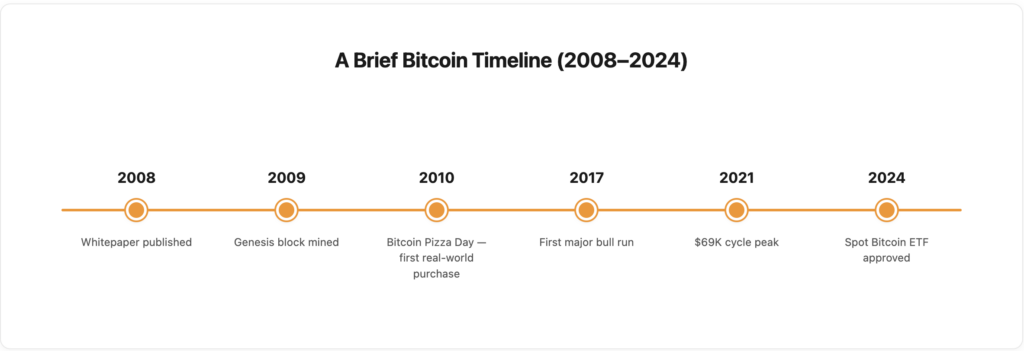
Bitcoin wasn’t born in a vacuum. The whitepaper — a 9-page PDF titled “Bitcoin: A Peer-to-Peer Electronic Cash System” — was published on October 31, 2008, right in the middle of the global financial crisis. Banks were collapsing. Governments were bailing them out. Trust in the financial system was, to put it gently, low.
The creator went by the name Satoshi Nakamoto. We still don’t know who that is — an individual, a group, alive, dead, anyone’s guess. Satoshi mined the first Bitcoin block in January 2009 and embedded a headline from The Times of London into it: “Chancellor on brink of second bailout for banks.” That wasn’t an accident. It was a statement about why this thing existed.
Satoshi was building on decades of work by a loose movement called the cypherpunks — programmers and cryptographers in the 1980s and 90s who believed strong cryptography could protect individual privacy and freedom from centralized power. Several earlier attempts at digital cash (DigiCash, b-money, Hashcash) had failed because they either needed a central operator or couldn’t solve the “double-spend” problem — how do you stop someone from spending the same digital coin twice when copying digital files is trivial?
Bitcoin’s breakthrough was solving that without anyone in charge. No company. No server you could shut down. Just a shared, public ledger that thousands of independent computers maintain together.
What is Bitcoin, exactly?
So what is Bitcoin when you strip away the philosophy? Three things stacked on top of each other:
A protocol — a set of rules that any computer can run. Like email, anyone can plug in and participate without asking permission.
A network — the thousands of computers (called nodes) around the world running that protocol right now, all keeping identical copies of the same ledger.
A token — the unit of value, the “bitcoin” with a lowercase b, that gets moved around on that network. Symbol: BTC.
When you “send Bitcoin” to someone, you’re broadcasting a message to the network that says, in effect, “move this amount from my address to theirs.” The network checks that you actually own those coins (using cryptographic signatures) and adds the transaction to the public ledger. Once it’s recorded, it can’t be reversed or edited.
That ledger is called the blockchain. Think of it as a shared spreadsheet that everyone on the network can read, no one can secretly edit, and new rows get added roughly every 10 minutes. Each new “block” of transactions is linked to the previous one, creating a chain stretching all the way back to January 2009.
There’s no customer service. No “forgot password” button. No central record-keeper. The rules are the rules, and they’re enforced by math and by the thousands of people running the software.
How mining works (without the math)
You’ve probably heard about Bitcoin mining and pictured warehouses full of computers. That’s accurate. But what are they actually doing?
Miners are the bookkeepers of the network. Roughly every 10 minutes, miners around the world compete to bundle up recent transactions into a new block and add it to the chain. To win the right to add that block, they have to solve a computational puzzle that requires enormous amounts of trial-and-error. This is called proof-of-work — you prove you did real work (burned real electricity) to earn the right to update the ledger.
The winning miner gets two rewards: newly created bitcoins (the “block reward”) plus the transaction fees from everyone whose payment they included. Right now the block reward is 3.125 BTC per block, halved from 6.25 BTC in April 2024.
Why bother with all this electricity? Because that energy cost is what makes the network secure. To rewrite Bitcoin’s history, an attacker would have to out-mine the entire rest of the world — billions of dollars in hardware and electricity, continuously. It’s not that it’s impossible. It’s that it would cost more than you could possibly gain.
This is where the energy debate gets heated. Bitcoin’s network consumes roughly 170–200 TWh per year — comparable to a mid-sized country like Thailand or Vietnam. Critics say that’s wasteful. Defenders point to data showing the majority of mining now runs on sustainable sources — Cambridge’s latest study puts the sustainable share at roughly 52% (about 43% renewables like hydro, wind, and solar, plus 10% nuclear), with miners often co-locating near stranded energy (think hydro in remote areas, flared natural gas at oil wells) that would otherwise be discarded. The honest answer is both things are true: it uses a lot of energy, and the mix is genuinely cleaner than the headlines suggest. We’ll cover that fight properly in a separate article on proof-of-work versus proof-of-stake.
The 21 million cap, and why scarcity matters
Bitcoin’s supply schedule is hard-coded. There will only ever be 21 million BTC. No emergency printing. No board meeting that decides to issue more.
The way new coins enter circulation slows down over time. About every four years, the block reward gets cut in half — an event called the halving. The reward started at 50 BTC per block in 2009, dropped to 25 in 2012, 12.5 in 2016, 6.25 in 2020, and 3.125 in 2024. The next halving is expected around 2028, with the final bitcoin mined sometime around 2140.
Roughly 20 million BTC are already in circulation. So most of the coins that will ever exist already exist.
Why does this matter? Because every other form of money you’ve ever used can be created at will. Central banks print currency. Companies issue more shares. Even gold — the classic scarce asset — gets dug out of the ground at roughly 1.5% more per year. Bitcoin’s issuance rate, by contrast, is on a predictable, decreasing schedule that no one can change without convincing the entire network to switch software, which has never happened and almost certainly never will.
That’s what people mean when they call Bitcoin “hard money.” Not that it’s difficult to use — that its supply is genuinely difficult to inflate.
Bitcoin as digital gold
This scarcity property is why most Bitcoin holders don’t actually spend their BTC. They hold it. The framing that’s stuck is “digital gold” — an asset you buy because you think it’ll hold its value over long periods, not because you want to pay for coffee with it.
The comparison to gold is surprisingly clean. Gold is valuable because it’s scarce, durable, divisible, and hard to fake. Bitcoin shares those properties — and adds a few gold can’t match. You can send it across the world in minutes. You can carry a billion dollars of it across a border by memorizing 12 words. You can verify its authenticity instantly with software, instead of assaying it with chemicals.
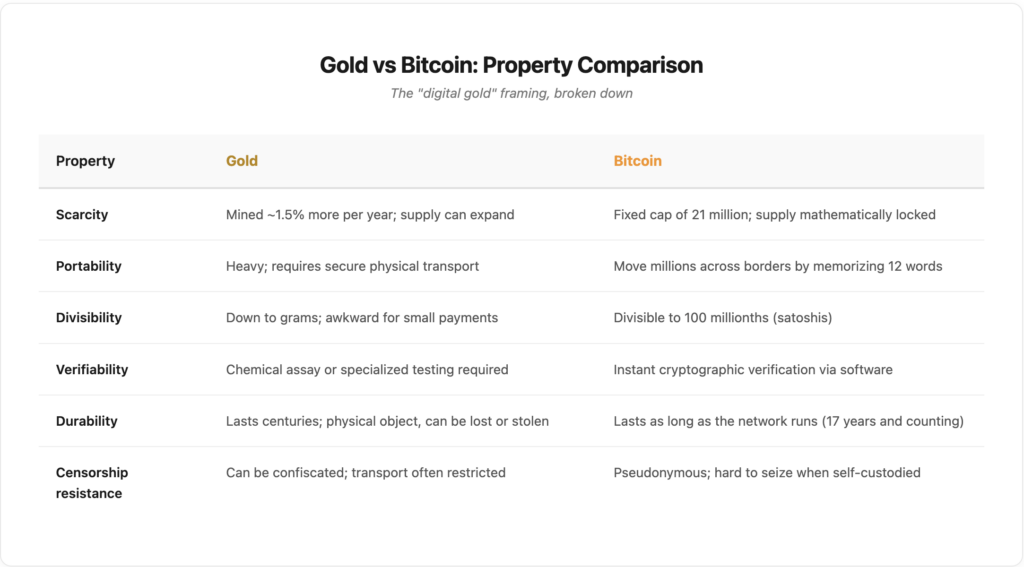
The trade-offs are real. Gold has 5,000 years of history. Bitcoin has about 17. Gold doesn’t crash 50% in a bad year — Bitcoin sometimes does. And Bitcoin only has value as long as the network keeps running and people keep agreeing it’s worth something. That’s a real risk, not a marketing point. Anything you put into Bitcoin should be money you can afford to see swing wildly, or potentially lose.
At the time of writing in mid-2026, one BTC trades around $63,000–65,000, and the total market cap of all bitcoins combined is roughly $1.3 trillion. Those numbers will be wrong by the time you read this. That’s normal.
What people actually use Bitcoin for
Beyond holding it, Bitcoin gets used for a handful of things real people genuinely need:
International settlement. Sending money across borders through banks is slow and expensive. Bitcoin doesn’t care about borders or banking hours. A transaction from Manila to Toronto settles in roughly the same time as one from Manila to the next street over.
Remittances. Workers sending money home to family in countries with weak banking systems often pay 5–10% in fees through services like Western Union. Bitcoin (and Bitcoin-based payment layers like the Lightning Network) can cut that dramatically.
Censorship resistance. If your bank account is frozen, your bitcoin still works. That’s a feature for activists and journalists in authoritarian states. It’s also, yes, sometimes a feature for criminals — more on that in the myths section.
A hedge against currency debasement. In countries where the local currency loses 20%, 50%, even 90% of its value in a year — Argentina, Turkey, Venezuela, Lebanon — Bitcoin offers an exit. It might be volatile, but it’s not melting in your hands.
Legal tender, in one country. El Salvador adopted Bitcoin as legal tender in September 2021. The experiment has been bumpy, but it’s the first time a sovereign nation made BTC a recognized currency.
How Bitcoin differs from everything that came after it
Bitcoin was first. Everything else is, in one way or another, a response to it.
Ethereum (launched 2015) added programmable contracts — code that runs on a blockchain. That opens up applications Bitcoin doesn’t natively support: lending, trading, NFTs, decentralized apps. The trade-off is more complexity and a different security model. We’ll cover Ethereum in its own dedicated article.
Stablecoins (USDT, USDC, and others) are coins pegged to the US dollar. They solve Bitcoin’s volatility problem — useful if you actually want to pay for things or hold value short-term — but they reintroduce a central issuer you have to trust. Stablecoins get their own dedicated article in the Coin Explainers series.
Altcoins is a catch-all for everything that isn’t Bitcoin. Some are serious technical projects. Many are not. Bitcoin maximalists argue that none of them are necessary. Others argue the ecosystem benefits from experimentation. Both sides have a point.
Bitcoin’s pitch is deliberately narrow: be the most secure, most decentralized, most predictable digital money possible. It doesn’t try to do everything. That’s a feature.
Common myths
“Bitcoin is anonymous.” It isn’t. It’s pseudonymous. Every transaction is permanently public on the blockchain. Addresses don’t have your name attached, but if anyone connects an address to you (an exchange, a tax authority, a chain analysis firm) your full history becomes visible. Cash is more private than Bitcoin.
“Bitcoin is dead.” Bitcoin has been declared dead in print hundreds of times since 2010 — 99bitcoins keeps a running tally. The network has produced a new block roughly every 10 minutes for 17 years straight, including through multiple crashes that wiped out most of its market value. Whatever you think of it, it has been remarkably hard to kill.
“Bitcoin is mostly for criminals.” Studies of on-chain activity consistently put illicit use somewhere under 1% of total Bitcoin transaction volume — lower than the share of illicit activity estimated in the traditional banking system. Criminals use Bitcoin. They use cash and banks more.
“Bitcoin uses too much energy.” It uses a lot of energy. Whether that’s “too much” depends on what you think Bitcoin is for. If it’s a useless toy, any energy is too much. If it’s a global, neutral monetary network, the comparison should be to the energy used by the global banking system, gold mining, and currency printing combined. Reasonable people disagree. Just don’t accept either framing without thinking.
Where to buy it and how to store it
Most beginners buy Bitcoin on a regulated exchange — Coinbase, Kraken, Binance, or whichever is licensed in your country. You sign up, verify your identity, deposit local currency, buy BTC. We’ll walk through the full process, including the gotchas, in our upcoming Buying & Storing series.
Storing it is the part beginners often underestimate. When your coins sit on an exchange, the exchange technically holds them — and exchanges have failed (Mt. Gox in 2014, FTX in 2022) and taken customer funds with them. The phrase you’ll hear is “not your keys, not your coins.” For any amount you actually care about, you’ll want to move it to a wallet you control. Wallet setup gets its own dedicated article — coming soon.
Common questions
Is Bitcoin a good investment?
No one can answer that for you, and anyone who tells you definitively yes or no is selling something. Bitcoin has produced extraordinary returns over long periods and brutal losses over short ones. Only put in what you can afford to lose entirely, and don’t borrow money to buy it.
Can Bitcoin be hacked?
The Bitcoin network itself has never been hacked in 17 years of operation. What gets hacked is exchanges, wallets, and individual users — almost always through phishing, weak passwords, or stolen seed phrases. The protocol is strong; the humans around it are the weak link.
What happens when all 21 million bitcoins are mined?
Miners will stop earning new coins and rely entirely on transaction fees to keep the network running. That’s expected around 2140, so it’s not exactly an urgent problem.
Is Bitcoin legal?
In most countries, yes — you can own it, buy it, and sell it. Some countries (China being the notable example) have restricted it heavily. Check your local rules.
How small a piece of Bitcoin can I buy?
One bitcoin is divisible into 100 million units called satoshis (or “sats”). You don’t have to buy a whole one. You can buy $20 worth.
Where to go from here
If you’ve read this far, you understand Bitcoin better than 95% of people who own it. The next steps are practical: figuring out how to buy a small amount safely, and learning how to store it so you actually control it. Take your time with both. Crypto rewards patience and punishes hurry — that’s the one rule I’ve watched hold up through every cycle since 2017.
Our upcoming Buying & Storing series will cover both — start there before you put in any meaningful amount.
A note on financial advice
I’m not your financial advisor. Nothing in this article is a recommendation to buy, sell, or hold Bitcoin or any other asset. Crypto is volatile, the rules vary by country, and you can lose what you put in. Only invest what you can afford to lose, and do your own research before making any decision with real money.