Dollar-cost averaging is what people who don’t try to time the market do instead. You pick an amount, you pick a schedule, you buy on that schedule regardless of what the price is doing, and then — this is the hard part — you stop watching prices.
That’s the whole strategy. This article unpacks what dollar-cost averaging crypto actually means, why it works for most people who try it, where the math gets honest, and how to actually set it up without overthinking it. We’ll use Bitcoin as the running example because it’s the asset most beginners are weighing, but the mechanics are identical for any volatile asset.
When I started using crypto in 2017, the thing I noticed within about six months wasn’t the technology — it was the people. The ones who tried to time tops and bottoms mostly lost. They sold winners early, held losers late, and capitulated at the worst possible moment in late 2018. The ones who put $50 or $100 in every two weeks and then went back to their lives ended up fine. Not always rich. But fine. That’s not because they were smarter. They just opted out of the game they were going to lose.
TL;DR
- DCA crypto — short for dollar-cost averaging — means buying a fixed dollar amount on a fixed schedule, regardless of price. Same amount every week or month, no exceptions.
- It removes the “when do I buy?” decision, which is the decision most beginners get wrong — usually expensively.
- The math: lump-sum investing wins on average in steadily rising markets. DCA wins behaviorally, because people actually stick with it.
- DCA works best in volatile assets over multi-year horizons. Crypto qualifies on both counts.
- The trade-off is real — you give up some upside in clean bull runs in exchange for not capitulating in bear markets.
- Pick weekly or monthly, automate it, then stop checking prices. The strategy works because you let it.
The one-sentence version
Dollar-cost averaging is buying a fixed dollar amount of crypto on a fixed schedule — every week, every month — instead of trying to figure out the “right time” to buy.
That’s the dollar cost average meaning in full. No more, no less. Everything else in this article is implications.
Why timing the market fails (for almost everyone)
Timing the market sounds like one decision. It’s actually two: when to buy, and when to sell. You have to get both right, in sequence, repeatedly, against a market full of professionals doing the same thing with better information than you have.
The behavioral data on this is brutal. Retail investors — the ones not getting paid to do this full-time — tend to buy near tops, when everything looks exciting and the headlines are loud, and sell near bottoms, when everything looks broken and the headlines have moved on. The pattern is so consistent it has a name in finance: the behavior gap. Morningstar’s annual Mind the Gap research finds that the average dollar invested in US funds lags those funds’ actual returns by roughly one to two percentage points a year — a gap attributed to the timing of buys and sells.
Even full-time professionals get this wrong more often than they get it right. The number of fund managers who consistently beat a simple buy-and-hold benchmark over ten years is small. Over twenty years, it’s almost zero.
Crypto makes this worse, not better. The volatility is higher. The news cycle is louder. There’s no closing bell — markets run 24/7, which means every emotional spike has a place to land. The timing game in crypto is the same game as in stocks, just with the difficulty turned up.
DCA sidesteps the problem entirely. You’re not trying to win the timing game. You’re refusing to play.
Worth noting: crypto market cycles are real and roughly identifiable in hindsight. The trouble is “in hindsight.” Recognizing a top while you’re standing on it is much harder than recognizing it three years later on a chart.
How DCA actually works (the mechanism)
Here’s the concrete version. Say you decide to put $50 per week into Bitcoin for 12 months. That’s $2,600 total, deployed in 52 equal slices.
Bitcoin’s price moves a lot over a year. Some weeks your $50 buys more BTC because the price is lower. Some weeks it buys less because the price is higher. You don’t change the dollar amount — that’s the entire discipline. The amount is constant. The quantity you receive floats with the market.
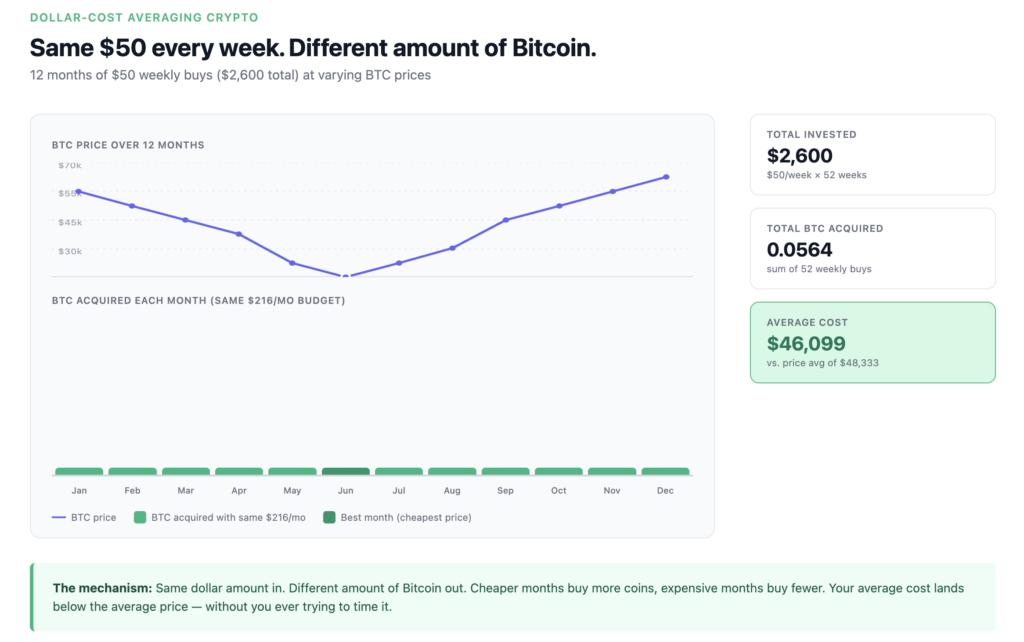
A simplified example with rough numbers:
| Week | BTC price | $50 buys |
|---|---|---|
| 1 | $60,000 | 0.000833 BTC |
| 13 | $45,000 | 0.001111 BTC |
| 26 | $30,000 | 0.001667 BTC |
| 39 | $50,000 | 0.001000 BTC |
| 52 | $70,000 | 0.000714 BTC |
(Prices used here are illustrative, not historical. The point is the mechanism, not the specific path.)
Notice what happens at week 26. Price has dropped hard. The emotional brain says “this asset is broken, stop buying.” The DCA brain doesn’t care — it buys, and that week’s $50 picks up roughly twice as much BTC as week 1’s $50 did. Those cheaper coins do disproportionate work for your average cost over time.
After 52 weeks, your average cost per coin lands somewhere in the middle of the range of prices you bought at — not the peak, not the bottom, somewhere honest. That’s the whole reframe. You didn’t catch the lows. You didn’t avoid the highs. You participated, evenly, in whatever the asset actually did.
That’s the entire mechanism.
Dollar-Cost Averaging Crypto vs Lump Sum: the honest version
This is the part where the math purists object. They’re not entirely wrong. The math says lump-sum investing — putting all your money in at once — beats DCA roughly two-thirds of the time over 12-month windows in equities. Vanguard has run this study more than once and the result is consistent.
The reasoning is simple: markets go up more often than they go down, so getting all your money exposed sooner means more time in the market, which on average means more upside. Sitting in cash while you spread out buys means you miss some of that average upward drift.
That math is correct. It’s also mostly irrelevant for most people.
Here’s why. The math assumes you can actually execute a lump sum — that you have $10,000 and on Tuesday you deploy $10,000. In practice, almost nobody does this. They have $10,000, they think “I should wait for a dip,” the price goes up, they think “I’ll wait for it to come back,” the price goes up more, and three years later the money is still sitting in a checking account. The math problem is solved. The behavior problem isn’t.
DCA isn’t optimal math. It’s optimal behavior. And behavior is what produces real returns — because the strategy that’s mathematically perfect on paper but never gets executed in practice has a real-world return of zero.
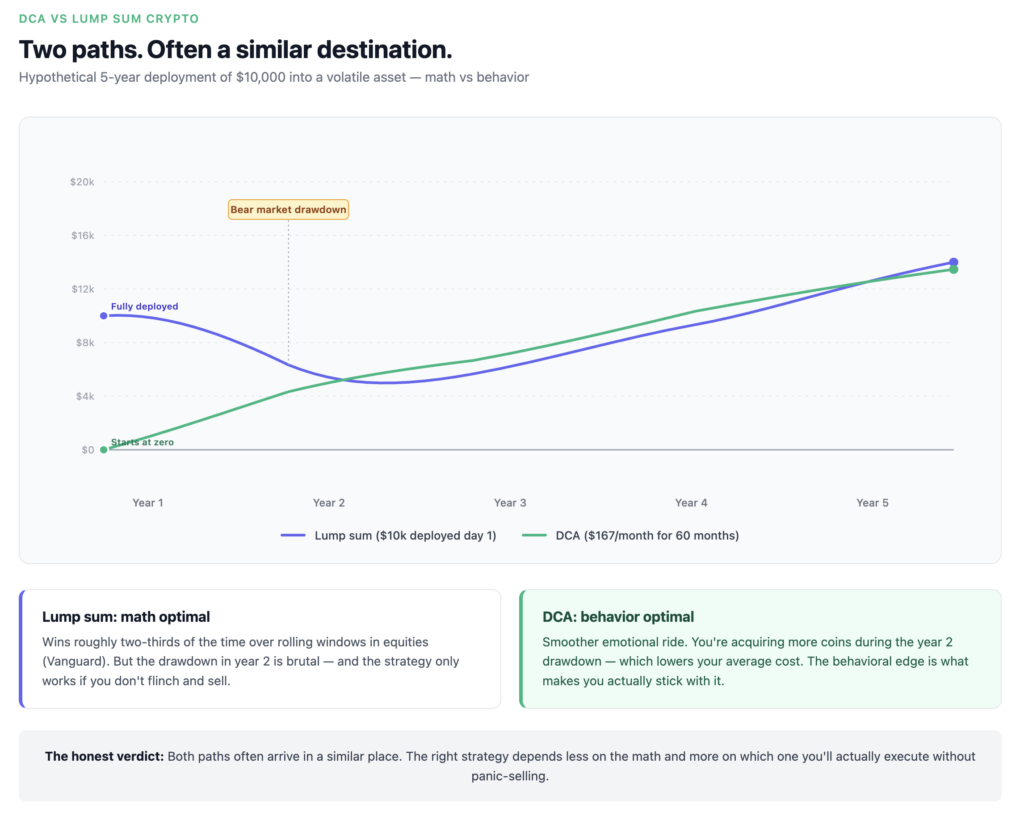
In crypto specifically, the case for DCA is stronger than in equities. Crypto’s volatility isn’t 15% annualized — it’s been 50–70%, several times what equities run. At that volatility, the emotional cost of deploying a lump sum and then watching it draw down 40% in a month is brutal. Most people can’t sit with it. They sell.
The honest verdict: if you have a lump sum and the iron stomach to deploy it in one tranche and not check the price for two years, lump sum probably wins. If you’re a normal human with a normal nervous system, DCA wins — because it’s the one you’ll actually stick with.
How to DCA crypto in practice
Setting up a DCA crypto plan takes four decisions. None of them are complicated.
Pick a frequency
Weekly buys smooth the averaging slightly more. Monthly buys generate fewer transactions and therefore fewer fees. The difference in long-run outcome between weekly and monthly is small enough that you shouldn’t agonize over it.
For most people, monthly is fine. Weekly only meaningfully matters in extremely volatile periods — and even then, the difference is measured in basis points, not percentages. Pick the cadence you’ll actually maintain. That matters more than the cadence itself.
Pick an amount
Small enough that you don’t feel it when markets crash 50%. Large enough that the position matters to you over a few years.
A rough rule of thumb for beginners: under 5% of monthly disposable income going into any single volatile asset. Crypto is risky — only put in what you can afford to lose entirely. The risk doesn’t disappear because the buying is spread out. DCA doesn’t protect you from the asset going to zero. It protects you from your own timing.
Pick a platform
Most major exchanges support recurring buys natively. Coinbase, Kraken, Binance, and many regional exchanges all have some version of “buy $X of Y every week/month.” You set it once and the platform handles the rest.
Manual DCA — a calendar reminder, a card on your fridge, a recurring transfer to an exchange where you buy by hand — also works. It’s a little more friction, but full-self-custody users sometimes prefer it because it keeps the exchange’s automated systems out of their workflow.
For more on choosing a platform and the security checks worth doing before you start, see buying crypto safely.
Decide where the crypto goes
This is the step most beginners skip and later regret. Coins sitting on an exchange are technically held by the exchange — not your keys, not your coins. Convenient, but exposed to platform risk.
A common approach: let coins accumulate on the exchange until you hit a threshold (say, $500 or $1,000), then sweep them to a wallet you control. That balances convenience against custody risk. For the wallet side of this, see where to store what you accumulate.
The trade-offs (what DCA doesn’t do)
DCA is useful. It’s not magic. The honest list of things it doesn’t do:
- DCA doesn’t protect against picking a bad asset. If you DCA into something that goes to zero, you’ve DCA’d into zero. The strategy averages your cost across price movements — it doesn’t validate that the asset is worth owning. Asset selection matters more than buying strategy.
- DCA doesn’t outperform lump sum in steadily rising markets. In a clean bull run, you’ll always feel “behind” — your average cost is rising along with the market because you haven’t fully deployed yet. That feeling is correct. It’s the trade-off.
- DCA doesn’t remove position-sizing decisions. You can absolutely over-allocate to crypto via DCA, just slowly. Doing it gradually doesn’t make a 60% portfolio allocation to a volatile asset less risky.
- DCA doesn’t tell you when to sell. Accumulation and distribution are separate decisions, governed by separate logic. DCA is a buying framework. The selling framework is a different conversation.
Common mistakes
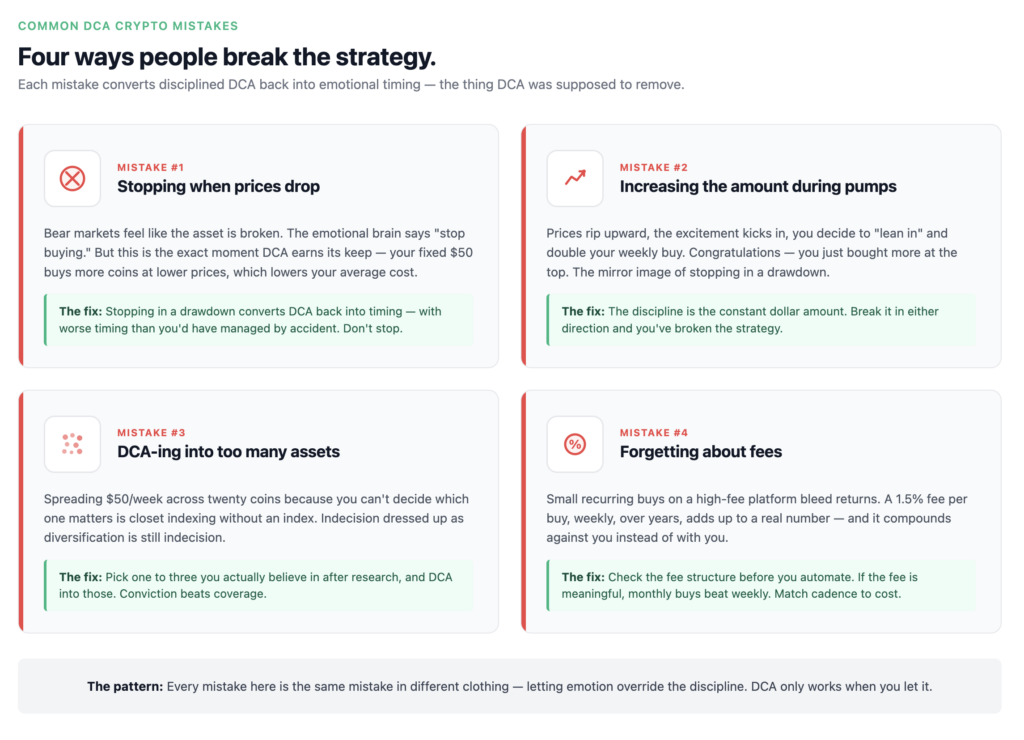
Stopping when prices drop. This is the most common one, and it’s the moment DCA matters most. The whole point is that you buy more coins per dollar when prices are low — that’s where the strategy earns its edge. Stopping in a drawdown converts DCA back into timing, with worse timing than you’d have managed by accident.
Increasing the amount during pumps. The mirror image of the above mistake. Prices rip upward, the excitement kicks in, you decide to “lean in” and double your weekly buy. Congratulations, you just bought more at the top. The discipline is the constant dollar amount. Break it in either direction and you’ve broken the strategy.
DCA-ing into too many assets. Spreading $50/week across twenty coins because you can’t decide which one matters is closet indexing without an index. Pick one to three you actually believe in after research, and DCA into those. Indecision dressed up as diversification is still indecision.
Forgetting about fees. Small recurring buys on a high-fee platform bleed returns. A 1.5% fee per buy, weekly, over years, adds up to a real number. Check the fee structure of your platform before you set up a long-running recurring buy. If the fee is meaningful, monthly buys are friendlier than weekly.
A fifth one worth noting: never reviewing the underlying thesis. DCA is set-and-forget for the buying itself, not for the question of whether you should still be buying this asset at all. Revisit the thesis once a year. Don’t revisit the price chart once a day.
When DCA is the right strategy — and when it isn’t
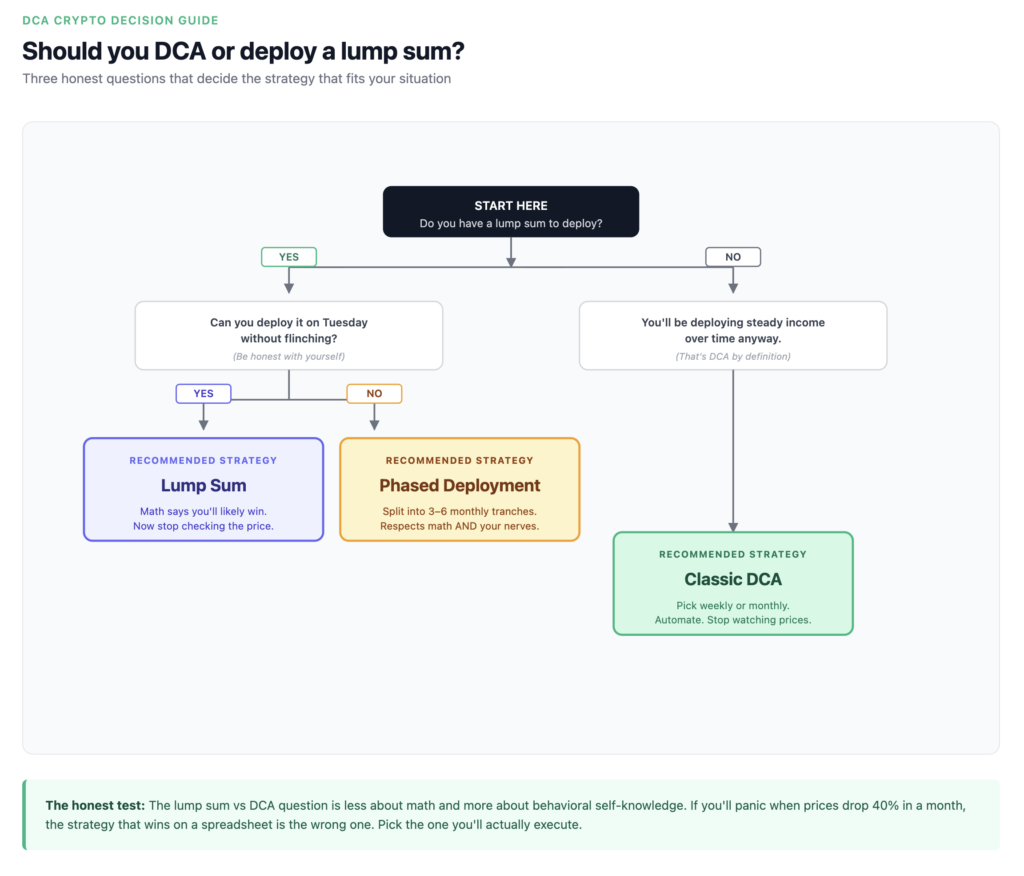
DCA is a good fit when:
- You’re early in your accumulation phase and have years ahead of you.
- You have steady income but no large lump sum to deploy.
- You’re behaviorally prone to panic-selling, FOMO-buying, or both.
- You believe in the asset over a multi-year horizon, not a three-month trade.
DCA is less useful when:
- You’re holding a one-time windfall and are genuinely emotionally able to deploy it in one go.
- You’re in distribution phase — selling, taking profits, exiting — which uses a different framework.
- You don’t actually believe in the underlying asset. DCA-ing into a thesis you don’t hold is just slow loss with a schedule.
That last bullet is the one people miss. The strategy doesn’t substitute for the conviction. It only works if there’s something underneath it worth accumulating.
Common questions
How often should I DCA into crypto?
Weekly or monthly both work. Weekly smooths volatility very slightly more but generates more transaction fees. For most people, monthly is fine. Pick the cadence you’ll actually stick with — that matters far more than the small difference between the two.
Is DCA better than buying the dip?
For most people, yes — because “buying the dip” requires correctly identifying a dip in real time. Every dip looks like a falling knife until later, when in retrospect it looks like an obvious buy. DCA removes the judgment call entirely. You buy on schedule and the dips take care of themselves.
Should I stop DCA-ing in a bear market?
No. That’s exactly when DCA earns its keep. You’re acquiring more coins per dollar at lower prices, which lowers your average cost and improves your eventual returns if the asset recovers. Stopping in a bear market is the same mistake as panic-selling, just dressed up as caution.
Can I DCA into multiple cryptocurrencies?
You can, but be honest about why. If you genuinely believe in two or three assets, splitting DCA across them is reasonable. If you’re spreading because you can’t decide what to own, that’s a signal to do more research before you start DCA-ing at all — not a signal to buy a little of everything.
What if I have a lump sum — should I DCA or invest it all at once?
Pure math says lump sum wins about two-thirds of the time. Practical reality says most people can’t actually deploy lump sums — they wait, hesitate, and end up DCA-ing by accident anyway, often at worse prices. If you can honestly deploy the lump sum on Tuesday without flinching, do it. If you can’t, splitting it into three to six monthly tranches is a fair compromise that respects both the math and your nervous system.
Where to go from here
Dollar-cost averaging is one piece of a larger picture. A DCA crypto plan pairs naturally with buying crypto safely — because DCA only works if the platform you’re DCA-ing through is still around in five years. It pairs with how cycles work — because understanding cycles helps you sit through them instead of panicking. And it pairs with where to store what you accumulate — because coins building up on an exchange aren’t really yours until you move them.
One thing this article doesn’t cover: how and when to sell. DCA is a buying strategy, not a selling strategy. Distribution — taking profits, rebalancing, exiting positions — uses a different framework entirely, and deserves its own article.
A note on financial advice
This article is for education, not financial advice. I’m explaining how dollar-cost averaging works as a strategy — not telling you to buy any specific cryptocurrency, or any cryptocurrency at all. DCA doesn’t protect you from picking a bad asset. Crypto is volatile and genuinely risky. Only put in what you can afford to lose entirely, and make your own decisions based on your own situation.