Crypto market cycles are the long, repeating swings between sustained price rises (bull markets) and sustained price falls (bear markets) that crypto has gone through roughly every four years. Understanding them won’t make you rich. But misunderstanding them is how most beginners get hurt — not by the cycles themselves, but by how they react to them.
If you’ve been following along on Plainly Crypto, this is the article about what to expect once you’re actually holding crypto. We’ve covered what cryptocurrency is, how Bitcoin works, what a blockchain actually does, and how to buy crypto without getting scammed. This one is about the emotional and structural rollercoaster you’re signing up for.
I’ve been in crypto since 2017, which means I’ve watched two complete cycles play out from the inside. What surprised me most wasn’t the math of the price moves — it was how certain every phase feels while you’re in it. At the top of the 2017 bull run, it genuinely felt like the financial system was being rewritten in real time. A year later, watching prices fall 80%+, it felt equally inevitable that crypto was done. Both feelings were wrong. The cycle just kept going. If I’d known then what cycles look like from the outside, I’d have made fewer emotional decisions. That’s what this article is for.
TL;DR
- Crypto market cycles run roughly four years with four phases: accumulation, markup, distribution, markdown.
- Bitcoin halvings (every ~4 years) have historically preceded major price peaks by 12–18 months, but the sample size is only three completed cycles.
- Crypto is roughly 3–5x more volatile than stocks because of smaller market size, 24/7 trading, retail dominance, and leverage.
- The emotional curve through a cycle is predictable: despair at bottoms, euphoria at tops. Your emotions aren’t a guide — they’re part of the mechanism.
- Spot Bitcoin ETFs and institutional buying might change how future cycles behave. The 2024-2026 cycle suggests they flatten cycles rather than ending them.
- Most beginners lose money by FOMO-buying near tops and panic-selling near bottoms. Cycles don’t hurt people; reactions to cycles do.
- Anyone confidently predicting the exact top, bottom, or timing is guessing — usually while selling you something.
What a market cycle actually is
A bull market is a period of sustained rising prices, usually combined with growing optimism, news coverage, and new buyers entering. A bear market is the opposite: prices fall over months or years, sentiment turns negative, and most people stop paying attention.
A cycle is one full loop — bottom to top and back to bottom. In traditional markets like stocks, cycles often play out over decades. In crypto, they’ve historically run their course in roughly four years.
That speed is the first thing to understand. A 70% drawdown in the S&P 500 happens once a generation and is treated as a once-in-a-lifetime crisis. In crypto, an 80%+ drawdown has happened in every completed cycle and is treated as Tuesday. The same compressed timeline applies on the way up — gains that would take a stock index a decade can happen in a Bitcoin bull market in 12 months.
We’ll get into why crypto cycles are so violent later. For now, just hold the basic shape in your head: long boring stretches near the bottom, a slow climb that turns into a sprint, a wild peak, then a crash that feels like it’ll never end. Repeat.
The four phases of a crypto cycle
The most useful mental model for crypto cycles divides them into four phases. Real cycles don’t have neat edges — these are labels, not dates — but the shape is consistent enough to be worth knowing.
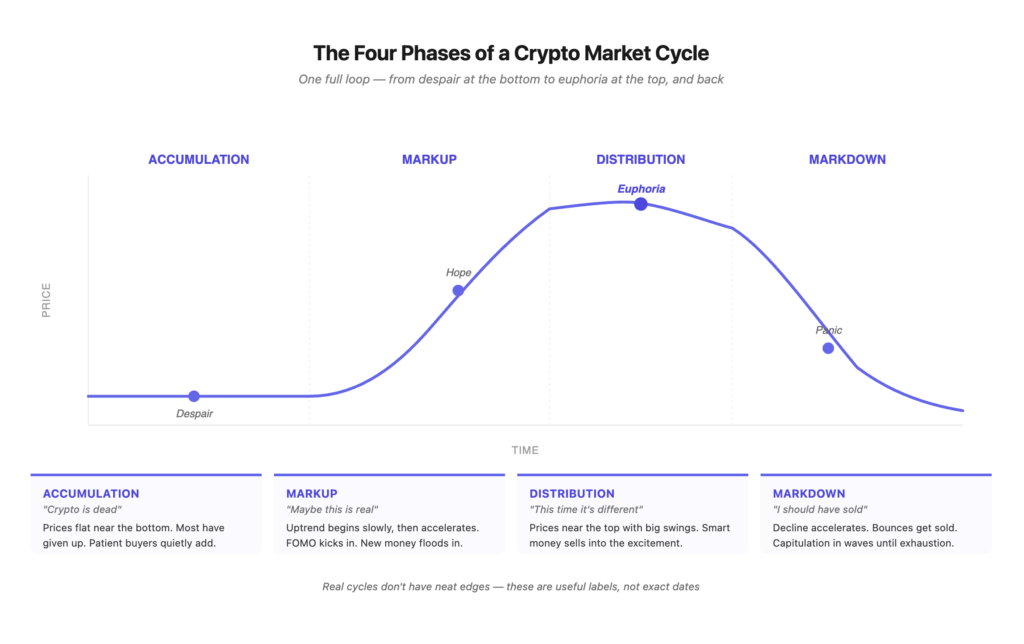
Accumulation. This comes after a crash. Prices are flat, low, and boring. Trading volume is thin. Most people who bought near the previous top have given up. Mainstream media has moved on — this is the phase that produces “crypto is dead” articles. Long-term holders and patient buyers quietly add to positions. Nothing exciting happens for months, sometimes more than a year.
Markup. The uptrend starts, often so gradually that almost no one believes it. Early gains get dismissed as a “dead cat bounce.” Then prices keep climbing. Old holders feel relief. New money starts trickling in. Halfway through, the FOMO (“fear of missing out”) kicks in — friends who ignored crypto a year ago start asking questions. Coverage returns. The mood shifts from cautious to confident.
Distribution. Prices are near the top and chop sideways with big swings. Volatility increases. Sentiment is euphoric. Friends who never cared about crypto are asking how to buy. There’s a wave of “this time it’s different” arguments to justify higher prices. Quietly, experienced holders sell into the excitement. Magazine covers and TikTok influencers join the party. The distribution phase often takes weeks or months — tops are rarely a single day.
Markdown. The decline. It usually starts subtly — a normal correction, nothing to worry about. Then it accelerates. Each bounce gets sold. “This is the bottom” gets called five, six, seven times before one finally is. Capitulation comes in waves — leveraged traders get liquidated, then long-term holders give up, then the very last believers. Eventually the selling exhausts itself and the market drifts into a new accumulation phase. The loop restarts.
Anyone telling you “we’re in markup phase right now” with confidence is guessing. Phases are clearest in hindsight. The model is useful for context, not for trading.
The Bitcoin halving theory: history and limits
Every four years (roughly), Bitcoin’s protocol cuts the reward miners receive for adding new blocks in half. Fewer new bitcoins enter circulation each day. If you want the deep mechanics, our Bitcoin explainer covers them. The relevant point here: the halving is a programmed supply shock, built into Bitcoin since 2009.
The pattern is striking. Each halving has been followed, roughly 12–18 months later, by a major cycle peak.
- November 2012 halving → December 2013 peak around $1,150
- July 2016 halving → December 2017 peak around $19,800
- May 2020 halving → November 2021 peak around $69,000
- April 2024 halving → October 2025 peak around $126,000
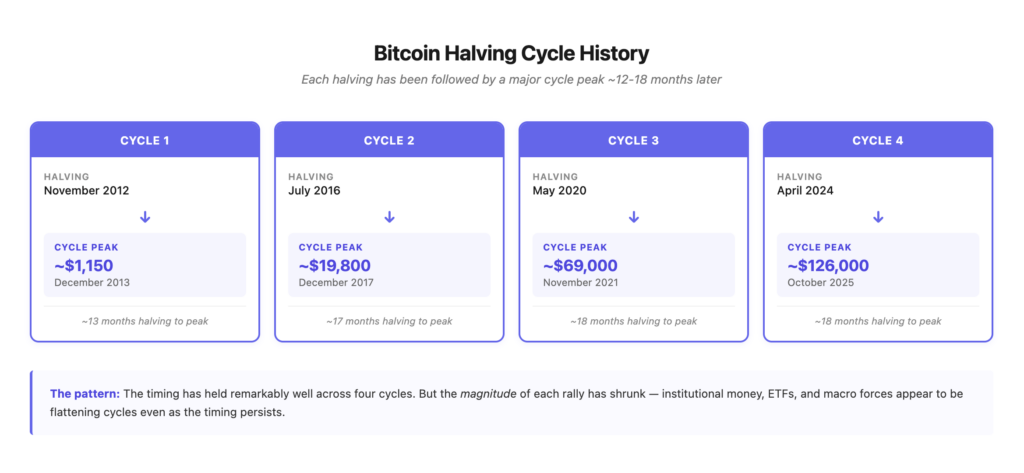
The theory is straightforward: existing demand against a suddenly slower new supply pushes prices up. Combined with attention, momentum, and new buyers piling in once headlines start, you get the bull cycle. The halving lights the fuse; psychology does the rest.
The limits matter just as much.
- The sample size is three. Three data points isn’t a law of physics.
- Each cycle had its own unique drivers. 2013 had the Mt. Gox exchange running hot. 2017 was driven by the ICO boom. 2020–21 was a perfect storm of pandemic stimulus, near-zero interest rates, and corporate adoption.
- The pattern could be coincidence. Or it could be self-fulfilling — people buy because they expect the post-halving rally, which creates the rally.
- The market is maturing. ETFs and institutional money may dampen or distort the cycle in ways we haven’t seen before.
The honest position: the halving correlation is a real, observable pattern worth knowing. Treating it as a guarantee is a mistake. Treating it as meaningless is also a mistake. It’s one useful framework among several.
Why crypto cycles are more violent than stocks
Bitcoin is roughly 3–5x more volatile than the S&P 500, and most altcoins are more volatile than Bitcoin. A few structural reasons:
Smaller market size. Even at multi-trillion-dollar total valuations, crypto is small next to global equities. Less capital is needed to move prices meaningfully — in either direction.
24/7 trading. Stock markets close. Crypto doesn’t. There are no overnight pauses, no weekends, no circuit breakers to halt a panic. When something cracks at 3am on a Sunday, the price moves immediately and keeps moving.
Retail dominance. Crypto has a much higher share of individual (rather than institutional) traders. Individuals tend to buy excitement and sell fear, which amplifies swings.
Leverage. Perpetual futures markets let traders take positions many times the size of their actual capital. When prices move against them, forced liquidations cascade — selling triggers selling, buying triggers buying.
Lower regulatory friction. Crypto is easier to manipulate at the edges than equities, especially for smaller coins.
Younger asset class. There’s less long-term institutional money providing the “gravity” that dampens swings in mature markets.
The practical result: four-year cycles instead of decade-long ones, and drawdowns of 70–85% are normal — not catastrophic outliers. The 2018 bear market took Bitcoin down roughly 84% from its peak. If that number scares you, that’s appropriate. It should. Position your portfolio accordingly — only with money you can genuinely afford to lose entirely.
The psychology of cycles
This is where most beginner damage gets done. The emotional curve through a cycle is so predictable it’s almost embarrassing.
At the bottom, the dominant feeling is depression. Capitulation. “Crypto is over.” The asset is boring, your portfolio is down 75%, and the smart-sounding people are explaining why it’ll never recover.
In early markup, when prices start to climb, the dominant feeling is disbelief. “It’s just a bounce. It’ll fade.” You don’t buy. The rally keeps going.
In mid markup, hope and cautious optimism creep in. “Okay, maybe this is real.” You consider adding.
In late markup, belief and excitement. “We’re going much higher.” You add aggressively. Friends are asking you for advice.
At the top, euphoria. Thrill. “This is the new economy. The old rules don’t apply.” You feel like a genius. Everyone you know is talking about crypto.
In early markdown, complacency. “Healthy correction. Buy the dip.” Prices keep falling.
In mid markdown, anxiety, then denial. “It’ll come back. It always comes back.” You hold. Prices keep falling.
In late markdown, panic. Capitulation. Depression. “I should have sold at the top. I’m an idiot.” You sell at a huge loss. The bottom forms shortly after.
Loop restarts.
The key insight, the one thing I wish I’d internalized in 2017: your emotions are part of the market mechanism, not a guide to it. Euphoria at the top is what creates the top — millions of people feeling exactly what you feel, buying at exactly the same time. Despair at the bottom is what creates the bottom. If you feel certain, that’s a data point. The question is whether your certainty is shared by enough other people to matter.
The most useful skill in crypto isn’t reading charts. It’s recognizing your own emotional state and asking whether you’d make the same decision if you felt the opposite.
Common cycle indicators (and their limits)
You’ll encounter dozens of indicators claiming to predict crypto cycles. None of them are crystal balls. A few are worth knowing as context.
200-day moving average. A line drawn through the average price of the last 200 days. Price below the 200-day average suggests a bearish trend; above suggests bullish. Useful for confirming what’s already happening. Useless for predicting what’s next — by definition, it lags.
Crypto Fear & Greed Index. A daily score from 0 to 100 that aggregates volatility, volume, social sentiment, and other inputs. Readings above ~75 (“extreme greed”) often appear near tops; below ~25 (“extreme fear”) often appear near bottoms. It’s a decent contrarian vibe check — useful for asking “am I being emotional right now?” It’s a terrible timing tool. The index can sit at “extreme greed” for months while prices keep climbing.
MVRV ratio. An on-chain metric comparing Bitcoin’s market value to the average price at which existing coins last moved. You’ll see it cited a lot. It’s beyond the scope of this article, but the short version is: it’s another lagging indicator with historical correlations and no predictive guarantees.
Halving proximity. The historical correlation discussed earlier.
The caveat that applies to all of them: every indicator describes the past. People who claim a single indicator can predict the future are usually selling courses, paid signals, or alt coins. Use indicators as context, never as instructions.
The “this time is different” debate
Every cycle has its “this time is different” arguments. The current one has more credibility than usual, but that doesn’t make it right.
Arguments that the next cycle will break the pattern:
- Spot Bitcoin ETFs were approved by the SEC in January 2024. For the first time, large institutions have a regulated wrapper to hold Bitcoin without touching crypto exchanges directly. That’s structurally new.
- Corporate treasuries. Companies like MicroStrategy have moved billions of dollars of corporate cash into Bitcoin. This is non-cyclical demand that didn’t exist in earlier cycles.
- Sovereign accumulation. El Salvador made Bitcoin legal tender in 2021. A handful of other countries and US states have started accumulating. Early days, but new.
- Macro integration. Bitcoin now correlates noticeably with stocks and reacts to interest-rate decisions. It trades more like a macro asset than a fringe tech bet.
- Maturing market. A larger share of trading is institutional. In theory, that means less retail-driven euphoria and panic.
Arguments that cycles persist:
- “This time is different” was said in 2013, 2017, and 2021. All three times, the cycle played out anyway.
- The halving mechanics haven’t changed. The supply schedule is the same.
- Human psychology hasn’t changed. Bigger money brings bigger euphoria and bigger panic.
- New asset classes don’t outgrow their cycles quickly. Mature markets still have cycles — they just stretch out.
Now that the 2024-2026 cycle has largely played out, we have a partial answer. The cycle did peak roughly 18 months after the April 2024 halving — consistent with historical timing. But the rally was much smaller in percentage terms than previous cycles. That suggests institutional involvement and ETF flows may be flattening cycles rather than ending them — the shape persists, but the magnitude is shrinking. Neither cycle maximalists nor cycle deniers got the call exactly right. Treat any confident claim about the next cycle — bullish or bearish — with skepticism. Especially mine.
How beginners actually get hurt in cycles
The cycle isn’t what hurts you. Your reaction to it is. The patterns are consistent across every cycle I’ve watched.
FOMO buying near tops. You see crypto everywhere. Friends are making money. You finally buy. The top is in two weeks later. You ride it down 80%.
Panic selling at bottoms. You bought near the top. You held through a 60% drop. At 80% down, you can’t take it anymore. You sell. The cycle turns within months.
All-or-nothing positioning. You go 100% in at the worst moment, or 100% out at the worst moment. Either decision is a single point of failure.
Leverage. You use borrowed money to amplify gains. A normal 30% pullback — routine for crypto — wipes out your position entirely. You’re now down 100% in a market that’s only down 30%.
Chasing altcoins at the top. Bitcoin’s already up a lot. You rotate into smaller coins for “bigger gains.” In the bear market, those coins crash 90%+. Many never recover. Some go to zero.
Trying to time the exact bottom. You wait for the perfect entry. The price runs without you. You chase. You buy higher than you would have if you’d just bought when you first decided to.
The shared pattern: emotion drives the wrong decision in the wrong direction at the wrong time.
What to actually do in each phase
I can’t tell you what to buy or when. Nobody honest can. But there are principles that have served patient holders across multiple cycles. Treat these as principles, not advice.
In a bull market: Don’t get euphoric. When friends who’ve never cared about crypto are asking how to buy, that’s a warning sign, not a green light. Many people take partial profits as prices rise — locking in gains in stages rather than trying to call the exact top. Ignore voices telling you “we’re only getting started” — they’re always loudest near the peak. Don’t add leverage to gains; you’re trading a real asset for a fragile one.
In a bear market: Don’t capitulate. The bottom feels exactly like more downside is coming — that’s how bottoms form. Dollar-cost averaging — buying small fixed amounts on a regular schedule — has historically worked well during bear markets, if you have conviction and capital you can afford to lose. Ignore the “crypto is dead” voices; they’re always loudest near the bottom. The bear is where conviction gets tested and where positions for the next cycle quietly get built.
Always:
- Only invest what you can afford to lose entirely. I mean that.
- Position size for sleep. If you’re checking the price every hour, your position is too big.
- For most people, time in the market beats timing the market.
- Keep your crypto secure. The methods in our guide on buying crypto safely apply across every phase of the cycle.
- The single rule that matters: if you’re making decisions emotionally, you’ve already lost.
Common questions
How long do crypto market cycles typically last?
Roughly 12–18 months each in completed cycles, though there’s significant variation. The 2014–2015 bear market ran about 14 months. The 2018–2020 bear lasted roughly two years before serious recovery. Bull markets tend to start slow and end fast. Bear markets tend to start fast and end slow. Plan for years, not months.
Are we in a bull or bear market right now?
We don’t make that call on Plainly Crypto. Anyone who tells you with confidence is guessing. The current phase is genuinely only clear in hindsight, often by 6+ months. If you’d like a heuristic: ignore the question. Decide your plan based on your own risk tolerance and timeline, not on what you think the next three months hold.
Can the halving cycle “break”?
Yes, eventually. Whether that’s now, next cycle, or three cycles from now is the open question. As Bitcoin’s market grows, the percentage impact of each halving on total supply shrinks — by the 2030s, halvings will have very small effects on the new-supply rate. The 2024-2026 cycle already showed the pattern weakening in magnitude even though the timing held. The pattern is unlikely to persist forever in its current form.
Should I try to sell at the top and buy at the bottom?
You’ll probably do worse than if you don’t. Tops and bottoms are only obvious afterwards. Most successful crypto holders I know don’t try to call exact turns — they scale in during bears and scale out during bulls, accepting that they’ll never get either extreme right.
Do altcoins follow Bitcoin’s cycle?
Mostly, yes, but with much more violence. When Bitcoin goes up 5x in a bull market, altcoins might go up 20x. When Bitcoin falls 75%, altcoins often fall 95%+. And many altcoins from the previous cycle never make new highs in the next one. Higher reward, much higher risk, much higher chance of total loss.
What’s dollar-cost averaging and why do people recommend it?
Dollar-cost averaging (DCA) means buying a small fixed amount on a regular schedule — say, $50 every week — regardless of price. It removes the need to time the market. You buy more units when prices are low and fewer when high, and over a full cycle you tend to end up with a reasonable average cost. It’s not magic, and it doesn’t guarantee profit, but it removes most of the emotional decisions that hurt beginners.
Where to go from here
If you’re new to all of this, the foundations come first: what cryptocurrency is, how Bitcoin works, how blockchains actually function, and how to buy crypto safely. Those four cover the why, the what, and the how — this article covers the when and the why-it-feels-the-way-it-does.
Next natural steps in the series: how crypto wallets actually work (so you can move your crypto off exchanges properly), and dollar-cost averaging in practice (the strategy most often recommended for surviving cycles). Both get dedicated articles in the Buying & Storing and Understanding the Market series.
The pattern that’s emerged across the four prior articles is the same one running through this one: crypto rewards patience and punishes hurry. The people I know who’ve done well across multiple cycles aren’t the ones who called the top or caught the bottom. They’re the ones who kept their position size sane, stayed off margin, didn’t capitulate at the worst moments, and didn’t get euphoric at the best ones. Cycles will keep happening. The market will still be here next year. The single most useful skill you can build is the patience to act on long timeframes instead of reacting to short ones.
A note on financial advice
This article is education, not financial advice. Crypto is volatile and risky, and there’s no guarantee any specific cryptocurrency will hold its value. Only put in what you can afford to lose entirely. Make your own decisions based on your own situation, your own research, and ideally a conversation with a financial professional who understands your circumstances.