A DEX (decentralized exchange) is software that lets you swap one crypto for another directly from your own wallet — no signup, no company holding your money, no middleman between you and the trade. You click, you sign, the swap happens. That’s the whole model.
This guide covers what a DEX actually is, how it works underneath the hood, when it’s the right tool for the job, and — just as important — when it isn’t. We’ll compare DEXes with centralized exchanges like Coinbase, Kraken, and Binance throughout, because most people asking “what is a DEX” are really asking “how is this different from the exchange I already know about?”
Quick personal note. The first time I used Uniswap — this was back when Ethereum gas was still merciful — I sat there refreshing the page, waiting for a signup form that never came. I connected my wallet, picked two tokens, hit swap, signed the transaction, and it just… worked. No email verification. No ID upload. No customer service chatbot asking me to describe my problem in three to five sentences. It felt like using a vending machine instead of standing in line at a bank. That contrast is the point.
TL;DR
- A DEX (decentralized exchange) lets you swap crypto directly from your wallet using a smart contract — no signup, no custody transfer, no middleman.
- The tradeoff is you take on more responsibility: gas fees, slippage, understanding what you’re clicking, and the risk that the smart contract itself has a flaw.
- Most DEX crypto swaps run through AMMs (automated market makers) — smart contracts that use liquidity pools and math to price trades automatically, without a traditional order book.
- Popular examples include Uniswap on Ethereum, PancakeSwap on BNB Chain, and Jupiter on Solana. Every major chain has its own DEX ecosystem.
- Use a DEX for: swapping tokens not listed on major exchanges, staying in self-custody, participating in DeFi. Skip a DEX for: your first crypto purchase, large amounts if you’re new, or when tax simplicity matters.
- DEXes complement centralized exchanges — they don’t replace them for most people.
The one-sentence version
So, what is a DEX in one sentence? A decentralized exchange is software you use directly from your wallet to swap one crypto for another, without any company holding your money in between.
That’s the DEX meaning stripped to essentials. Everything else in this article is elaboration on that sentence.
DEX vs CEX — the fundamental difference
The clearest way to understand a DEX is to hold it next to a CEX (centralized exchange) and look at what each one does with your money.
Centralized exchanges (CEX) — Coinbase, Kraken, Binance — work like a bank with a trading floor attached. You sign up, verify your ID (this is called KYC, “know your customer”), and deposit funds. The exchange holds your crypto in its own accounts. When you trade, you’re not actually moving coins on the blockchain — you’re moving numbers around inside their internal database. The exchange matches your buy order against someone else’s sell order using an order book, just like a stock exchange. You get: convenience, a familiar interface, customer support, sometimes insurance on deposits. You give up: control of your private keys, and the freedom to trade less-known assets that the exchange hasn’t listed.
Decentralized exchanges (DEX) — Uniswap, PancakeSwap, Jupiter — never touch your money. You visit the site, connect your wallet, and every trade runs as a smart contract (self-executing code on a blockchain) directly from your wallet to the pool and back. There’s no account. No password. No “your funds are held with our regulated custodian.” You keep control of your coins the entire time. You give up: hand-holding, the customer service line, and the safety net when you mess up.
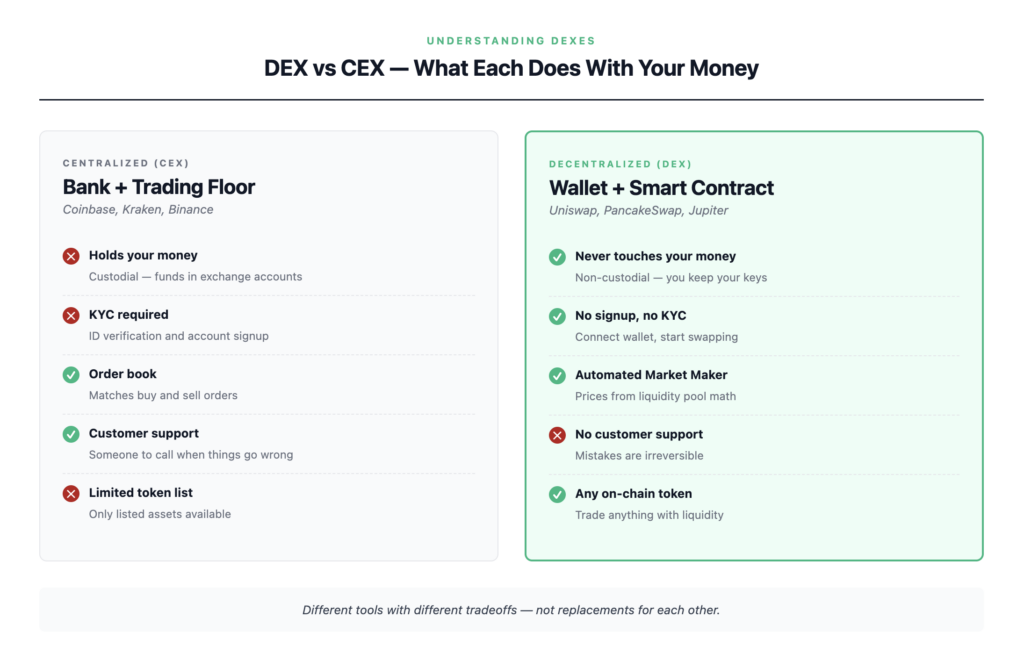
It’s not that DEXes replace exchanges. They replace the middleman between you and other traders. That’s a different, narrower claim than the “future of finance” pitch you’ll see on crypto Twitter.
How a DEX actually works
Here’s where most explanations get lost in jargon. Let’s not do that.
A traditional exchange — stock market, CEX, whatever — uses an order book. Buyers post the prices they’d pay. Sellers post the prices they’d accept. The exchange matches them up. Simple, but it needs a lot of traders and infrastructure to work well.
Most DEXes don’t do this. Instead, they use something called an automated market maker, or AMM. Instead of matching buyers and sellers, an AMM lets you trade against a pool of tokens using a formula.
Liquidity pools, in plain English
A liquidity pool is a pot of two tokens sitting in a smart contract. Let’s say it holds ETH and USDC. When you want to swap USDC for ETH, you send your USDC to the pool, and the pool sends you ETH back. The math decides how much ETH you get.
The most common formula is called the constant product formula: X × Y = K. In plain English: the amount of Token A in the pool, multiplied by the amount of Token B, has to stay equal to the same number (K) after every trade. If someone takes ETH out, they have to put enough USDC in to keep that product constant. The bigger your trade relative to the pool, the more the ratio shifts — and the more your price moves against you.
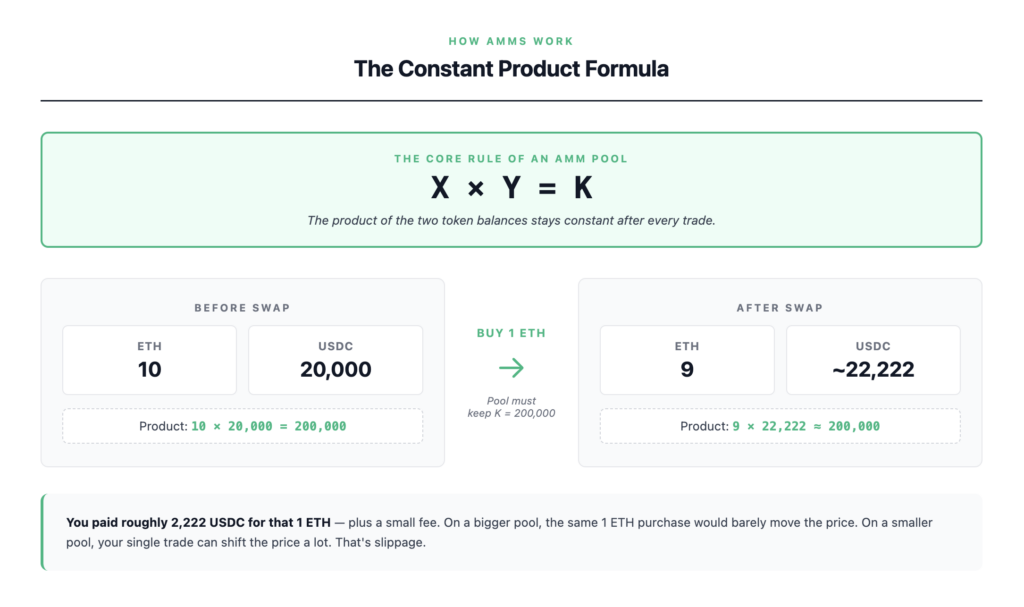
Quick example. A pool holds 10 ETH and 20,000 USDC. That’s a product of 200,000. If you want to buy 1 ETH, the pool now has 9 ETH — so the USDC side needs to reach 200,000 ÷ 9, or about 22,222 USDC. You pay roughly 2,222 USDC for that ETH, plus a fee. On a bigger pool, the same 1 ETH purchase would barely move the price. On a smaller pool, your single trade can shift the price a lot.
Where do the tokens in these pools come from? People deposit them. These people are called liquidity providers (LPs), and they earn a share of the trading fees — usually 0.05% to 0.3% per swap, depending on the pool. Providing liquidity comes with its own risks (more on that in a moment), so it’s not free money.
That’s the whole mechanism. No brokers. No order books. Just a pool, a formula, and a fee.
The tradeoffs of using a DEX
DEXes remove some risks and add others. The risks they add tend to hit beginners hardest, so worth going through carefully.
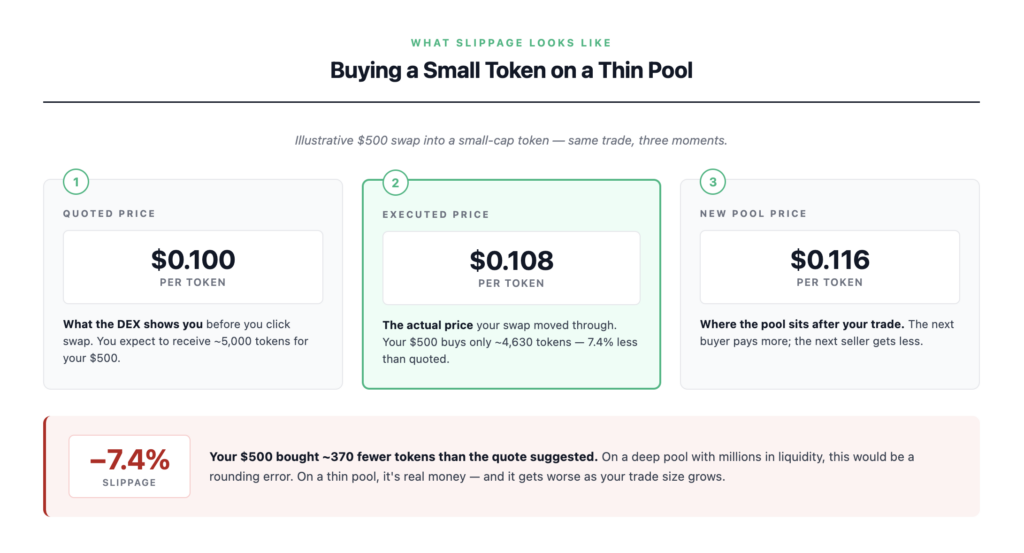
Slippage. Your swap moves the price of the pool. The bigger your trade relative to the pool, the worse your executed price will be compared to the quote you saw. On a deep pool (millions of dollars in liquidity), slippage is negligible. On a thin pool with a small token, a $500 trade might execute at a price 5% or 10% worse than expected. Every DEX lets you set a maximum slippage tolerance — too tight and your transaction fails, too loose and bots can front-run you.
Impermanent loss. This one only matters if you provide liquidity, not if you’re just swapping. When the two tokens in the pool change price relative to each other, LPs end up with a mix worth less than if they’d just held the tokens outright. It’s called “impermanent” because if prices return to where they started, the loss disappears. In practice, it often doesn’t. If you ever see the term mentioned, that’s what it means. A deeper explanation is a whole article of its own.
Gas fees. Every action on a DEX is a blockchain transaction, and every blockchain transaction has a fee (called gas). On Ethereum mainnet, a swap in 2026 typically costs $0.25 to $3 — much lower than the $20 to $50 you might remember from the 2021 DeFi boom, thanks to most activity moving to Layer 2 rollups (Arbitrum, Base, Optimism) where swaps usually cost under $0.10. On Solana, the same swap usually costs less than a cent. On BNB Chain, typically under 30 cents. Gas has nothing to do with the DEX itself — it’s a blockchain-level cost that every transaction pays. Match the chain to the size of your trade.
No customer support. Send tokens to the wrong contract, sign a malicious transaction, or fall for a phishing site, and there is nobody to call. No “please reverse my transaction.” No fraud department. The trade is final the moment it confirms.
Approval risk. Before a DEX can swap your token, you have to sign an “approval” — a transaction that gives the DEX’s smart contract permission to move that token from your wallet. Many DEXes ask for unlimited approval by default, which means the contract can move that token from your wallet forever, in any amount, unless you revoke it. If the contract gets exploited, so does your token. Tools like revoke.cash let you check and remove old approvals — worth doing every few months if you use DEXes regularly.
That’s the tradeoff. You get self-custody and access to any token on the chain. You take on the responsibility of not screwing it up.
When a DEX is the right tool
A DEX makes sense when:
- You want to buy a token that isn’t listed on a major exchange. Most tokens live on-chain long before (or without ever) getting a CEX listing.
- You care about staying in self-custody through the entire process. Your wallet never hands the funds over to anyone.
- You’re already active in DeFi (decentralized finance) — lending, yield, providing liquidity — and you’re just moving between tokens.
- You want to swap between two tokens on the same chain without the round trip of moving them to a CEX, trading, and moving them back.
If any of those describe you, DEX crypto swaps are usually the more direct path.
When a DEX is the wrong tool
A DEX is the wrong tool when:
- It’s your first crypto purchase. A DEX assumes you already have crypto in a self-custody wallet. If you don’t, you can’t use one — you need a centralized exchange to get onboarded. Start with buying crypto through a regular exchange and come back to DEXes once you have a wallet and some experience.
- You’re new and the amount is large. Small mistakes on a DEX get expensive fast, and the errors are irreversible. Learn with amounts you can genuinely afford to lose.
- Tax simplicity matters to you. A DEX swap is typically a taxable event, same as selling one asset and buying another. You’ll generate more transactions to track, and reconciling them at tax time is more work than a CEX statement.
- You want someone to call when things go wrong. There is nobody. If that bothers you, use a CEX.
DEXes aren’t better or worse than centralized exchanges. They’re different tools with different tradeoffs, and beginners tend to overweight the “no middleman” pitch and underweight the “no safety net” reality.
Common mistakes people make on DEXes
Most DEX crypto disasters are self-inflicted. The same handful of mistakes come up over and over.
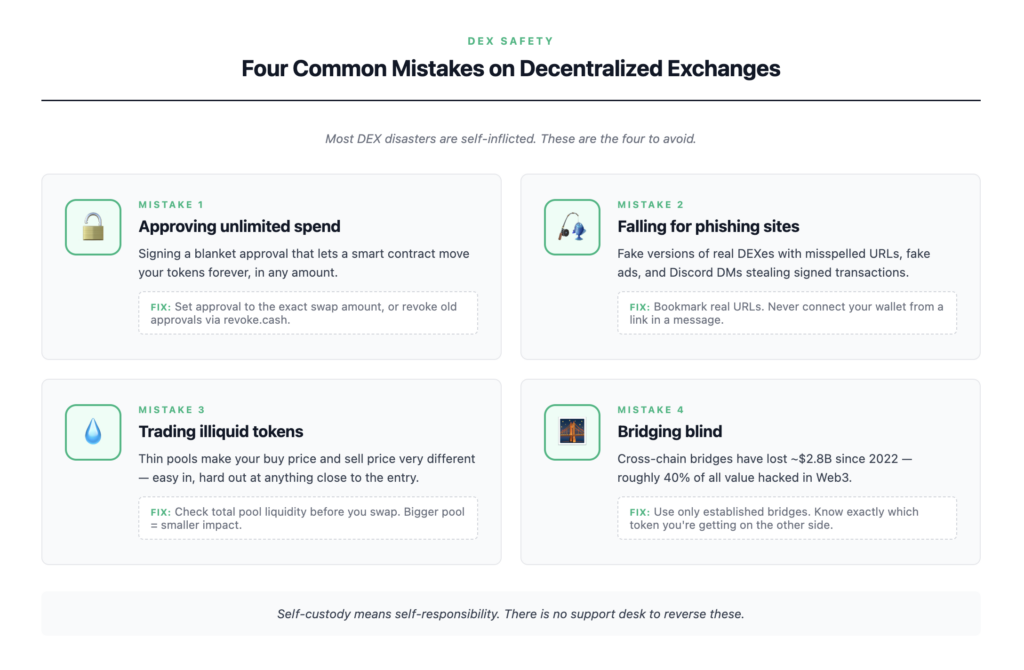
Approving unlimited spend on random tokens. When a new DEX or dapp asks for token approval, the default is often “unlimited.” Change it to just the amount you’re swapping. If you can’t, ask why.
Falling for phishing sites. Fake versions of popular DEXes are everywhere — misspelled URLs (uniiswap.org instead of uniswap.org), sponsored search results, Discord DMs with “official” links. Always type the URL yourself or use a bookmark you set up from a trusted source. Never connect your wallet from a link in a message.
Ignoring slippage settings. Default slippage on some DEXes is either too tight (your transaction fails and you still pay gas) or too loose (bots called MEV bots — short for “maximal extractable value,” specialized programs that watch pending trades — detect your swap and front-run it, worsening your price on purpose). For deep pools, 0.5% is usually fine. For thin pools, you’ll need to be careful either way.
Trading illiquid tokens in a rush. On a thin pool, your buy price and your sell price can be very different. Traders sometimes buy in easily and then find they can’t sell without a big loss. Check the pool size before you swap.
Bridging blind. Cross-chain bridges — tools that move tokens from one blockchain to another — have been hacked repeatedly. Cumulative bridge losses since 2022 are approaching $2.8 billion, and bridges account for roughly 40% of all value ever hacked in Web3. That’s not a rounding error; it’s a structural risk. If you’re bridging, understand exactly what tokens you’re getting on the other side, and stick to well-established bridges with strong security track records.
Popular DEXes by chain
This section is a reference, not a recommendation. Dominant DEXes change over time — you can check current rankings on DefiLlama. Always verify the current official URL from a reputable source before connecting your wallet.
- Ethereum: Uniswap (dominant by volume across its v3 and v4 versions), Curve (specialized in stablecoins), SushiSwap, Balancer.
- BNB Chain: PancakeSwap (dominant, roughly 85% of BNB Chain DEX volume).
- Solana: Jupiter (dominant aggregator, meaning it routes across multiple pools like Raydium and Orca for the best price), Raydium.
- Layer 2s (Arbitrum, Optimism, Base): Uniswap deployments plus various native DEXes such as Aerodrome on Base.
I’m listing these because you’ll encounter their names, not because you should use any specific one. Pick the DEX that matches the chain you’re on and the token you want to swap.
A note on perpetuals DEXes. This article focuses on spot DEXes — the kind you use to swap one token for another. Perpetuals DEXes like Hyperliquid or dYdX enable leveraged trading, which is a different tool with meaningfully different risks. Leverage can multiply gains, but it can also liquidate your position in minutes when the price moves against you. If you’re new to crypto, stay away from perps until you’ve spent significant time with spot trading first.
Common questions
Are DEXes safer than centralized exchanges?
They’re differently safe. DEXes eliminate custodial risk — no exchange can freeze your funds, go bankrupt with your coins, or block your withdrawals. But they add smart contract risk, phishing risk, and the risk of self-inflicted mistakes. Whether a DEX is “safer” than a CEX depends on which set of risks you’re better equipped to manage. A new user with a strong CEX password and 2FA is often safer on a CEX than trying to navigate wallet approvals for the first time.
Do I have to pay taxes on DEX swaps?
In most jurisdictions, yes. Swapping one crypto for another is typically a taxable event, treated like selling one asset and buying another. Rules vary by country and change over time. Keep records of every swap (transaction hash, date, USD value of both sides) and consult a tax professional familiar with crypto in your jurisdiction. This is not tax advice.
What’s the minimum amount to use a DEX?
Technically nothing, but gas fees create a practical floor. On Ethereum mainnet in 2026, gas typically runs $0.25 to $3 per swap — much cheaper than the $20+ swaps of a few years ago, but still meaningful on a $10 trade. On Layer 2 chains like Arbitrum or Base, swaps are usually under $0.10. On Solana or BNB Chain, gas is typically under a dollar. Match the chain to your trade size, not the other way around.
Why are gas fees sometimes so high on DEXes?
Gas is the fee paid to validators (the computers that process blockchain transactions), not to the DEX. It rises when the network is congested — lots of people transacting at once. Ethereum sees this most because it’s the busiest smart contract chain. Other chains are usually cheaper. The DEX itself doesn’t set gas; it just uses whatever the network is charging at the moment you swap.
Can I lose money on a DEX without being scamm
Yes. Slippage on illiquid pools, MEV bots front-running your trades, impermanent loss as a liquidity provider, and simple errors like approving unlimited spend or signing the wrong transaction can all cost you money without anyone technically “scamming” you. The code did exactly what you told it to. That’s why DEXes aren’t beginner-friendly for large amounts.
Where to go from here
You now have the answer to “what is a DEX” — the mechanism, the tradeoffs, and the mistakes people make. But a DEX is the second half of a two-part setup: a wallet you control, and a place to swap tokens directly from it. If you don’t have the wallet piece down yet, start there. Read how crypto wallets work so the “connect wallet” step on a DEX actually means something to you.
If you don’t have any crypto to swap in the first place, you’re not ready for a DEX yet — and that’s fine. Start with a centralized exchange to get your first coins, using the checklist in how to buy crypto safely. Once you’ve moved some crypto into a self-custody wallet, a DEX opens up as an option for anything you want to trade next.
For anyone thinking about buying gradually rather than all at once, dollar-cost averaging is worth reading too. Most DCA setups live on centralized exchanges, but the principle carries over.
A note on financial advice
This article is for education, not financial advice. I’m explaining how decentralized exchanges work as tools — not telling you which DEX to use, which tokens to swap, or whether to use a DEX at all. DEXes involve smart contract risk, self-custody risk, and irreversible transactions. Only interact with amounts you can afford to lose entirely, verify every URL before connecting your wallet, and make your own decisions based on your own situation.