This weekly crypto brief opens on a split week: Bitcoin touched $65,000 mid-week — its highest level since early June — then pulled back to about $63,500 by Friday after US airstrikes on Iran entered their sixth day and risk assets across markets got hit. Ethereum outperformed Bitcoin for the second week running, briefly clearing $1,900 before settling near $1,830. And the CLARITY Act is finally on the Senate floor calendar for the week ahead — the biggest US crypto legislation in a decade, up for a real vote at last.
This is your week in crypto for the week ending Sunday, July 19, 2026. What actually moved. What matters for beginners. What’s noise dressed up as news.
The thing worth noticing this week isn’t the price. It’s that the same asset moved for three completely different reasons in seven days — soft inflation data, geopolitical shock, and legislation timing — and none of them had much to do with crypto itself. That’s what the market looks like when it’s driven by outside forces. Learning to name those forces is one of the more useful skills you can build.
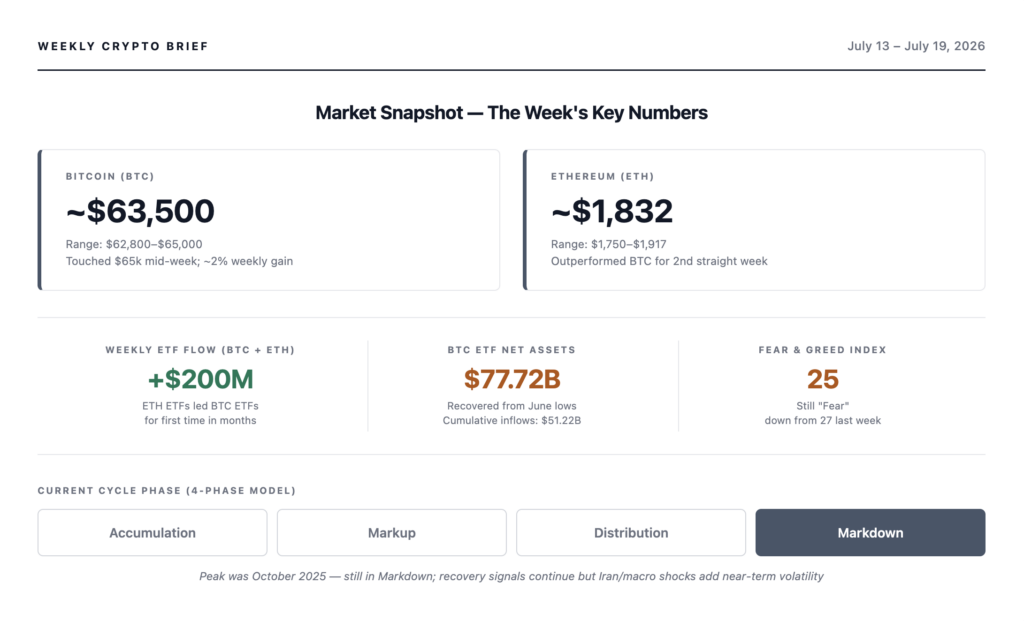
Weekly crypto brief — TL;DR
- Bitcoin touched $65,000 on the softer-than-expected CPI report earlier in the week, then pulled back to ~$63,500 after US airstrikes on Iran escalated. Weekly gain: ~2%.
- Ethereum outperformed Bitcoin for the second consecutive week — up ~4% vs BTC’s ~2%. Fundstrat and other analysts flagged historical precedent for ETH leading crypto recoveries.
- The CLARITY Act is on the Senate floor this week. Merged text expected to drop, floor debate beginning as early as tomorrow, July 20. Polymarket odds sit near 43%; Galaxy Research at ~50%.
- ETF flows stayed positive but volatile — combined ~$200M inflows (BTC $76M, ETH $105M). Ethereum ETFs actually led. BTC ETF AUM recovered to $77.72B.
- Uniswap proposed governance changes to enable protocol fees across Ethereum, Base, Arbitrum, and other chains, strengthening the UNI burn mechanism.
- Fear & Greed Index dropped to 25 (from 27 last week) despite higher prices — a mood-vs-price divergence worth noticing.
- Coinbase Bitcoin Premium was negative for 60 consecutive days — a record. Signals US investors are less aggressive buyers than international ones right now.
Bitcoin’s week: soft inflation, then Iran
The week ran in two acts.
Act one — inflation surprised soft. The June US CPI report, released Tuesday, came in below expectations. Fed Chair Kevin Warsh’s dovish tone from Sintra held. Rate-cut expectations firmed. Risk assets rallied. Bitcoin cleared $64,000 on Wednesday and touched $65,000 on Thursday — its highest print since early June. The Coinbase premium turned briefly positive (US buyers paying more than international ones) for the first time in weeks.
Act two — Iran. On Friday, the sixth consecutive day of US airstrikes on Iranian targets combined with President Trump’s fresh comments on China trade to send risk assets sharply lower. The Strait of Hormuz remained effectively closed. Oil spiked. Semiconductor stocks fell hard. Bitcoin gave back most of its weekly gains to close around $63,500 — still positive on the week, but well below the mid-week high.
In plain English: The Bitcoin move up was about the Fed. The move back down was about geopolitics. Neither was about anything happening inside crypto. This is what it looks like when Bitcoin trades as a global risk asset rather than a standalone story — it reacts to inflation data, war headlines, and central bank speeches like tech stocks or emerging market currencies do.
What it means for beginners: When the same asset moves in different directions in the same week for completely different reasons, it’s usually a signal that the fundamentals haven’t actually changed. The market shifted its attention. Learning to name the actual driver of each move (macro, geopolitical, regulatory, crypto-native) is much more valuable than tracking daily price direction.
Ethereum starts to outperform
More interesting than Bitcoin’s price this week: Ethereum outperformed Bitcoin for the second consecutive week. ETH is up roughly 7% over the last five trading days versus BTC’s 2%. It briefly cleared $1,900 mid-week before settling around $1,832 as the Iran-driven selloff hit crypto broadly.
Fundstrat’s digital asset strategist Sean Farrell called ETH “increasingly compelling” this week, citing historical precedent: during the 2022 bear market, Ethereum began outperforming Bitcoin several months before Bitcoin actually reached its cycle bottom. Ethereum-led recoveries have happened before.
Two structural things also happened this week worth naming:
Ethereum ETFs led the flows. For the week of July 14-18, US spot Ethereum ETFs recorded ~$105M in net inflows — more than Bitcoin ETFs ($76M) for the first time in months. BlackRock’s ETHA led the ETH side.
A $1.3B fund tokenization pilot launched on Ethereum. Announced July 16, the pilot uses a yen stablecoin for instant settlement on Ethereum’s base layer. It’s an institutional infrastructure story — the kind that moves slowly but compounds.
Meanwhile, Ethereum’s Amsterdam hard fork continues its final testing before mainnet activation, and BitMine’s corporate ETH treasury holdings continue to grow (added 42k+ ETH last week to bring total corporate ETH treasury holdings past 5.7 million ETH).
In plain English: When Ethereum outperforms Bitcoin during a rally, it’s often called “altseason” (short for altcoin season). When ETH outperforms during weakness or sideways action, it’s a different signal — historically it’s shown up when institutional money starts rotating from BTC into ETH ahead of broader market recoveries. That doesn’t mean it’ll happen this time. But it’s a pattern worth knowing.
What it means for beginners: Watching the ETH/BTC ratio can be more informative than watching either price alone. If ETH keeps outperforming BTC over multiple weeks, it usually means the market’s risk appetite is returning. If they move together, it means macro forces are dominating.
The CLARITY Act reaches the Senate floor
The CLARITY Act — the biggest US crypto legislation attempt in a decade — is finally at the point where it can pass or die.
The Senate returned from July 4 recess on Monday, July 13. On Thursday, July 17, the House Financial Services Committee held a field hearing in New York specifically on how the CLARITY Act could unlock innovation — a public forcing function that put every stakeholder’s cards on the table. And per multiple sources, the merged Senate text (reconciling the Banking Committee version with the Agriculture Committee’s Digital Commodity Intermediaries Act) is expected to drop this coming week, with floor debate beginning as early as Monday, July 20 — tomorrow.
The math hasn’t changed. The bill needs 60 Senate votes to overcome a filibuster. Republicans hold 53 seats. Senators Josh Hawley and Rand Paul are expected to vote no. So the bill needs approximately seven to nine Democratic crossover votes — and the three big blocking disputes (ethics rules for government officials’ crypto holdings, Section 604 developer protections, stablecoin yield loopholes) remain unresolved as of Friday.
Prediction markets: Polymarket odds sit near 43% for 2026 passage. Galaxy Research has revised down to roughly 50%. Both signal the deadline pressure is real, but the outcome is genuinely uncertain.
Why this week matters more than the last two: Missing the July window pushes real Senate floor time into a compressed August-September stretch before the fall political calendar consumes attention. Senator Cynthia Lummis has publicly warned that missing 2026 could push comprehensive federal crypto regulation as far out as 2030.
In plain English: Regulatory legislation is usually written in years, not weeks. The unusual thing about this bill is that it has moved from committee to floor in months — but the last mile (passing 60 votes, resolving three specific disputes, doing it before recess) is where legislation typically dies. Watch the merged text release and the initial floor votes for signals. Ignore everyone’s confident predictions about the outcome.
What it means for beginners: Don’t invest based on regulatory certainty happening. The base rate for major legislation clearing this kind of gauntlet is low. If the bill passes, expect market volatility in both directions — some celebration, some sell-the-news. If it fails, expect political finger-pointing but no market catastrophe (the industry has been operating in ambiguity for a decade already).
ETF flows: positive but small
For the week ending July 18, US spot crypto ETFs recorded approximately $200M in combined net inflows:
- Bitcoin ETFs: +$75.67M
- Ethereum ETFs: +$105.4M
- Total BTC ETF net assets: $77.72B
Ethereum ETFs leading Bitcoin ETFs in weekly inflows is a first in several months — reinforcing the ETH-outperformance story from earlier.
The week was volatile: Bitcoin ETFs had a rough Monday (-$424.66M on July 13) before recovering with three consecutive positive sessions Wednesday through Friday. IBIT (BlackRock’s flagship) contributed $80.82M on July 15 alone, per SoSoValue data.
Keep the scale in perspective. The June ETF drawdown was ~$4.51B; two weeks of positive $200-$300M flows recovers less than 10% of that. Cumulative Bitcoin ETF inflows sit at $51.22B all-time. Ethereum ETF inflows total is smaller but growing.
In plain English: ETF flows are the clearest available proxy for how mainstream investors are actually positioning through their regular brokerage accounts. A single positive week is a headline; multiple consecutive positive weeks is a signal. We’re now at three-plus weeks of net inflows across BTC and ETH — a genuine trend reversal from the eight-week outflow streak that dominated most of June.
Uniswap proposes protocol-level fees
For anyone reading the DEX article we just published: Uniswap governance submitted proposals this week to enable protocol fees across Ethereum, Base, Arbitrum, Robinhood Chain, and other deployments. Newly generated fees would flow into the existing UNI token burn mechanism — meaning trading activity would directly reduce UNI supply over time.
This has been a long-running debate in the Uniswap DAO. The core question: should the largest DEX by volume start capturing a small portion of trading fees at the protocol level (currently, fees go entirely to liquidity providers), and if so, should that value flow to token holders via burns?
The proposal doesn’t change how DEX swaps work for users. It changes how value flows within the Uniswap ecosystem.
In plain English: Token holders arguing for “value capture” — where protocol tokens accrue economic value from usage — has been one of the biggest tensions in DeFi for years. Uniswap moving toward yes on this is significant because it’s the industry’s largest DEX. If it passes, expect similar proposals across other DEXes.
What it means for beginners: You don’t need to have a view on UNI to notice this trend. Watching how DEXes evolve their tokenomics is one way to understand how “decentralized” governance actually works in practice — messy, slow, and driven by economic self-interest rather than principle.
Quick hits
Iran and the Strait of Hormuz. The sixth consecutive day of US airstrikes against Iranian targets extended into the weekend, keeping the critical shipping strait effectively closed and oil prices elevated. Crypto continues to trade as a global risk asset — reacting to geopolitical shock in the same direction as tech stocks.
Coinbase Bitcoin premium negative for 60 days. The Coinbase Premium Index (which measures whether US buyers pay more than international ones for Bitcoin) has now been negative for a record 60 consecutive days. Historically, this has coincided with periods of international demand leading US demand. Read that as US institutions being cautious rather than absent.
Solana bridge exploit — no user losses. Across Protocol paused Solana deposits after an exploit; all in-flight transfers were completed or refunded. Users lost no funds; the relayer network absorbed the loss. Bridge risk (a topic we covered in what is a DEX this week) remains real — but the industry’s incident response has improved.
BitMine keeps buying ETH. Corporate Ethereum treasury growth continues. BitMine now holds ~5.74 million ETH, adding to the institutional ETH accumulation trend.
Grant Cardone dollar-cost averaging into BTC. Cardone Capital added another 10.5 BTC this week from July cash flow, pushing total corporate holdings past 2,700 BTC. Cardone publicly commits to DCA’ing crypto acquisition from operational cash flow — a real-world example of the strategy covered in dollar-cost averaging in crypto.
What this actually means, if you’re a beginner
Four takeaways from this week worth pulling out:
- When the same asset moves for three different reasons in one week, the fundamentals aren’t changing — the attention is. Learning to name the actual driver of each price move (macro, geopolitical, regulatory, sentiment, crypto-native) is more valuable than tracking daily direction.
- Ethereum starting to outperform Bitcoin is a pattern worth watching. Historically it has preceded broader market recoveries — but “historically has preceded” is not “guarantees.” It’s a signal to watch, not a signal to act on.
- The CLARITY Act’s Senate week is genuinely pivotal. Whichever direction it goes, expect volatility in both markets and headlines. Don’t invest based on your prediction of the outcome — invest based on your plan regardless of the outcome.
- Bridge risk is real but incident response is maturing. The Across exploit this week is the second serious bridge incident of 2026, and users lost no money in either case. That’s a real improvement from 2022-2023, when bridge exploits routinely wiped out user funds directly.
Bottom line
Bitcoin touched $65k then pulled back on Iran, Ethereum outperformed for a second week, ETFs stayed positive but small, Uniswap moved toward protocol fees, and the CLARITY Act finally hit the Senate floor. That’s your week.
Don’t check the price on Monday. If you have a dollar-cost averaging plan, stick to it. If you’re still figuring out how crypto wallets work, how to buy safely, or what a DEX actually is, those are useful weekend reads.
See you next Sunday.
A note on financial advice
This article summarizes news, not recommendations. Nothing here is a suggestion to buy, sell, or hold any specific cryptocurrency. Crypto markets are volatile and genuinely risky. Only put in what you can afford to lose entirely, and make your own decisions based on your own situation.