This weekly crypto brief opens on a real news week: Bitcoin traded between $63,700 and $65,406 through the week — flat-ish on a headline basis, but underneath that was a week of real news. The CLARITY Act’s merged text finally dropped after months of negotiation. Ethics provisions got resolved (kind of), then unresolved, then partly resolved again. Galaxy Research cut its passage odds from 50% to 30%. Ethereum touched $1,954 mid-week before pulling back to $1,857. And a new nine-firm consortium including BlackRock, Coinbase, and Strategy committed $15 million to prepare Bitcoin for quantum computing threats.
This is your week in crypto for the week ending Sunday, July 26, 2026. What actually moved. What matters for beginners. What’s noise dressed up as news.
The theme of the week: the difference between negotiation progress and vote counts. The CLARITY Act made real progress — it has a merged bill, it has an ethics compromise, it has industry lobbying at full pitch. What it doesn’t have is 60 Senate votes. And with just five business days before analysts’ practical deadline for starting the floor voting process, that gap is the entire story.
TL;DR
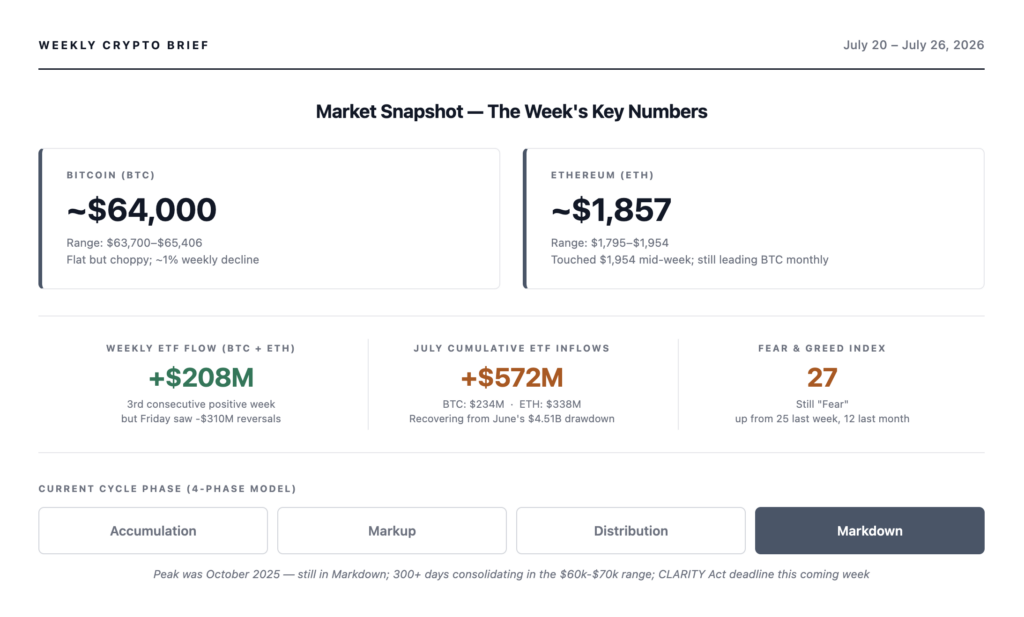
- Bitcoin traded flat but choppy between $63,700 and $65,406. Ended around $64,000, down about 1% on the week. Iran strikes and rising oil prices remained the macro backdrop.
- Ethereum touched $1,954 mid-week before pulling back to $1,857 by Friday. Still outperforming BTC on a longer horizon despite the pullback.
- CLARITY Act merged text dropped July 22 — a 616-page bill combining Senate Banking and Agriculture committee versions. Ethics provisions were made temporary rather than permanent, which Democrats immediately flagged as insufficient.
- Galaxy Research cut passage odds from 50% to 30%. Practical deadline for starting Senate floor voting is July 30 — this coming Thursday.
- ETFs recorded a third consecutive positive week — BTC ETFs +$103.9M, ETH ETFs +$103.9M — but Friday saw sharp reversals (-$240M BTC, -$71M ETH).
- Bitcoin Security Consortium formed — BlackRock, Coinbase, Strategy, and six others committed $15M to prepare Bitcoin for post-quantum cryptography.
- Fear & Greed Index at 27 (up from 25 last week). Still fear, but the trend is slowly improving.
The CLARITY Act week: real progress, still short on votes
The week started with anticipation and ended with a colder assessment.
Monday, July 20: Reports began surfacing that ethics provisions were making progress in Senate negotiations. Bitcoin briefly touched $65,000 on the news.
Tuesday, July 21: President Trump reportedly approved the compromise ethics provisions after a meeting with Senators Cynthia Lummis, Bernie Moreno, and adviser Patrick Witt.
Wednesday, July 22: The merged bill dropped. 616 pages. 104 sections. It combines the Senate Banking Committee’s May text with the Senate Agriculture Committee’s January work — splitting oversight so the CFTC handles commodities like Bitcoin and the SEC handles securities. But the ethics provisions restricting federal officials from profiting through digital assets were made temporary rather than permanent — a concession the White House pushed for. Senate Democrats, who hadn’t yet seen the final text when it dropped, immediately signaled displeasure with the temporary framing.
Thursday, July 23: Traditional banks launched aggressive last-minute lobbying against the bill’s stablecoin yield provisions. Goldman Sachs’ leadership publicly backed the bill in a symbolic industry split.
Friday, July 25: Blockchain Association launched ClarityForAmerica.com, a campaign site letting constituents contact their senators. Fidelity issued a public statement urging Senate passage. Simultaneously, Galaxy Research’s Alex Thorn cut his personal probability estimate for 2026 passage from 50% to 30%, citing the shrinking calendar and vote-count gap.
The math hasn’t changed. Republicans hold 53 seats. With reported holdouts and one senator’s absence since a June hospitalization, the reliable Republican starting point is roughly 50 votes — well short of the 60 needed to overcome a filibuster. At least 10 Democratic crossover votes are needed. Currently, publicly committed Democratic support sits at approximately 2.
The dates that matter:
- Thursday, July 30: Analysts’ practical deadline for starting the Senate floor voting process
- Friday, August 7: Senate’s scheduled session ends before recess
- Monday, August 10: Formal recess begins
In plain English: Passing complex legislation with a 60-vote filibuster threshold requires bipartisan compromise, and compromise takes time. The Senate has approximately five business days to compromise on issues (ethics, stablecoin yield, developer protections) that have been unresolved for months. That’s technically possible. It’s not likely.
What it means for beginners: When you read confident headlines this coming week — either “CLARITY Act about to pass” or “CLARITY Act is dead” — treat both with skepticism. Vote counts and floor scheduling are the actual signals to watch. Everything else is narrative.
Bitcoin’s flat-but-choppy week
Bitcoin’s headline number barely moved this week (roughly -1%), but that flat surface hid real volatility. Range: $63,700 to $65,406 — a $1,700 span. Touched $65,000 on Monday on CLARITY Act optimism, gave it back over the following days as Iran tensions escalated, briefly recovered mid-week, then closed near $64,000 on Friday after $240M in Bitcoin ETF outflows hit.
Three forces pulled Bitcoin in different directions this week:
- CLARITY Act optimism — pushed prices higher early in the week
- Iran/oil pressure — 13th consecutive night of US strikes; Fed rate hike probability for July jumped from 12% to 40% on rising oil prices; risk assets sold off
- Institutional ETF re-engagement — three consecutive positive weeks of BTC ETF flows despite Friday’s reversal
Coinbase’s Bitcoin premium remained slightly negative for most of the week — international buyers are still leading US buyers in bidding aggressiveness. The Fear & Greed Index closed at 27 (Fear), up from 25 the prior week and 12 a month ago. Recovery, slowly.
In plain English: A “flat” weekly close can hide a week of real drama. Bitcoin is currently trading in a range where each week’s news barely moves the needle over five days — but individual days can see 2-3% swings on macro or regulatory headlines. That’s what a consolidation range looks like from the inside.
What it means for beginners: If your investment strategy requires you to know which direction Bitcoin is moving over any single week, you’re in for a bad time. Zoom out. Bitcoin has traded in the $60,000-$70,000 range for over 300 days now — the third-longest single $10,000 consolidation Bitcoin has ever done. Whichever direction that resolves, it won’t be settled by any one Sunday’s news.
Ethereum’s mid-week spike and pullback
Ethereum touched $1,954 on Wednesday — the highest print since June — before selling off with the broader market as Iran tensions escalated. Closed at $1,857 on Friday, down about 2.7% on the week. Still outperforming Bitcoin on a rolling one-month basis.
Underneath the price, three things happened that matter more:
Ethereum ETFs recorded a third positive week — $103.9M in weekly net inflows, bringing July cumulative inflows to $337.74M. The five-day positive streak inside the week broke on Friday with -$70.62M, but the weekly finish stayed green.
BitMine kept buying. The corporate ETH treasury company continued accumulating; total corporate ETH treasury holdings now approach 5.8 million ETH industry-wide.
Ethereum’s Glamsterdam upgrade continues its testnet preparation. Mainnet activation remains targeted for H2 2026.
In plain English: Ethereum is doing three different things at once — recovering price weakness, attracting institutional flows, and shipping technical infrastructure. All three can be true even if any single one fails to convert into a durable price recovery.
The Bitcoin Security Consortium — a real quantum defense story
Genuinely significant news that got less coverage than it deserved: a nine-firm consortium including BlackRock, Coinbase, Strategy, and six others committed $15 million to prepare Bitcoin for post-quantum cryptography threats.
For context: Bitcoin currently uses secp256k1 elliptic curve cryptography — the same encryption underpinning most of the internet’s security. Current classical computers cannot break it. Sufficiently powerful quantum computers eventually could. Industry estimates place practical quantum threats to secp256k1 at 10-15 years out, but the migration path to post-quantum cryptography needs to be designed and implemented before that timeline, not after.
The Consortium’s $15M commitment is not a large number in crypto terms. What matters is the signal: the largest asset manager on Wall Street (BlackRock), the largest US crypto exchange (Coinbase), and the largest corporate Bitcoin treasury (Strategy) are all publicly acknowledging quantum resistance as an infrastructure priority worth spending real resources on.
In plain English: Bitcoin isn’t broken by quantum computing today. But institutions that hold billions of dollars in Bitcoin have decided that preparing for it is worth doing now, not later. That’s how infrastructure risk gets addressed — slowly, publicly, and by consortiums rather than any single actor.
What it means for beginners: Long-term infrastructure risks (quantum, protocol governance, regulatory) rarely become urgent stories. They become slow, boring, well-funded projects that gradually resolve themselves. This is one of those.
ETF flows: third positive week, but Friday reversed
The weekly numbers for the week ending July 25:
- Bitcoin ETFs: +$103.9M net weekly inflow (third consecutive positive week)
- Ethereum ETFs: +$103.9M net weekly inflow (third consecutive positive week)
- Combined: ~$208M
- July cumulative: BTC $233.96M, ETH $337.74M
But Friday was ugly: BTC ETFs saw $240M in outflows on July 25 alone, ending a seven-session inflow streak. ETH ETFs broke a five-day inflow streak with -$70.62M. The week’s positive close required the earlier days to overpower Friday’s reversal.
Keep the scale in perspective: June’s ETF drawdown was ~$4.51B. Three weeks of ~$100M positive flows recovers roughly 15% of what left in June. Cumulative Bitcoin ETF inflows sit at $51.22B all-time.
In plain English: ETF flows have flipped from strongly negative (June) to modestly positive (July). That’s a genuine trend reversal — but modest weekly inflows don’t create the same market impact that the earlier heavy outflows did. Watch the flow direction, but don’t expect the size to match the pain from June immediately.
Japan’s coming ETF wave
Japan’s regulatory reform paving the way for local spot crypto ETFs continued this week. XWIN estimates $18.4 billion in potential inflows once the products launch.
The context: Japanese household wealth totals approximately $14.6 trillion. Currently, only a tiny fraction is exposed to crypto. Spot ETFs would create a familiar brokerage-based access route similar to what US ETFs opened up in 2024. Approval timeline: expected before end of 2026, though final regulations still in draft.
In plain English: The US ETF launch in January 2024 pulled roughly $60 billion into Bitcoin over its first two years. Japan opening similar rails could unlock a smaller but meaningful new pool of institutional and retail demand. The scale isn’t US-scale, but it’s not trivial either.
Quick hits
Bitcoin & Ethereum-backed lending in Canada. Netcoins launched a crypto-backed lending product on July 23 for Canadian users, powered by APX Lending. Users can borrow fiat against BTC or ETH holdings without a taxable liquidation event. It’s a small product but a real infrastructure step toward crypto being usable inside traditional financial workflows.
MoonPay + Discover partnership. US Discover cardholders can now buy crypto assets — BTC, ETH, XRP, SOL, and thousands more — directly through MoonPay’s integrated on-ramp. Consumer-facing distribution matters more than tech breakthroughs for adoption.
Brazilian tokenized cattle. A Brazilian farm tokenized 10 dairy cows using AI smart collars, securing R$100,000 in agricultural credit through B3’s first livestock collateral tokenization transaction. This is real-world asset tokenization in an unglamorous form — which is how most useful crypto adoption actually looks.
UK cracks down on crypto tax. HMRC recovered over £8 million from 502 crypto investors over two years. New OECD reporting rules starting in 2026 will make hiding crypto gains structurally harder. If you trade in the UK, keep records.
Drift Exploit aftermath continues. The attacker who exploited the Drift decentralized derivatives protocol transferred 23,095 ETH (~$44.4M) to Tornado Cash on July 24. Recovery unlikely; the incident is now a stolen-funds tracking exercise rather than an active response.
What this actually means, if you’re a beginner
Four takeaways from this week worth pulling out:
- The CLARITY Act situation is still unresolved and you should not invest based on how you think it turns out. Whatever happens next week, both outcomes are already partially priced in. If it passes, expect some rally and some sell-the-news. If it fails, expect some drop and some “this was already expected” recovery. Neither is a good reason to make significant portfolio changes.
- Weekly volatility inside a flat consolidation is exhausting to watch but ultimately not meaningful. Bitcoin has now spent 300+ days in the $60,000-$70,000 range. Whichever direction resolves, it won’t happen because of a single week’s news.
- Institutional infrastructure keeps building — quantum defense, tokenization, backed lending, distribution partnerships. These are unglamorous stories that compound over years. They’re also the actual reason crypto adoption continues to grow.
- Regulatory clarity in the US matters, but it isn’t the only game. Japan’s ETF preparation, UK’s tax enforcement, and OECD reporting standards are all shaping the global regulatory picture. Watching only Washington gives you a partial view.
Bottom line
Bitcoin flat but choppy, Ethereum spiked and pulled back, CLARITY Act made real progress but still short on votes, ETFs closed a third positive week, and BlackRock quietly signed on to prepare Bitcoin for the quantum era. That’s your week.
Don’t check the price on Monday morning. If you have a dollar-cost averaging plan, stick to it. If you’re still figuring out how crypto wallets work, how to buy safely, or what a DEX actually is, those are useful weekend reads.
See you next Sunday.
A note on financial advice
This article summarizes news, not recommendations. Nothing here is a suggestion to buy, sell, or hold any specific cryptocurrency. Crypto markets are volatile and genuinely risky. Only put in what you can afford to lose entirely, and make your own decisions based on your own situation.