Disclosure: Disclosure: this guide was written by DexTrading, one of the tools it describes. Plainly Crypto earns a share of trading fees from readers who go on to trade on DexTrading. We edited the piece before publishing and kept the right not to run it. All on-chain figures were read on 27 October 2026 (UTC).
A token’s chart tells you what other people paid. It doesn’t tell you whether you’ll be allowed to sell, whether someone can print more of it tomorrow, or whether the money sitting in its trading pool can be pulled out tonight.
Those are not market questions. They’re questions about how the token was built and who still controls it, and every one of them can be answered before you spend anything. The answers sit on the blockchain in public, and knowing how to check a token before you buy it is mostly a matter of knowing where to look.
In what is liquidity in crypto, we explained that liquidity providers on decentralised exchanges can pull their capital out of pools, exactly when you need it most. This guide is the practical follow-up for anyone who has decided to buy a token beyond Bitcoin and Ethereum, especially one that trades on a decentralised exchange and was launched recently. It covers how to check a token before you buy it in seven steps: what each one means, how to do each by hand on a block explorer, and how it looks in an automated checker.
A note on the examples. The large, well-known tokens in this guide are named. The small and newly launched ones are not, and we’ve removed their contract addresses deliberately. Naming a one-day-old microcap in a beginner’s guide is an invitation to go and buy it, which is the opposite of the point. Every figure is real and was read at the time stated; the lesson is in the pattern, not the ticker.
TL;DR
- Start with the address, not the name. On 27 October 2026, a search for one trending token name returned 12 different tokens using it.
- Can you sell it? A honeypot lets you buy and blocks or taxes the sale. On BNB Chain, Ethereum and Base this is tested by simulating a sell.
- Can anyone print more or freeze yours? On Solana, look for a revoked mint authority and a revoked freeze authority.
- Can the liquidity disappear? Find out who holds the pool’s LP tokens: a burn address, a lock contract, or one person’s wallet.
- Who holds the supply? Read the top-10 list yourself. The biggest “holder” is often the trading pool, not a whale.
- What can the owner still change? Unverified code and upgradeable contracts mean the rules can change after you buy.
- Is the pool deep enough for your order? In a $10,500 pool, a $500 buy gets you about 10% less than the price on screen.
- A clean check is not a forecast. It removes some ways to lose money. It doesn’t make a token a good buy.
How to check a token before you buy it, in one sentence
Checking a token means confirming, from the blockchain itself, that you are looking at the right contract, that it lets you sell, that nobody can create or freeze tokens at will, that the trading pool can’t simply be withdrawn, and that the supply isn’t concentrated in a few hands, before you decide whether the price makes sense.
That’s the whole thing. None of it tells you whether the price will go up. It tells you whether the game is rigged against you before it starts.
Before any check: make sure it’s the right token
Anyone can create a token with any name and any logo. Names aren’t unique on a blockchain. Addresses are. When a name starts trending, copies appear within hours, on the same chain and on others.
On 27 October we searched one trending token name and got 12 different tokens carrying it, across three chains, with prices ranging from $0.0000059 to $0.0214. Two of the Solana ones show the gap clearly. One had 21,600 holders and $1.06 million of liquidity spread across eight pools. Another had 328 holders and $25,270, at a price about 100 times lower. Identical names. Nothing else in common.
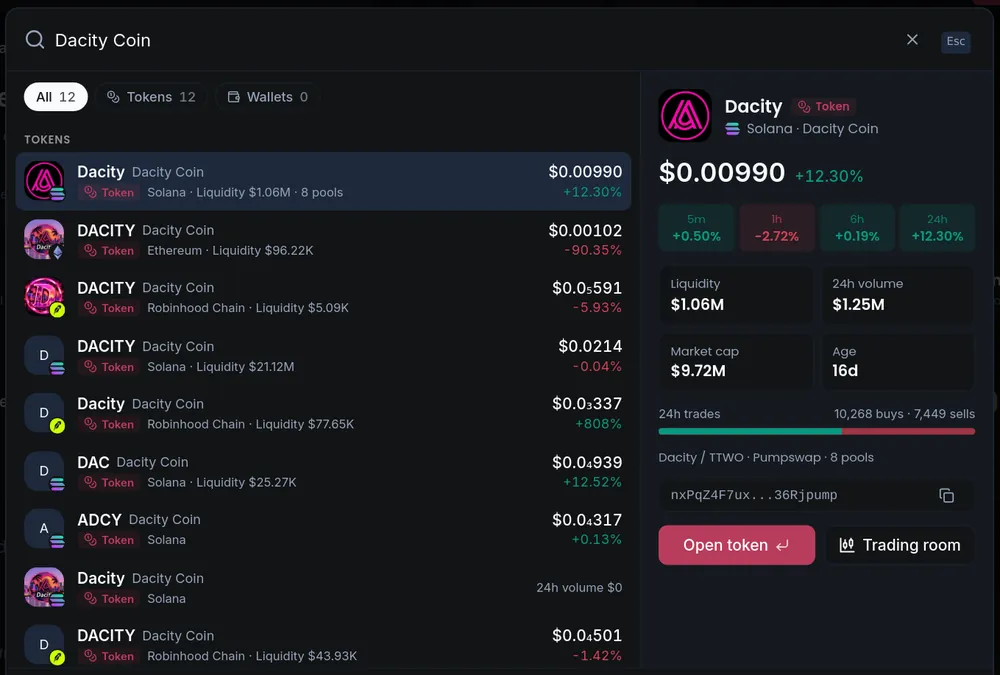
How to check: get the contract address from the project’s own website or official social account, never from a reply, a direct message or a search result. Paste the full address into the explorer or tool you use, and compare the first and last six characters every time you trade. If you can’t find an official address, that is your answer.
Check 1: Can you sell it? Honeypots, taxes and transfer tricks
A honeypot is a token you can buy but can’t sell. On BNB Chain, Ethereum, Base and other EVM chains, a token is a small program, and its creator can write almost any rule into it: block sells from everyone except a list of addresses, charge a 99% “sell tax”, or let only the first buyers out. The chart looks healthy because buys keep coming in. The sells just never happen.
Honeypots are found by simulation: a checker pretends to buy a small amount and then sell it, and reports whether the sale went through and what it cost. That’s also how buy and sell taxes are measured.
- By hand: on the chain’s explorer, open the token’s Contract tab. A verified contract shows its source code. Search it for words like
blacklist,fee,taxormaxSell. Then open the token’s transfers and confirm that wallets other than the creator have actually sold. - With a checker: the result reads as “selling works” or “can’t sell”, plus the two tax figures. Anything above a few per cent deserves a reason; above 10% is a red flag.
One small BNB Chain token we checked at 16:04 UTC passed the sell simulation with a 1.00% buy tax and a 1.00% sell tax. That’s normal for many small BNB Chain tokens. You’d want to know about it before you buy, though, because you pay it on the way in and again on the way out.
On Solana, it works differently. Most Solana tokens use the same shared token program and don’t carry custom code, so the classic honeypot is rare. The equivalent tricks are the token’s authorities (the next check) and the optional extensions of the newer Token-2022 program: a transfer hook that runs custom code on every transfer, a transfer fee, a permanent delegate that can move tokens out of any wallet, or accounts that start frozen by default. A good checker lists each one if it’s present.
Check 2: Can anyone print more, or freeze yours? Mint and freeze authority
Every Solana token has two switches that matter more than anything on its website.
- The mint authority is the address allowed to create new tokens. If it still exists, the supply isn’t fixed: someone can print a billion more and sell them into the pool.
- The freeze authority is the address allowed to freeze a wallet’s tokens. A frozen wallet can’t send or sell. For a meme coin, there’s no innocent reason to keep it.
When the creator gives a power up, it’s called revoked, and the field becomes empty for good. You can read both fields yourself: open the token on Solscan or the Solana Explorer and look for “mint authority” and “freeze authority”.
Two well-known tokens show the difference. Both were read directly from the Solana blockchain on 27 October 2026 at 15:58 UTC.
| Token | Mint authority | Freeze authority | What it means |
|---|---|---|---|
| BONK | none (revoked) | none (revoked) | Supply is fixed at about 88 trillion. Nobody can freeze holders. |
| USDC (on Solana) | active | active | The issuer can create new USDC and freeze accounts. |
USDC keeping both powers isn’t a scam signal. A regulated stablecoin issuer mints new coins when dollars come in, and it keeps the ability to freeze funds, for example after a theft or a court order. That’s the point: the same flag means different things for different tokens. A company you can identify, which publishes its rules, keeping a freeze switch is one thing. An anonymous meme coin launched yesterday keeping one is another.
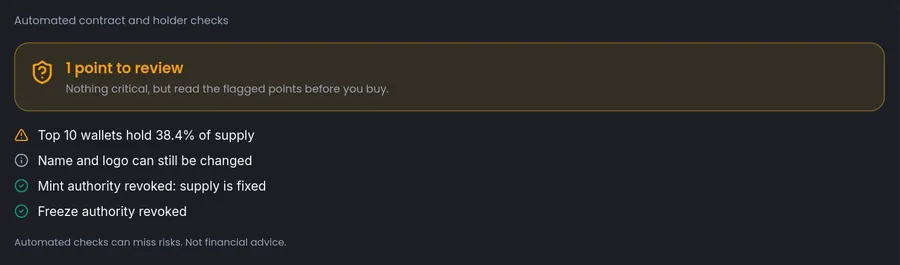
That last grey line, “name and logo can still be changed”, is the token’s metadata. It can’t take your money directly. But a token that can rename itself can also start imitating a better-known one, which brings you back to checking the address.
On EVM chains, the same question is answered by the contract’s owner. If the code has a mint function only the owner can call, and the owner still exists, the supply isn’t fixed. That’s check 5 below.
Check 3: Can the liquidity disappear? LP tokens, locks and burns
This is the check that follows directly from our liquidity guide. On a DEX, your trade doesn’t go to another person. It goes to a pool holding the token and something to pay with. Whoever adds money to that pool receives LP tokens, a receipt that lets them take their share back out.
For a token launched last week, the person who added most of the liquidity is usually the creator. If they still hold the receipt, they can withdraw the pool’s money whenever they like, and the token is left with nothing to sell into. That’s the classic rug pull. So the question is simple: where are the LP tokens?
- Burned: sent to an address nobody controls, such as
0x…dEaD. The liquidity can never be withdrawn. - Locked: held by a lock contract until a set date. It’s safe until that date, so check the date.
- In a wallet: nothing stops the holder from withdrawing it.
Three tokens we checked on-chain at 15:58 UTC on 27 October cover all three cases:
| Token | Pool liquidity | Where the LP tokens were | What it means |
|---|---|---|---|
| A one-day-old BNB Chain token | $10,500 | 100% at the burn address | Can’t be withdrawn, ever |
| A mid-sized Base token | $699,600 | 99.92% in a Team Finance lock contract | Can’t be withdrawn until the lock’s end date, which the lock contract shows |
| A small Base token | $189,200 | 99.48% in the wallet that created the token | Can be withdrawn at any time |
That third one also had unverified source code, meaning nobody outside the team can read what its contract allows. Unlocked liquidity plus unreadable code is the combination to walk away from.
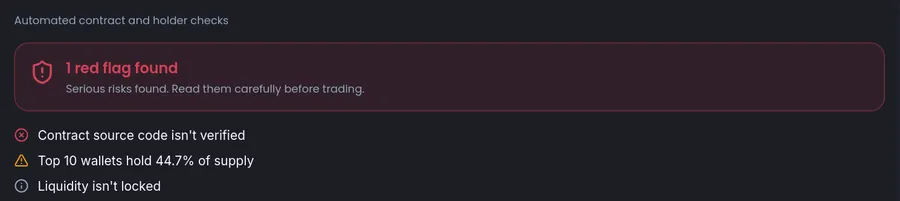
By hand on an EVM chain: find the token’s main pool (the “pair” address) on the explorer, open that pool contract’s Holders tab, and look at who holds its LP tokens. A burn address or a known locker is reassuring. A plain wallet is not. If it’s a lock, open the locker and read the unlock date.
One honest caveat: this works cleanly for classic “V2-style” pools. Newer pool types on Uniswap V3 and V4, and most Solana DEXs, handle liquidity positions differently, and tools don’t always agree on what counts as locked. On Solana, RugCheck reports the share of a pool’s liquidity it considers locked or burned. DexTrading’s check shows the LP lock on EVM chains but not yet on Solana.
Check 4: Who actually holds the supply?
If ten wallets own most of a token, ten people decide its price. One large sell into a small pool can halve it. Checkers summarise this as the share held by the top 10 holders, typically flagging it amber above 30% and red above 50%.
But the number needs reading, because the biggest “holder” is often the pool itself. The pool holds tokens so people can trade. Those tokens aren’t a whale waiting to dump.
The one-day-old BNB Chain token above had a top-10 share of 68.3%, which reads as a red flag. But 46.04% of that was the PancakeSwap pool, which leaves about 22.3% for the other nine. That’s a very different picture. The second holder, at 8.61%, was labelled simply “Contract” — worth one click to find out whether it’s a lock, a vesting contract or something else.
Labels aren’t always there. On Solana, holder lists often show only addresses.
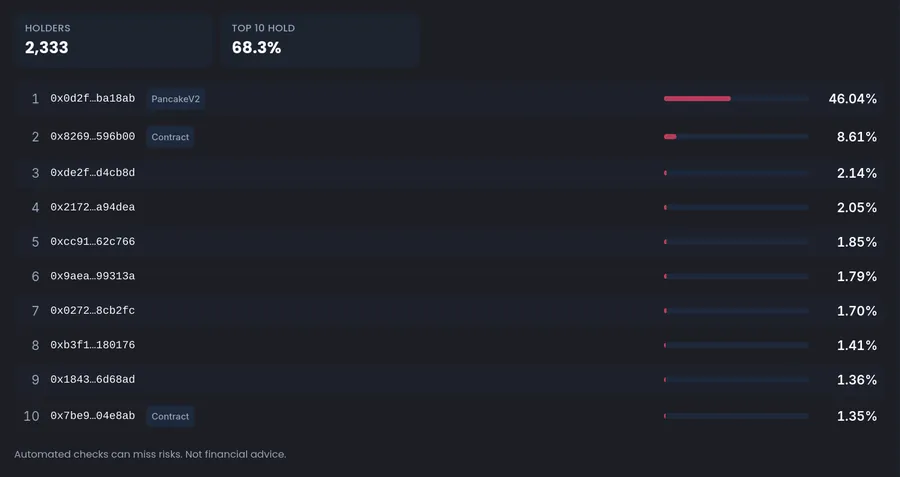
The smaller of the two same-named tokens we looked at earlier had a top-10 share of 76.8%, with a single address holding 61.03%. We checked that address on-chain: it was an account of the PumpSwap pool program. The pool, not a person.
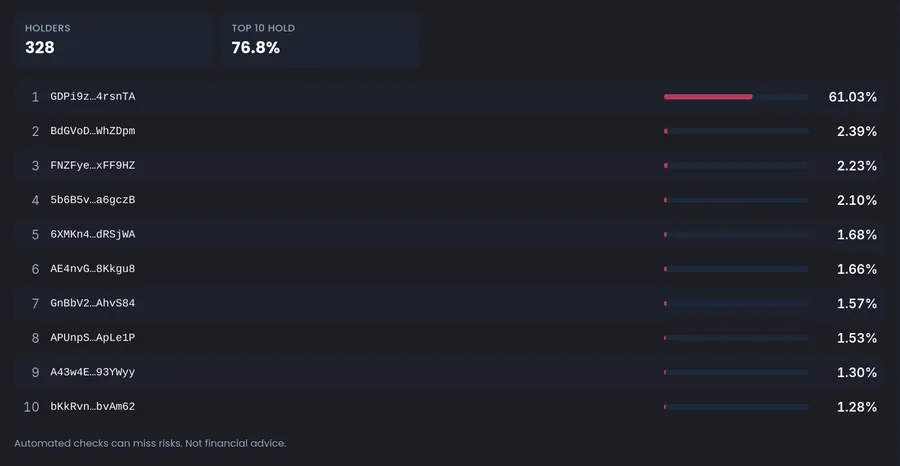
How to check: click the top address and look at what owns it. On Solana, an account owned by a DEX program is a pool. On EVM chains, the explorer usually names pools, lockers and exchange wallets. Take those out, then look again. If the remaining wallets still hold a large share, or a cluster of fresh wallets bought at the same minute, treat it seriously.
Check 5: What can the owner still change?
On EVM chains, many contracts have an owner, the address allowed to call special functions such as changing taxes, blacklisting wallets, pausing transfers or minting. When the owner gives up control, the contract is renounced and the owner becomes the zero address (0x000…000).
Renouncing matters because it turns off whatever the code allows. PEPE on Ethereum is a good example. Its published code includes an owner-only blacklist. On 27 October 2026 its owner() function returned the zero address, so nobody can use that blacklist.
Three situations deserve extra care:
- The code isn’t verified. If the source isn’t published on the explorer, nobody outside can read what the owner can do. One of the Base tokens above had an unverified contract, and calling the standard
owner()function on it failed outright. Treat any claim about its ownership as unknown. - The contract is an upgradeable proxy. A proxy lets someone swap the code underneath, so today’s checks only describe today’s code. The mid-sized Base token with 99.9% locked liquidity was exactly this: safe on liquidity, still changeable on rules.
- “Renounced” isn’t proven. Check it yourself: on the explorer’s Read Contract tab, call
owner(). That same Base token returned a live owner address on 27 October, so it isn’t renounced, whatever anyone says.

An owner isn’t automatically bad. Plenty of real projects keep one to fix bugs. What matters is that you know it’s there, and that you trust whoever holds it as much as you’d trust anyone holding your money.
Check 6: Is the pool deep enough for your order?
This is where the liquidity guide’s slippage lesson comes back. A DEX pool sets its price by formula: every token you take out makes the next one more expensive. In a small pool, your own buy moves the price.
The one-day-old BNB Chain token’s main pool held about $10,500 at 16:04 UTC, roughly $5,250 on each side. Working through the pool’s formula with its 0.25% swap fee and the 1% buy tax:
| Buy size | Tokens received, valued at the price before you bought | Lost to price impact, fee and tax |
|---|---|---|
| $100 | $96.91 | 3.1% |
| $500 | $450.92 | 9.8% |
| $1,000 | $829.85 | 17.0% |
A quick rule: if your order is more than about 1% of the pool’s total liquidity, you’ll feel it. Getting out works the same way, and if the pool shrinks because others sell first, your exit costs more. Size your position to the exit, not the entry, as the liquidity guide put it.
A worked example: one token, every check
Here is that one-day-old BNB Chain token run through all seven checks, between 15:58 and 16:05 UTC on 27 October 2026. We chose it because it was new and small enough for every check to matter.
| Check | What we found | Verdict |
|---|---|---|
| Right token | Address confirmed against the pool | Always confirm against the project’s own channels |
| Can you sell? | Sell simulation passed. Taxes 1.00% in, 1.00% out | OK, small cost |
| Mint / owner powers | Code verified. owner() = zero address (checked on-chain) | OK |
| Liquidity | 100% of LP tokens at the burn address | Can’t be pulled |
| Holders | Top 10 = 68.3%, of which the pool = 46.04%. The rest ≈ 22.3% | Look closer at the “Contract” holder (8.61%) |
| Pool depth | About $10,500. A $500 buy loses about 10% on entry | Very thin |
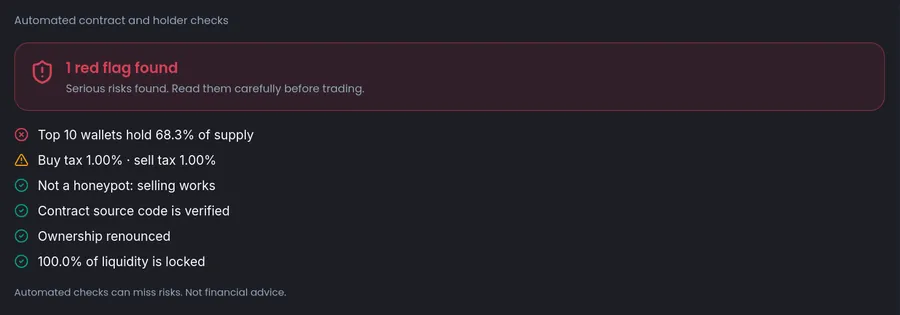
It passes most of the checks, and it’s still no safer a buy for that. Since its launch the day before, its price had ranged from $0.0000046 to $0.000081 — a factor of about 17 in 24 hours. Its whole market value was about $11,100. The checks told us the contract isn’t rigged. They told us nothing about whether the price makes sense. That’s a separate question, and usually a harder one.
What a clean check can’t tell you
- Insiders spread across many wallets. A team can split its tokens over 50 fresh addresses so no single one shows up in the top 10.
- Team selling. A renounced contract with locked liquidity can still fall 90% if the people holding the most tokens sell them.
- Timing. Every check is a snapshot. A lock can end, an owner can act, holders can change within minutes. One token’s measured sell tax moved from 1.18% to 1.00% in the 15 minutes between our two readings.
- Tool errors. Automated checks read the same blockchain but interpret it differently, and all of them miss things. When something matters, confirm it on the explorer yourself.
Tools that run these checks
No single tool covers everything, so it helps to know what each is good at. All are free to use for these checks.
- Block explorers — Solscan on Solana; Etherscan, BscScan and Basescan on EVM chains. This is the source every other tool reads from. Slower, but nothing is interpreted for you.
- RugCheck (Solana). Scans tokens for scam signals, holder concentration, liquidity risks, insider activity and metadata. Particularly useful for whether a Solana pool’s liquidity is locked or burned.
- Honeypot.is (BNB Chain and Ethereum). Simulates a buy and a sell and reports whether selling works and what the taxes are.
- DexTrading (Solana, Ethereum, BNB Chain, Base and other EVM chains). Every token page has a Security tab with the checks in this guide and a Holders tab with the top 10, next to the price chart, liquidity and trades. Free, no account needed to read it. Its LP-lock check covers EVM chains, not Solana yet.
Our suggestion: use one checker to find the flags quickly, then confirm any flag that would change your decision on the explorer.
If you trade on DexTrading: who holds your money
Since this guide is about knowing who controls what, here is the same answer for us:
- Trading from your own wallet is non-custodial. Connecting a wallet only lets the site read public data, every swap is confirmed in your own wallet, and DexTrading never asks for a seed phrase or private key.
- Three optional services do hold funds:
- Scan deposit swaps, where you pay from any wallet without connecting it, hold your payment only for the moment of the swap.
- Scan prediction bets hold funds from payment until the market settles and the payout is sent.
- Copy-trading wallets trade by rules you set and can be withdrawn at any time.
Common misconceptions worth naming
“Renounced means safe.” It means the owner can’t change the rules. It says nothing about who holds the tokens, or whether the price makes sense.
“Locked liquidity means it can’t go to zero.” A lock stops the creator pulling the pool. It doesn’t stop holders selling into it until the price is near zero.
“Thousands of holders means it’s well spread.” Holder counts include dust wallets and airdrops. The top-10 share, minus the pool, tells you more.
“If a big DEX lists it, someone checked it.” Anyone can create a pool on a decentralised exchange in minutes. Nobody reviews it first.
“A green check means a good buy.” A clean check removes some ways to lose money. It adds no reason to make any.
Common questions
How do I check if a token is a honeypot?
On BNB Chain, Ethereum, Base and other EVM chains, use a checker that simulates a buy and a sell, such as Honeypot.is or the Security tab on a DexTrading token page, and look at the sell result and the sell tax. Then confirm on the explorer that wallets other than the creator have actually sold. On Solana, classic honeypots are rare; check instead that the freeze authority is revoked and that no transfer hook, transfer fee or permanent delegate is set.
What does “mint authority revoked” mean?
It means nobody can create new units of the token any more, so the supply is fixed. On Solana you can see it on the token’s page in Solscan or the Solana Explorer: a revoked mint authority shows as empty. If the mint authority still exists, someone can print more tokens and sell them.
What is locked liquidity, and is burned better than locked?
When liquidity is added to a DEX pool, the provider receives LP tokens that let them withdraw it. Locked means those LP tokens sit in a lock contract until a set date; burned means they were sent to an address nobody controls, so the liquidity can never be withdrawn. Burned is permanent; a lock is only as good as its end date, so check the date.
What share of the top 10 holders is too much?
There’s no exact line. A common convention marks more than 30% as worth a look and more than 50% as a red flag. First take out the trading pool, lock contracts and exchange wallets, which often top the list; what the remaining wallets hold is the number that matters.
Is a token safe if it passes every check?
No. The checks rule out some deliberate traps, such as unsellable tokens, unlimited minting and removable liquidity. They can’t stop large holders from selling, insiders hiding across many wallets, or the price simply falling. Treat a clean check as the minimum, not a reason to buy.
Where to go from here
- What is liquidity in crypto? — why the size of the pool decides your exit.
- What is a DEX? — how pools replace order books.
- How crypto wallets work — what you’re actually signing when you approve a swap.
- How to buy crypto safely — the first-purchase basics this guide assumes.
- What is market cap in crypto? — why a tiny market cap and a tiny pool usually go together.
A note on risk
This article is educational and isn’t financial advice. Small, newly launched tokens are among the riskiest things you can buy in crypto. Most lose almost all of their value, often within days. The checks above can rule out some deliberate traps. They can’t make a token a sound investment. If you buy anyway, use only money you could lose entirely, decide your exit before you enter, and check the regulations where you live.
Sources
All data was read on 27 October 2026 (UTC). Prices, holders and liquidity change constantly, and the small tokens referenced here may no longer exist in the same form.
- Duplicate token-name search and the two same-named Solana tokens: DexTrading search and token pages, 15:48–16:09 UTC.
- BONK and USDC mint and freeze authorities: read from the Solana blockchain via
getAccountInfo, 15:58 UTC. BONK safety check: DexTrading, 16:04 UTC. - One-day-old BNB Chain token: safety check, taxes and holder data from DexTrading, 16:04–16:05 UTC. Owner, LP token location and pool reserves read from BNB Chain, 15:58 UTC.
- Small Base token (unverified contract, unlocked LP): safety check from DexTrading, 16:05 UTC. LP token holder read from Base, 15:58 UTC.
- Mid-sized Base token (locked LP, upgradeable proxy): safety data from DexTrading, 15:53 UTC. Lock contract and
owner()read from Base, 15:58 UTC. - PEPE (Ethereum)
owner(): read from Ethereum, 15:58 UTC. - Solana pool account ownership confirmed against the PumpSwap program: Solana, 15:58 UTC.
- Price-impact figures: constant-product pool formula, with $10,500 liquidity at 16:04 UTC, a 0.25% swap fee and a 1% buy tax.