Bitcoin spent most of the last two weeks in the low $60,000s, dipped to a 21-month low near $57,950 in late June, and clawed back to around $61,500 by the weekend. Ethereum found footing near $1,700. If you were watching prices every day this past week, you probably felt sick. If you weren’t watching, congratulations — you handled it correctly.
This is your week in crypto for the week ending Sunday, July 5, 2026. What actually moved. What matters for beginners. What’s noise dressed up as news.
When I started using crypto in 2017, one of the earliest lessons was that daily price watching taught me nothing useful and cost me a lot of sleep. The people I know who did well over the long run mostly stopped checking prices. These weekly briefs exist so you don’t have to.
TL;DR
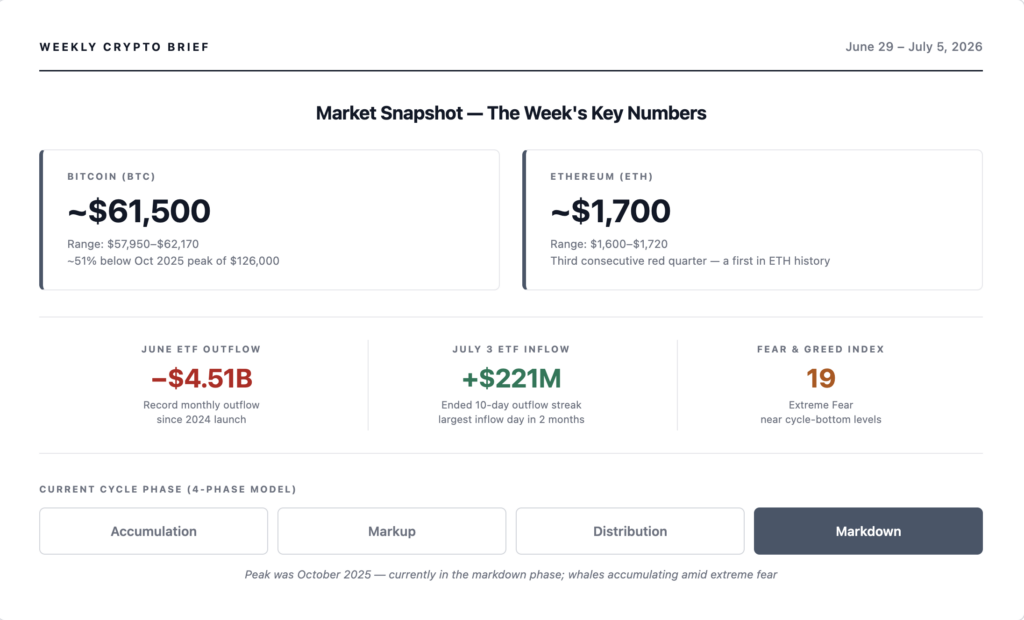
- Bitcoin hit a 21-month low near $57,950 on July 1 before bouncing to ~$61,500 by the weekend. Federal Reserve Chair Kevin Warsh’s dovish comments and a $221M ETF inflow on July 3 (ending a 10-day outflow streak) helped the recovery. The Fear & Greed Index sits at 19 — extreme fear.
- June was the worst month ever for spot Bitcoin ETFs — roughly $4.51 billion in net outflows, led by BlackRock’s IBIT.
- Citi slashed its 12-month Bitcoin target from $112,000 to $82,000, with a bear case of $53,000. It now expects zero net ETF inflows over the next year.
- The CLARITY Act was NOT signed by the White House’s July 4 target. Senate returns July 13. Polymarket odds for 2026 passage dropped to 42–48%.
- Ethereum Institutional launched July 1 — a new nonprofit with Joe Lubin backing and relationships spanning roughly $250 trillion in institutional assets.
- Strategy quietly sold some of its Bitcoin for the first time since 2022, and its market-to-BTC ratio fell below 1.0.
- Whales bought $16.7B in BTC over two weeks while ETFs bled record capital. Historically, this divergence pattern shows up near cycle bottoms.
- First Fannie Mae-backed crypto mortgage issued by Better and Coinbase to a couple in Michigan. Small deal, possibly meaningful precedent.
Bitcoin’s rough June, cautious July bounce
The headline number: Bitcoin dropped to approximately $57,950 on July 1 — its lowest level in more than 21 months (652 days, to be precise). By Friday, July 3, it was back above $61,000, up roughly 4% on the week. It closed the weekend hovering around $61,500.
The proximate cause of the bounce was Federal Reserve Chair Kevin Warsh’s speech at the European Central Bank’s forum in Sintra, Portugal. Warsh said inflation risks had eased — his first notably softer public comment since being confirmed as Fed Chair earlier this year. Markets read it as reducing the odds of further rate hikes in 2026.
Then on July 3, spot Bitcoin ETFs saw a $221M net inflow — the strongest single-day inflow in two months, and the end of a 10-day outflow streak that had been quietly draining the market.
The Crypto Fear & Greed Index — a composite sentiment gauge — currently reads 19, well into “extreme fear” territory. That’s a level rarely seen outside cycle bottoms.
In plain English: Bitcoin’s price is currently more sensitive to Federal Reserve policy than to anything happening inside crypto itself. When the Fed sounds hawkish (rates staying high), risk assets like Bitcoin struggle. When it sounds dovish (rates might drop), they bounce. This isn’t a bug in crypto — it’s a feature of any asset that competes with cash returns for investor attention. Higher cash yields make holding volatile assets less attractive.
What it means for beginners: Not every price move is a story about crypto. Sometimes it’s a story about the dollar, or bond yields, or a Fed speech in Portugal. Learning to distinguish crypto-specific news from macro-driven price moves is one of the most valuable skills a beginner can build.
The worst month ever for Bitcoin ETFs
June was ugly for spot Bitcoin ETFs. Roughly $4.51 billion in net outflows — the highest monthly outflow since the products launched in early 2024, and the first time yearly flows have gone negative.
The most surprising part: BlackRock’s iShares Bitcoin Trust (IBIT), previously the workhorse of ETF inflows and the largest spot Bitcoin ETF, led the outflows in June. When even IBIT is bleeding capital, the demand signal from institutional buyers is weakening structurally.
Wall Street took notice. Citigroup cut its 12-month Bitcoin price target from $112,000 to $82,000, citing ETF outflows, softer investor interest, and slow progress on the CLARITY Act. Its bear case now sits around $53,000. More striking than the target cut: Citi’s analysts now expect zero new money to enter Bitcoin ETFs over the next 12 months.
In plain English: Spot Bitcoin ETFs were the story of 2024 — the mechanism that let mainstream investors buy Bitcoin through their regular brokerage accounts. They pulled in tens of billions of dollars in their first year. Now the same plumbing is running in reverse. It doesn’t mean ETFs are broken; it means investor appetite has shifted, likely into AI-related equities and cash-equivalent yields.
What it means for beginners: When a demand engine that drove prices up is running in the other direction, prices tend to fall. That’s the mechanical explanation for a lot of Bitcoin’s June weakness. Doesn’t tell you what happens next — but it does explain what already happened.
The CLARITY Act didn’t cross the finish line
Backdrop: the CLARITY Act is the primary US bill aiming to sort out which crypto assets are securities (SEC’s jurisdiction) versus commodities (CFTC’s jurisdiction). It’s been the industry’s top regulatory priority for years.
The Trump administration had publicly targeted July 4, 2026 for a signed bill. That did not happen. The Senate adjourned on June 25 and doesn’t return until July 13, leaving fewer than four weeks of legislative floor time before the August recess.
Senator Cynthia Lummis (Republican, Wyoming) told Fox Business on June 25 that the bill will reach the Senate floor in July — the first hard public floor-date commitment from the bill’s lead sponsor. Final compromise text was expected around July 4 for public review. But the bill still needs 60 Senate votes to overcome a filibuster, which means at least seven Democratic crossovers.
Prediction markets are pricing in delay: Polymarket odds for 2026 passage sit around 42–48%, down from 73% earlier this year. Galaxy Research puts the odds at roughly 50-50.
In plain English: US crypto has been operating in a legal grey zone for years, where the SEC and CFTC both claim authority over different products and neither side fully wins. The CLARITY Act would draw clean lines. Without it, exchanges face compliance ambiguity, institutional adoption stays cautious, and every new product launch becomes a lawyer-heavy exercise.
What it means for beginners: Regulation isn’t scary — it’s slow. Even when the White House, industry lobbyists, and a majority of one party want the same outcome, the legislative process moves in months and years, not weeks. Don’t invest based on “the regulation is coming any minute” — it’s rarely that simple.
Ethereum: institutional signals despite a rough half
Ethereum has had a genuinely bad six months. It closed three consecutive red quarters — the first time in its history: down 28% in Q4 2025, down 29% in Q1 2026, and down again in Q2 2026. ETH ended the week around $1,700, well below where it started the year.
Against that grim price backdrop, two institutional stories landed this week:
Ethereum Institutional launched July 1. This is a new nonprofit, backed by Joe Lubin (co-founder of Ethereum, founder of ConsenSys), with over 500 relationships spanning Tier 1 banks, asset managers, and sovereign institutions — representing roughly $250 trillion in combined AUM. The nonprofit’s stated goal: connect institutional finance to Ethereum infrastructure through structured programs.
BlackRock’s ETHB staked ETH ETF and JPMorgan’s JLTXX tokenized money market fund continued to attract steady flows. These products distribute yield to shareholders and run on Ethereum — the kind of demand that operates independent of short-term price momentum.
Meanwhile, Ethereum’s next major upgrade, Glamsterdam, is scheduled for H2 2026. Testnet deployment is targeted for July or August. The upgrade centers on two proposals: EIP-7732 (Enshrined Proposer-Builder Separation, or ePBS) and EIP-7928 (Block-Level Access Lists, groundwork for parallel transaction processing).
In plain English: “ePBS” separates who proposes a block from who assembles it, which reduces certain kinds of centralization risk. “Block-Level Access Lists” is a change that could eventually make Ethereum process transactions in parallel rather than one at a time. Both are behind-the-scenes engineering changes — they won’t reduce fees overnight, but they raise Ethereum’s long-term ceiling.
What it means for beginners: Price and fundamentals can diverge for extended periods. Ethereum’s price is down badly for six months while its institutional footprint and engineering pipeline arguably strengthened. Whether that divergence resolves via ETH catching up to fundamentals, or via fundamentals disappointing, remains to be seen — but “the price is down” and “the network is in trouble” are not the same statement.
The whales-vs-ETFs divergence
Two data points that don’t obviously fit together:
- Spot Bitcoin ETFs had their worst month in history in June — roughly $4.51 billion in net outflows.
- At the same time, large Bitcoin holders (whales) bought approximately $16.7 billion of BTC over two weeks.
Someone was selling. Someone else was buying. And the buyers were sizing up while the sellers were sizing down.
Historically, this divergence pattern has shown up near past cycle bottoms — moments when institutional and retail investors capitulate while large, long-term holders accumulate quietly. On-chain data also showed rising wallet-cohort balances across several size brackets, and long-term holder accumulation continuing throughout the drawdown.
The pattern isn’t a guarantee of anything. Similar divergences appeared in 2018-19 and in 2022, and in both cases prices spent several months basing before eventually recovering. The chart doesn’t resolve itself; ETF flows returning and macro pressure easing are what typically convert accumulation into a price signal.
In plain English: “Whales” don’t have secret knowledge, but they do have longer time horizons and more patience than most retail investors. When they buy heavily while ETFs are being liquidated, it doesn’t mean price goes up tomorrow — it means someone with a multi-year view thinks current levels are attractive. That’s information worth noticing, not blindly following.
What it means for beginners: Big buyers and big sellers can both be right — because they’re playing different games with different time horizons. Don’t infer your strategy from theirs unless you actually share their situation.
Strategy blinked
For years, Strategy (formerly MicroStrategy, Michael Saylor’s company) built its entire corporate identity on one promise: never sell Bitcoin. Buy more, hold forever, borrow against it if needed, but never sell. The company holds roughly $51.1 billion in BTC on its balance sheet — the largest corporate Bitcoin treasury in the world.
This week, that promise cracked slightly. Strategy sold some of its Bitcoin holdings for the first time since 2022 — a small amount, but symbolically significant.
The pressure point: Strategy’s mNAV (market-to-Bitcoin-holdings ratio) fell below 1.0 for the first time in years. That means the stock market values the entire company at less than the Bitcoin it holds ($50.4 billion enterprise value vs. ~$51.1 billion in BTC). At that ratio, issuing new shares to buy more Bitcoin would dilute existing holders rather than accretively increase the BTC-per-share number. So Strategy has paused its at-the-money equity issuance programs and shifted toward preferred stock and share buybacks — while quietly making its first actual Bitcoin sale in nearly four years.
In plain English: Even the loudest “hold forever” corporate Bitcoin buyer had to blink under real financial pressure. Doesn’t mean Bitcoin is broken. Does mean that even conviction-driven strategies have breaking points when the math changes.
Crypto mortgages get their first real deal
Better and Coinbase issued the first Fannie Mae-backed crypto mortgage this week, to a couple in Ann Arbor, Michigan. Fannie Mae — the government-backed mortgage giant — announced earlier this year that it would begin accepting crypto as collateral for conventional mortgages. This is the first actual loan under that framework.
The mechanics: borrowers pledge crypto holdings as reserves that count toward mortgage qualification, rather than being required to convert crypto to dollars before applying. The loan itself is still denominated in dollars and backed by the property. It’s a modest but real bridge between crypto wealth and the traditional US housing system.
Bill Pulte, the Housing Finance Director overseeing Fannie Mae and Freddie Mac, said this week that the housing system “needs a massive upgrade” and that crypto holders should be able to buy homes like everyone else.
In plain English: For years, one of crypto’s practical frustrations has been that even significant crypto wealth was hard to use for major financial transactions like buying a home. You either had to sell (triggering taxes and losing exposure) or explain to skeptical loan officers what a Bitcoin is. This starts to change that.
What it means for beginners: This is a small deal in isolation. But it’s the kind of infrastructure story that quietly matters. Crypto becoming usable inside the traditional financial system — not just alongside it — is a slower and more consequential trend than any weekly price move.
Quick hits
Securitize went public. The BlackRock-backed tokenization platform completed its IPO this week, with the stock jumping 3% on debut. Securitize is one of the plumbing companies behind institutional tokenized assets. A public listing during a crypto downturn is worth noticing — the pipeline for institutional infrastructure keeps building regardless of price.
Binance withdrew its MiCA application. MiCA is the EU’s comprehensive crypto regulatory framework, which went into full effect earlier this year. Binance pulled its Markets in Crypto-Assets license application days before the July 1 deadline. Binance’s Europe head Gillian Lynch said the company met Greece’s licensing requirements and remains committed to Europe, but the withdrawal suggests something in the compliance path wasn’t working. Expect a longer regulatory story here.
Cardano hits governance friction. Cardano’s Summit 2026 was canceled after a funding proposal failed to secure the required governance threshold. Founder Charles Hoskinson publicly flagged a “wave of failures” across the ecosystem. ADA trades around $0.19, roughly 95% below its 2021 peak. The van Rossem hard fork continues through its on-chain governance vote.
What this actually means, if you’re a beginner
Four things worth pulling out of this week:
- Bitcoin’s price is currently a story about the Fed and macro pressure — not about crypto being broken. Bitcoin hitting a 21-month low is uncomfortable. It doesn’t tell you anything about whether Bitcoin is “over.” Long-term holders continued buying through it.
- Regulatory certainty is coming, slowly. The CLARITY Act missing its July 4 target doesn’t mean it dies — it means Washington moves at Washington speed. Adjust your patience accordingly.
- Institutional infrastructure keeps building even in bad markets. Ethereum Institutional launching during a three-red-quarter stretch. First Fannie Mae crypto mortgage during a Bitcoin drawdown. Securitize IPO’ing while ETFs bleed. These stories look like they’re happening despite the price. Historically, they set up what comes next.
- Even hold-forever conviction has breaking points. Strategy blinking is a reminder that “never sell” is easy to say and hard to do when the math turns against you. Plan for your own breaking points before you hit them.
Bottom line
Bitcoin near cycle lows, Ethereum through three red quarters, regulation delayed, Wall Street cutting targets, and institutional infrastructure quietly compounding underneath all of it. That’s your week.
Don’t check the price on Monday morning. If you have a dollar-cost averaging plan, stick to it. If you’re still figuring out how crypto wallets work or how to buy safely, those are useful weekend reads.
See you next Sunday.
A note on financial advice
This article summarizes news, not recommendations. Nothing here is a suggestion to buy, sell, or hold any specific cryptocurrency. Crypto markets are volatile and genuinely risky. Only put in what you can afford to lose entirely, and make your own decisions based on your own situation.