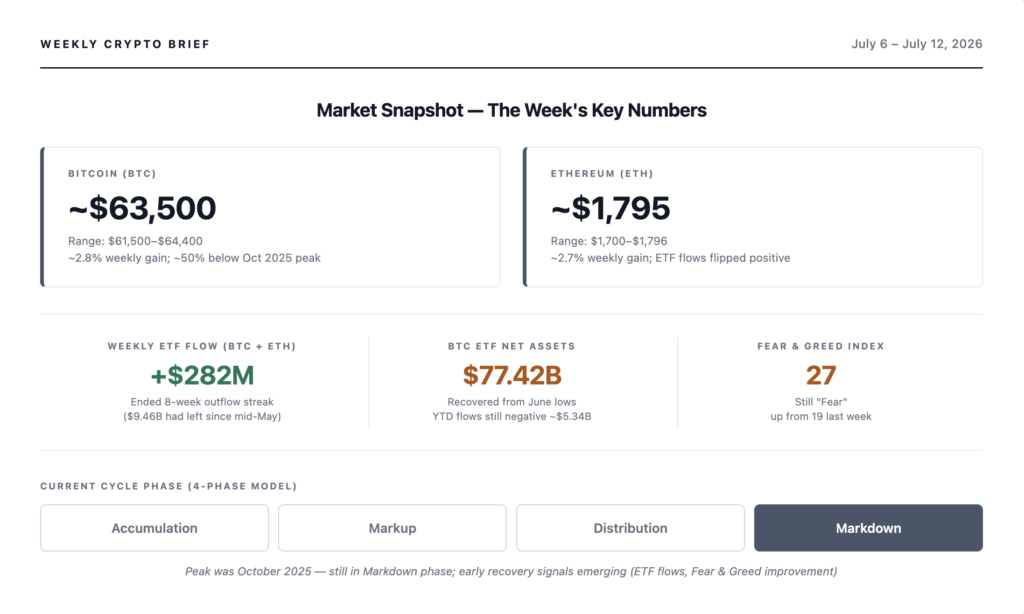
Bitcoin spent the week clawing back from last Sunday’s 21-month low near $58,000, ending around $63,500 after a mid-week peak above $64,400. Ethereum recovered to just under $1,800, up 2.7% on the week. The big story wasn’t the price — it was underneath it. After eight consecutive weeks of outflows totaling roughly $9.46 billion, spot Bitcoin and Ethereum ETFs flipped positive at the same time.
This is your week in crypto for the week ending Sunday, July 12, 2026. What actually moved. What matters for beginners. What’s noise dressed up as news.
When I started using crypto in 2017, one lesson that took me longer than it should have was to weigh streaks over headlines. One good ETF day is a headline. Eight bad weeks followed by one good week is a streak break, and streak breaks matter more — they’re the market changing its mind, not just its mood.
TL;DR
- Bitcoin recovered from a 21-month low near $57,950 last Sunday to ~$63,500 by Friday, briefly touching $64,400 mid-week. Weekly gain: ~2.8%.
- Spot ETFs flipped positive for the week — combined ~$282M inflows across Bitcoin and Ethereum ETFs, ending an eight-week outflow streak that had drained $9.46B.
- CLARITY Act enters its make-or-break window. Senate returns from recess Monday, July 13. Analysts identify three usable weeks before August recess as the last realistic gate for 2026 passage.
- Trump’s crypto income hit $1.4B in 2025 per his July 1 financial disclosure — now the central sticking point blocking Democratic votes on CLARITY.
- Strategy officially sold 3,588 BTC for $216M — its first Bitcoin sale since 2022, to cover interest payments. Michael Saylor’s “never sell” thesis has publicly cracked.
- 17 major banks including HSBC, UBS, Wells Fargo, and Citi are preparing to pilot Swift’s new blockchain payments platform.
- Fear & Greed Index rose to 27 — still fear, but up from 19 last week. Cautious recovery, not conviction.
Bitcoin’s recovery week
The proximate cause of the bounce was macro, not crypto. Fed Chair Kevin Warsh’s dovish comments at Sintra last week set the tone. A softer-than-expected June jobs report (57,000 jobs vs the ~100,000 forecast) reinforced the “Fed can stay patient” read. Together, those reduced the odds of further rate hikes and gave risk assets — including Bitcoin — room to breathe.
Bitcoin moved from ~$58,000 on Sunday to a mid-week high above $64,400 before settling around $63,500. Ethereum tracked similarly, ending near $1,795. Solana recovered to the high-$70s. All three major assets participated, which matters — narrower recoveries where only Bitcoin moves usually fade faster.
Worth noting for context: Bitcoin has now spent 307 days in the $60,000–$70,000 range — the third-longest consolidation Bitcoin has ever done in any single $10,000 price band. Consolidations can resolve in either direction, and long consolidations sometimes precede large moves. But the direction of that resolution isn’t something anyone can call in advance.
In plain English: Bitcoin didn’t rally because of anything crypto-specific. It rallied because macro conditions became slightly less hostile. That’s a real move, but it’s not the same as fundamental strength returning. Track whether next week’s flows and price confirm this or fade it.
What it means for beginners: When the same asset moves for two different reasons in two consecutive weeks — down on macro fears, then up on macro relief — the fundamental story hasn’t actually changed. The market has just shifted its attention. Learning to separate “the story has changed” from “the mood has changed” is one of the highest-leverage skills in crypto investing.
The ETF flow flip
This is the more interesting story than the price. For eight consecutive weeks — starting mid-May — spot Bitcoin and Ethereum ETFs had bled capital every single week. The combined damage: roughly $9.46 billion in net outflows, split between $8.26B out of Bitcoin ETFs and $1.35B out of Ethereum ETFs. The worst week was the one ending June 26, when Bitcoin ETFs alone shed $1.79B.
For the week of July 7-11, both flipped positive at once:
- Bitcoin ETFs: +$197.4M
- Ethereum ETFs: +$84.4M
- Combined: +$282M
Bitcoin ETF net assets recovered to $77.42 billion. Ethereum ETF assets recovered to $9.59 billion. Fidelity’s FBTC led the Bitcoin side. BlackRock’s IBIT — the largest spot Bitcoin ETF — also contributed meaningfully to the reversal. On the Ethereum side, BlackRock’s ETHA led.
But keep the scale in perspective: the $282M inflow represents only about 3% of the $9.46B that left. Bitcoin ETFs remain down roughly $5.34 billion year-to-date; Ethereum ETFs are down about $1.35 billion. A single positive week doesn’t undo eight negative ones.
In plain English: Spot ETFs are the primary way institutional and mainstream investors buy Bitcoin and Ethereum through regular brokerage accounts. Their weekly flows track institutional sentiment in near-real-time. Eight weeks of outflows meant institutions were quietly rethinking their crypto allocation. This week’s turn means some of them re-engaged. Whether that continues or fades will define the next few weeks.
What it means for beginners: Don’t treat one good week as a bottom signal, and don’t treat one bad week as the end of the cycle. Weekly ETF flows are a useful sentiment gauge precisely because they aggregate what a lot of professional investors are actually doing with money — not just what they’re saying on TV.
CLARITY Act enters its make-or-break window
Backdrop: the CLARITY Act (H.R. 3633, formally the Digital Asset Market Clarity Act) is the primary US bill for federal crypto market structure. It would draw clean lines between what the SEC regulates (securities) and what the CFTC regulates (commodities). Industry has treated it as the number-one regulatory priority for years.
The Senate returns from its Fourth of July recess tomorrow, Monday, July 13, 2026. The merged compromise text — reconciling the Senate Banking Committee version with the Senate Agriculture Committee’s companion measure — is expected to land the week of July 13.
Analysts across Wall Street and Washington converge on roughly the same view: the Senate has about three usable weeks of floor time before the August recess. Missing that window doesn’t kill the bill, but it makes 2026 passage significantly harder. Senator Cynthia Lummis has warned that a failure this summer could push comprehensive federal crypto regulation as far out as 2030.
The math problem: Republicans hold 53 Senate seats. Senators Josh Hawley and Rand Paul are expected to vote no. That leaves the bill needing seven to nine Democratic crossover votes to reach the 60-vote filibuster threshold. Currently, only two Democrats — Ruben Gallego (Arizona) and Angela Alsobrooks (Maryland) — have publicly backed the bill, both with conditions.
Prediction markets: Polymarket odds sit at approximately 48% for 2026 passage, down from 74% a month ago. Galaxy Research: roughly 50-50.
In plain English: The bill’s technical merits aren’t really what’s blocking it. Three specific political disputes are — and they’re all essentially about who benefits from crypto regulation and how much. Even in a favorable political environment, passing complex 60-vote legislation takes time and floor debate. That time is now measured in days.
What it means for beginners: When you hear commentary about “regulatory certainty coming to crypto,” pay attention to the actual vote counts, not the vibes. The industry has been “days away” from regulatory clarity for three years. What’s different this month is that the calendar is now doing the enforcement.
The three disputes blocking CLARITY
Since these disputes will drive next week’s coverage, worth breaking down briefly:
1. Ethics rules and Trump’s crypto income. President Trump’s July 1 financial disclosure showed approximately $1.4 billion in cryptocurrency-related income during 2025, including $635M from $TRUMP meme coin licensing and more than $500M from World Liberty Financial token sales. Multiple Democratic senators — Kirsten Gillibrand explicitly, others implicitly — have said an enforceable ethics provision barring government officials from personal crypto holdings while in office is a prerequisite for their support. The White House opposes any provision targeting the president’s personal holdings. An ethics amendment from Senator Chris Van Hollen failed 13-11 in the Banking Committee on party lines.
2. Section 604 — developer protections. This provision would shield non-custodial software developers (people who write code but don’t hold customer assets) from being classified as money transmitters. The DeFi industry considers this existential. Law enforcement — the National District Attorneys’ Association, National Sheriffs’ Association, and others — has written to Senate leaders opposing the language, arguing it would impede crypto-related criminal investigations. Senators Mark Warner and Catherine Cortez Masto have tied their floor support to law enforcement’s sign-off.
3. Stablecoin yield loophole. The American Bankers Association argues the current text creates a loophole for interest-equivalent yields outside limits set by the earlier GENIUS Act. Coinbase alone earns roughly $1.35 billion annually in USDC rewards revenue — the economic stakes for the industry on this specific carve-out are significant.
Any one of these can be resolved with a floor amendment. Resolving all three, drafting them into text, and getting them through cloture and a final vote before August recess is a genuinely tight calendar.
Strategy blinked — officially
Last week we noted Strategy (formerly MicroStrategy) had reportedly sold some Bitcoin for the first time since 2022. This week the details were confirmed: Strategy sold 3,588 BTC for approximately $216 million to cover interest payments on its outstanding debt.
For context: Strategy holds roughly $51 billion in BTC on its balance sheet. Selling 3,588 coins — a fraction of a percent of holdings — is small in relative terms. But symbolically, it ends a five-year run in which Michael Saylor’s public position was “never sell.” The sale followed Strategy’s mNAV (market-to-Bitcoin-holdings ratio) falling below 1.0, which made new share issuance dilutive rather than accretive to per-share Bitcoin holdings.
In plain English: When your only viable financing model breaks (issuing shares to buy more Bitcoin), and you still have interest payments due, you sell some of the Bitcoin. That’s not a rejection of Bitcoin. That’s how corporate finance works when the math turns.
What it means for beginners: Every conviction-based strategy has breaking points. Even the loudest “never sell” positions bend when financial reality demands it. Plan for your own breaking points — the market volatility, life circumstances, or financial pressure that would force you to sell — before you actually hit them.
Ethereum’s mixed week
Ethereum’s ETF flows flipped positive alongside Bitcoin’s, and ETH price recovered to around $1,795. But three developments this week are more interesting than the price:
AI found a real Ethereum validator bug. The Ethereum Foundation coordinated multiple AI agents against the client software Ethereum validators run and produced a remotely triggerable crash — a genuine bug that could have taken validators offline. The AI also produced hundreds of confident-sounding false positives that humans had to sort through. It’s a preview of where security research is heading: AI-augmented, but humans still needed for validation.
Ethereum Foundation, BitMine keeps buying. BitMine added another 42,197 ETH last week, bringing total corporate treasury holdings to 5.74 million ETH. Corporate ETH treasury demand continues quietly through the price weakness.
Glamsterdam upgrade still on track for H2 2026. Testnet deployment targeted July-August. The upgrade’s two headline proposals — EIP-7732 (Enshrined Proposer-Builder Separation) and EIP-7928 (Block-Level Access Lists) — remain on schedule.
Swift plugs into blockchain
Genuinely major banking story that got surprisingly quiet coverage: 17 major banks are preparing to pilot Swift’s new blockchain payments platform. The participant list is heavyweight — HSBC, UBS, Wells Fargo, Citi, and 13 others. Swift is the messaging network that underpins roughly $150 trillion in annual cross-border payments; adding blockchain-based settlement is a foundational infrastructure change.
The pilot doesn’t involve Bitcoin or public blockchains directly. It involves tokenized digital assets running on a Swift-managed blockchain layer. But the direction of travel is what matters: the largest bank consortium in global finance is committing serious pilot resources to blockchain-based settlement infrastructure.
In plain English: For years, “crypto adoption by banks” has been mostly narrative — a few working groups, some pilots, no live products. Swift moving 17 major banks into a live pilot changes the base rate. Once the payment layer that most of global finance already uses runs blockchain settlement, the distinction between “crypto” and “banking infrastructure” starts to blur.
Quick hits
Bitget Wallet crosses 100 million users. Daily payment users now outnumber traders for the first time — a milestone that suggests crypto wallets are becoming everyday spending infrastructure in emerging markets. Southeast Asia card spending was up 416% in H1 2026.
Solana Alpenglow upgrade coming Q3. Solana co-founder Anatoly Yakovenko confirmed at Consensus Miami 2026 that the Alpenglow consensus upgrade could ship as early as Q3 2026, cutting transaction finality from approximately 12.8 seconds to 150 milliseconds.
Metaplanet exploring BTC-backed credit in Japan. The Japanese Bitcoin treasury company is working with JPYC and Progmat to launch tokenized credit products backed by Bitcoin — potentially creating 24/7 credit markets in Japan.
US temporary CBDC ban. A provision in the housing bill going into effect this week temporarily bars the US government from issuing a central bank digital currency. Trump refused to sign the underlying bill, but it took effect via bipartisan congressional override.
Alaska Bitcoin ATM enforcement. Alaska has become the first US state to enforce criminal Bitcoin ATM statutes with civil penalties — a small but notable state-level regulatory step.
What this actually means, if you’re a beginner
Four things worth pulling out of this week:
- Streak breaks matter more than single-day noise. Eight weeks of outflows flipping to inflows is a change in institutional posture, not just a mood swing. Whether it holds — that’s next week’s story.
- Regulation is finally at the negotiating table, not just in the queue. The CLARITY Act won’t necessarily pass. But the three disputes blocking it are all specific and negotiable, and the calendar is now doing the forcing function. Watch the merged draft text this week.
- Even legendary “hold forever” strategies have breaking points. Strategy’s sale is a reminder that no thesis is immune to real-world financial pressure. Design your own crypto strategy assuming your circumstances might change.
- Bank infrastructure is quietly integrating. Swift moving 17 major banks into a blockchain payment pilot is the kind of story that reads slow but compounds fast. Watch this space over months, not weeks.
Bottom line
Bitcoin bounced, ETF flows flipped, Ethereum’s institutional pipeline kept building, CLARITY hits its real deadline, Strategy blinked officially, and Swift quietly moved 17 major banks into blockchain infrastructure. That’s your week.
Don’t check the price on Monday. If you have a dollar-cost averaging plan, stick to it. If you’re still figuring out how crypto wallets work or how to buy safely, those are useful weekend reads.
See you next Sunday.
A note on financial advice
This article summarizes news, not recommendations. Nothing here is a suggestion to buy, sell, or hold any specific cryptocurrency. Crypto markets are volatile and genuinely risky. Only put in what you can afford to lose entirely, and make your own decisions based on your own situation.