XRP is a cryptocurrency built for banks — and that alone makes it different from anything else in this guide. Most cryptocurrencies were designed to route around banks. XRP was designed to work with them.
This guide answers what is XRP, how the XRP Ledger works, why Ripple Labs (the company) is not the same thing as XRP (the token), and what’s actually happening in 2026 — including the awkward reality that Ripple’s business is thriving while XRP itself has had a rough year.
I’ve watched XRP through two full market cycles now. It’s the token I’ve seen more people misunderstand than any other. Not because XRP is complicated, but because the story around it is unusually tangled — a company, a token, a blockchain, and a stablecoin all sharing the same brand. Let’s untangle it.
TL;DR
- XRP is a cryptocurrency, and the XRP Ledger is the decentralized blockchain it lives on.
- Ripple Labs is a for-profit company that created XRP and drives most of its institutional adoption. Ripple and XRP are not the same thing — this distinction matters more here than it does for Bitcoin or Ethereum.
- The XRP Ledger is fast (3–5 second finality) and cheap ($0.0002 per transaction).
- XRP was designed for cross-border payments, but real-world XRP-token usage in payments is more limited than the marketing suggests.
- Ripple’s RLUSD stablecoin — market cap around $1.7 billion in August 2026 — has been more successful at institutional adoption than XRP itself.
- XRP has had a rough year. Down ~43% in 2026 and ~70% from its July 2025 peak of $3.65.
The one-sentence version
So, what is XRP in one sentence?
XRP is a decentralized cryptocurrency built for cross-border payments, created and heavily supported by a for-profit company called Ripple Labs — a relationship you need to understand to think about XRP clearly.
That last bit — the Ripple Labs relationship — is where most beginner explainers wave their hands and move on. I don’t want to do that here, because it’s the part that actually matters when you’re deciding whether XRP makes sense to you.
XRP vs Bitcoin, Ethereum, Solana — a different design philosophy
Every major cryptocurrency is a bet about what crypto is for. XRP’s bet is unusual.
Bitcoin is decentralization-first. Its whole point is that no company, government, or foundation can control it. Slow, expensive, deliberately conservative — that’s the tradeoff Bitcoin makes on purpose.
Ethereum is programmability-first. It exists so developers can build smart contracts and applications on top of it. Speed and cost matter, but flexibility matters more.
Solana is speed-first. Thousands of transactions per second, sub-cent fees, at the cost of a more complex validator setup and occasional network outages.
XRP is institution-first. It was designed from day one to appeal to banks, payment providers, and regulated financial institutions. Fast settlement, tiny fees, a governance model that regulators find easier to understand, and a company (Ripple Labs) whose entire business is selling this stuff to institutions.
That’s a real tradeoff. XRP gains institutional credibility — a Deutsche Bank compliance officer can meet with Ripple Labs in a way they simply cannot meet with “Bitcoin.” But XRP loses some of the pure-decentralization mystique that Bitcoin holders care about. Ripple Labs’ role as a major XRP holder, primary developer, and business development engine gives one entity more influence over XRP than any single organization has over Bitcoin or Ethereum.
This isn’t a rivalry — it’s a different bet about who crypto is for. If you think crypto’s future is retail users escaping the traditional financial system, Bitcoin’s your answer. If you think it’s programmable money and applications, that’s Ethereum. If you think it’s institutions rebuilding their payment rails on faster, cheaper infrastructure, that’s the bet XRP is making.
For a comparison of the programmability-first approach, see what is Ethereum. For the speed-first approach, see what is Solana.
That’s the tradeoff. Institutional-first vs anyone-first.
The Ripple Labs vs XRP distinction
This is the section most XRP explainers skip. It shouldn’t be skipped.
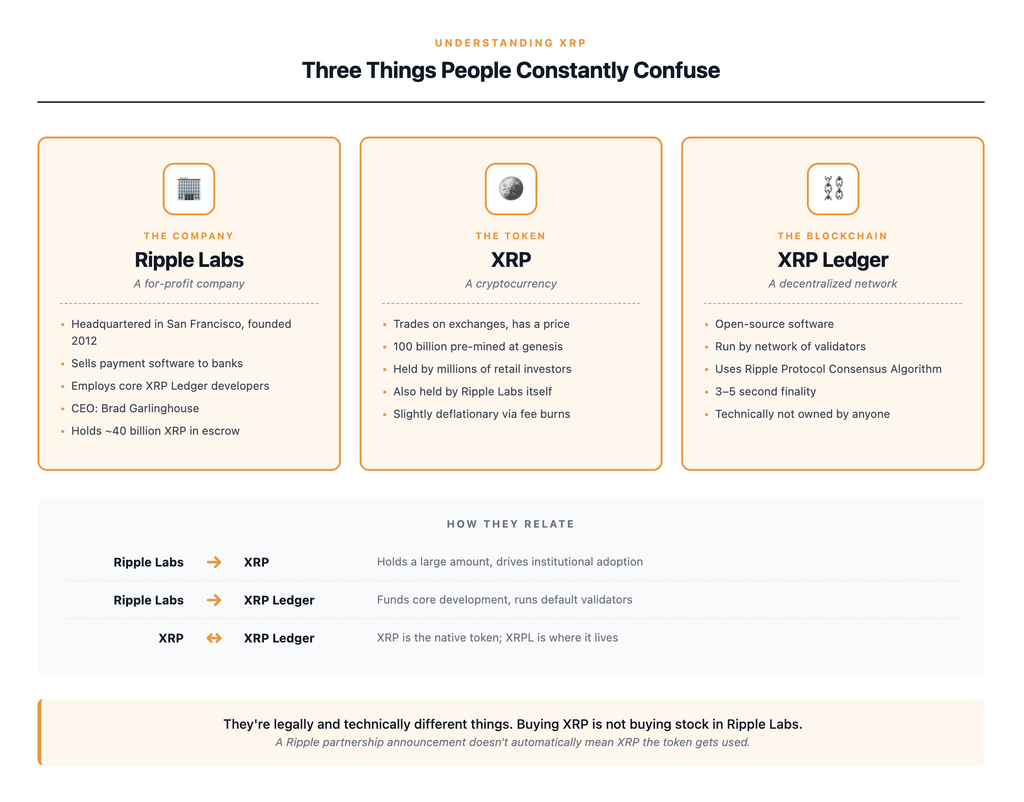
Here are three things people constantly confuse:
- Ripple Labs — the for-profit company, headquartered in San Francisco, founded in 2012. Sells payment software to banks. Employs the core XRP Ledger developers. Has a CEO (Brad Garlinghouse), investors, and a business model.
- XRP — the cryptocurrency token. Trades on exchanges. Has a price. Held by millions of retail investors and, notably, by Ripple Labs itself.
- XRP Ledger (XRPL) — the decentralized blockchain that XRP runs on. Open-source software, run by a network of validators, technically not owned by anyone.
Ripple Labs did not “invent” the XRP Ledger in the way Satoshi invented Bitcoin — the XRPL was built by David Schwartz, Jed McCaleb, and Arthur Britto, who then handed 80 billion of the 100 billion pre-mined XRP to a company that became Ripple Labs. Schwartz remains Ripple’s CTO today; McCaleb left Ripple in 2013 and went on to co-found Stellar (XLM), a competing blockchain with architectural DNA from the same design tradition; Britto stepped back from public involvement.
That’s the origin story, and it explains everything downstream.
Ripple Labs has more influence over XRP than any company has over Bitcoin or Ethereum because:
- It holds roughly 40 billion XRP in escrow, released on a monthly schedule that increases circulating supply over time.
- It funds most of the core development work on the XRP Ledger.
- It drives essentially all of the major institutional partnerships you hear about (Deutsche Bank, SBI, Mastercard, etc.).
- Selling XRP has historically been one of its revenue sources.
Is this bad? Not necessarily. It just means XRP is a different kind of asset than Bitcoin. Bitcoin has no company behind it, no marketing budget, no institutional sales team. That’s a feature to Bitcoin holders and a bug to XRP holders — which is fine. They’re different bets.
But here’s the honest version: when someone says “Ripple just signed a deal with Bank X,” that is not automatically a deal that increases demand for XRP the token. Sometimes it is. More often, in 2026, it isn’t. We’ll get to that.
The “not your keys, not your coins” purists give Bitcoin a hard look on self-custody. XRP requires a slightly different frame — you can absolutely self-custody your XRP, but the asset itself is more entangled with a single company than most cryptocurrencies. That’s the honest picture. Neither shill nor smear.
How XRP actually works
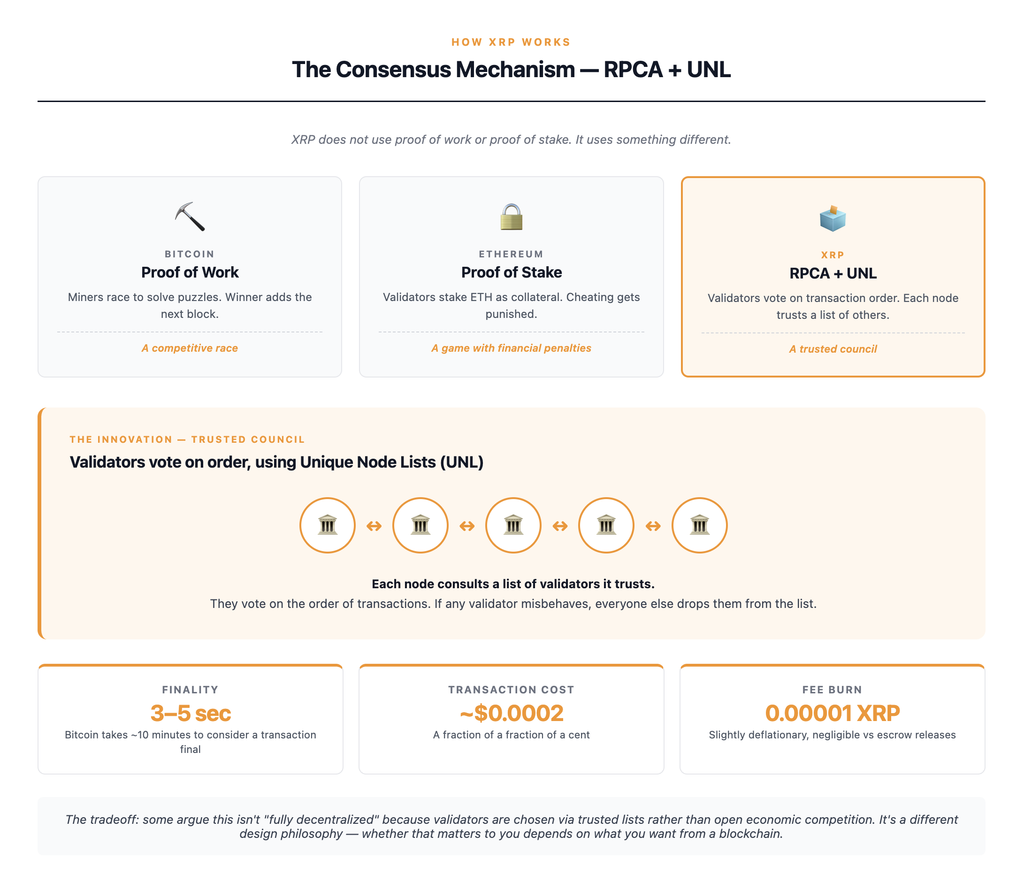
That’s what is XRP at the mechanism level: not proof of work, not proof of stake, but something called the Ripple Protocol Consensus Algorithm (RPCA).
Here’s the plain-English version. Bitcoin uses miners racing to solve puzzles. Ethereum uses validators who stake ETH as collateral. XRP does neither. Instead, XRPL validators vote on the order of transactions, and they trust each other via something called a Unique Node List (UNL) — essentially a list of validators each node considers trustworthy.
Think of it like a trusted council. Bitcoin miners are a competitive race. Ethereum stakers are a game with financial penalties. XRPL validators are more like a group of institutions who agree to check each other’s work honestly, and if any of them starts misbehaving, everyone else drops them from their list.
What this gets you:
- Finality in about 3–5 seconds, versus roughly 10 minutes for a Bitcoin transaction to be considered final.
- Transaction costs of about $0.0002, a fraction of a fraction of a cent.
- A tiny XRP burn on every transaction — 0.00001 XRP is destroyed each time, making XRP slightly deflationary. I say “slightly” because the burn amount is negligible compared to escrow releases.
What it costs you: some purists argue this isn’t “fully decentralized” because validators are chosen via trusted lists rather than open economic competition. Ripple Labs itself now runs a minority of the default validators, but the design philosophy is still fundamentally different from Bitcoin’s. Whether that matters to you depends on what you want from a blockchain.
The 100 billion XRP that will ever exist were all created at genesis. There is no mining, no new issuance from consensus — just the fixed supply, minus the tiny burns, with Ripple’s escrow releasing chunks each month.
What XRP is used for — narrative vs reality
Now for the section where I stop being diplomatic.
The marketing story: XRP is a “bridge currency” for cross-border payments. When Bank A in the US wants to send money to Bank B in the Philippines, they can use XRP as an intermediate step — dollars to XRP, XRP to pesos — completing in seconds instead of days.
The reality is more nuanced. Ripple has a product called On-Demand Liquidity (ODL) that genuinely does use XRP as this bridge currency in some corridors. That is a real thing that happens.
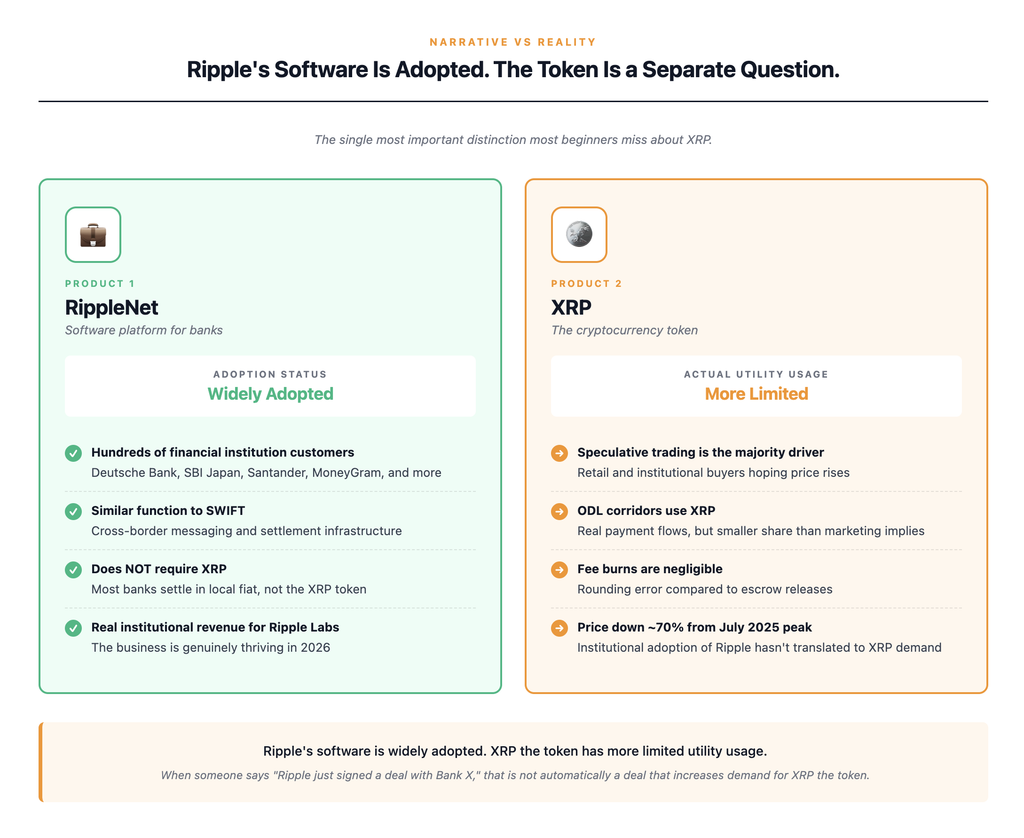
But Ripple also has a bigger product called RippleNet — a software platform that banks use for cross-border messaging and settlement, similar to how SWIFT works. RippleNet does not require XRP. Most banks using RippleNet settle in local fiat, not XRP.
This is the distinction most beginners miss:
- Ripple’s software is widely adopted. RippleNet has hundreds of financial institution customers.
- XRP the token has more limited utility usage. Most XRP trading volume is speculative, not payments-related.
So what actually drives demand for XRP today?
- Speculative trading — retail and institutional buyers hoping the price goes up. This is the majority.
- ODL corridors — real payment flows using XRP as a bridge, but a smaller share than marketing implies.
- Transaction fee burns — negligible impact on supply.
For years, the XRP thesis has been: “Eventually, institutional adoption will translate into massive XRP demand, and the price will follow.” That thesis has been consistent since about 2018. It has not played out. Price movements have tracked crypto market cycles more than they’ve tracked institutional adoption of Ripple’s software.
I’m not saying it can’t happen. I’m saying if you’re buying XRP, you should be honest about the fact that you’re buying a bet on a future demand story that hasn’t materialized yet — not an established cash flow. All crypto has this element, but XRP more than most, because the disconnect between “Ripple wins deals” and “XRP goes up” has been real and measurable.
Speaking of measurable disconnects, we need to talk about RLUSD.
RLUSD — the stablecoin that’s beating XRP
This is where the story gets uncomfortable for XRP holders.
RLUSD is Ripple’s US-dollar-pegged stablecoin. It launched in December 2024. As of August 2026, its market cap sits around $1.7 billion, with 84,189 holders and monthly transfer volume of about $9.75 billion (data from RWA.xyz). Q1 2026 was its biggest quarter yet, with $18.4 billion in transfer volume.
The backing is conservative: cash and short-term US Treasury bonds, held at BNY Mellon. It has NYDFS approval (the New York regulator that oversees stablecoins), and Ripple recently received OCC trust bank charter approval — meaning Ripple can operate as a federally regulated trust bank in the US.
RLUSD is not just on the XRP Ledger — it’s also live on Ethereum, and on Layer 2 networks like Base, Optimism, Unichain, and Ink, bridged via Wormhole’s Native Token Transfers system.
The institutional adoption list is long and, frankly, impressive:
- Deutsche Bank integrated RLUSD for cross-border payments.
- SBI Japan began distribution in Q1 2026.
- Mastercard partnered via the Gemini Credit Card in late 2025.
- BlackRock uses RLUSD as a redemption mechanism for its BUIDL tokenized fund.
- LMAX Group holds it as a core collateral asset.
- Société Générale’s euro stablecoin, EURCV, launched on the XRP Ledger in February 2026.
- On May 6, 2026, JPMorgan, Mastercard, and Ondo Finance settled a cross-border tokenized Treasury transaction using RLUSD.
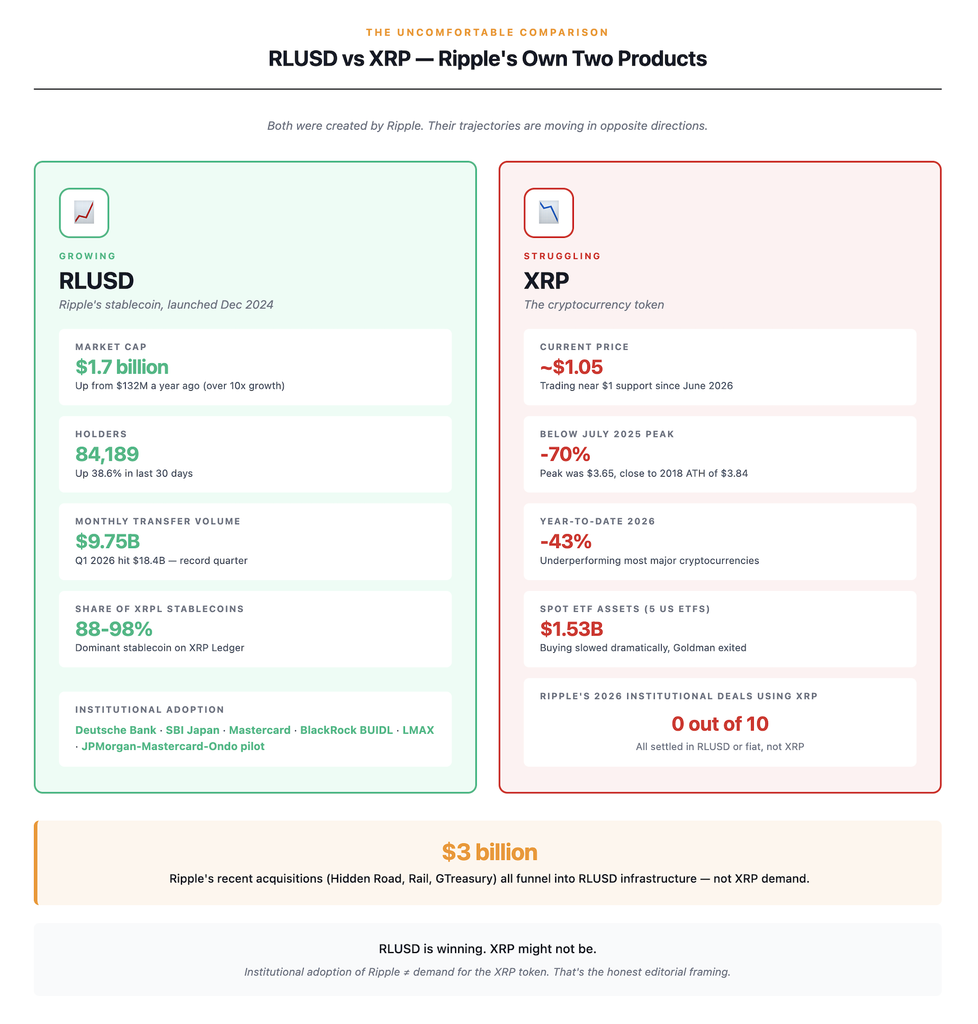
Here’s the uncomfortable truth: Ripple closed ten major institutional deals in 2026. None of them used XRP as the settlement asset. They used RLUSD, or they used Ripple software with fiat currencies.
Ripple has spent roughly $3 billion on acquisitions — Hidden Road (prime brokerage), Rail (cross-border payments), and GTreasury — and all of these acquisitions plug into RLUSD infrastructure, not XRP demand.
RLUSD now holds somewhere between 88% and 98% of all stablecoin liquidity on the XRP Ledger. The only XRP demand it generates is the negligible 0.00001 XRP burn per transaction — a rounding error at any realistic volume.
What does this mean for XRP holders? Institutional adoption of Ripple is real and accelerating. Institutional adoption of XRP the token is a separate question — one Ripple’s own product strategy is not clearly answering in XRP’s favor.
RLUSD is winning. XRP might not be. That’s the honest editorial framing and I’m not going to soften it because that’s what you’re here for.
The state of XRP in 2026 (honest edition)
Let’s look at the numbers.
Price: XRP set its true all-time high of $3.84 back in January 2018 — a record that stood for over seven years. It came within striking distance again in July 2025, peaking at $3.65 before turning down. As of mid-August 2026, XRP trades around $1.05 — roughly 70% below the July 2025 peak and about 43% down year-to-date. Many XRP holders who bought during the 2024-2025 rally are currently underwater on their positions.
ETFs: Five spot XRP ETFs launched in the US in late 2025 and now hold roughly 978 million XRP with about $1.53 billion in assets. That’s meaningful, but not enormous by ETF standards — and buying has slowed dramatically since the launch window, with Goldman Sachs already exiting its position. ETF launches were supposed to be a major bull catalyst. The price action suggests the market has priced them in without much lift.
The RLUSD paradox: Ripple’s ecosystem is thriving. XRP is not benefiting proportionally. This has been true for roughly two years now.
The SEC case (the short version):
The SEC sued Ripple Labs in December 2020, alleging that XRP was an unregistered security (original SEC filing). This case dragged on for years and hung over the entire US crypto industry. In July 2023, Judge Analisa Torres ruled that XRP is not a security when sold to retail investors on secondary markets — a major win for XRP holders — but that Ripple’s direct institutional sales had been unregistered securities offerings. After both parties initially appealed, the case was formally closed in August 2025, with Ripple paying a $125 million penalty and accepting a permanent injunction on direct institutional XRP sales.
The immediate impact: XRP became clearly legal to trade in the US, US exchanges relisted it, and Ripple could operate without existential legal risk. The broader impact: the case shaped how the SEC has approached the crypto industry ever since, and the “sold on secondary markets” distinction from that ruling has been cited in other cases.
What XRP holders should honestly consider:
- Ripple’s institutional success has not translated to XRP price appreciation for going on two years now.
- RLUSD’s growth is neutral-to-bearish for XRP token demand — it uses XRPL infrastructure but doesn’t generate meaningful XRP buying pressure.
- The “utility unlock eventually pumps the price” thesis has been stated for years. It hasn’t materialized.
- But — infrastructure adoption is real, regulatory clarity is improving, and long-term outcomes are genuinely uncertain.
Whether Ripple’s institutional wins eventually translate to XRP token demand is the question every XRP holder is trying to answer. Nobody knows yet. And anyone who tells you they know is selling you something.
How to hold and use XRP
If you already own XRP or are considering it, here’s the practical layer.
Buying: XRP is available on most major exchanges — Coinbase, Kraken, and Binance all support it. For most beginners, buying through a regulated exchange and then moving XRP to a self-custody wallet is the safer path. If you’re new to buying crypto in general, the safer-onboarding guide is over here: how to buy crypto safely.
Self-custody wallets: For XRP specifically, the most popular self-custody wallet is Xumm — it’s designed specifically for the XRP Ledger and handles the XRPL’s specific quirks well. For larger amounts, hardware wallets like Ledger and Trezor both support XRP. The general wallet primer is here: how crypto wallets work.
The XRPL account reserve: Here’s something specific to the XRP Ledger that catches beginners off guard. Every XRPL account needs to hold a minimum reserve of 10 XRP to exist on the network. This isn’t a fee — you get it back if you close the account — but it means you can’t send all your XRP out of a wallet. If you have 10 XRP and try to send 10 XRP, the transaction will fail. Small thing, but confusing the first time it happens.
Trust lines: Another XRPL-specific concept. If you want to hold non-XRP assets on the XRP Ledger (like RLUSD, or tokenized stocks issued on XRPL), you first have to establish a “trust line” with the issuer. It’s a one-time setup that tells the network you’re willing to receive that specific asset. You don’t need to worry about this for holding plain XRP, but you will hit it the first time you try to receive a token on XRPL.
Staking: Here’s a straightforward answer that a lot of XRP content dodges. XRP doesn’t have traditional staking. The XRPL uses a consensus mechanism that doesn’t require locking tokens as collateral, so there’s no protocol-level staking yield. Some centralized exchanges offer “XRP yield” products, but those are lending programs, not staking — you’re loaning your XRP to the exchange or their counterparties, which adds counterparty risk on top of everything else. Read the fine print carefully if you go this route.
Using it: If you own XRP, the most direct use is sending it — payments to another XRPL address settle in a few seconds for a fraction of a cent. Beyond that, honestly, most XRP holders hold and don’t use. Which is fine, but worth naming.
Holding XRP is a starting point. What Ripple’s institutional ecosystem does with the XRP Ledger over the next few years will determine whether that starting point translates into anything more.
Common questions
Is XRP the same as Ripple?
No, and this is the single most common confusion. Ripple (technically Ripple Labs) is the for-profit company. XRP is the cryptocurrency token. The XRP Ledger is the blockchain XRP runs on. Ripple Labs holds a lot of XRP and drives most of its institutional adoption, but they’re legally and technically different things. When you buy XRP on an exchange, you’re not buying stock in Ripple Labs. When Ripple signs a partnership with a bank, that doesn’t automatically mean XRP the token gets used.
Is XRP a good investment?
We don’t give investment advice — but we can tell you what buying XRP is actually a bet on. It’s a bet that Ripple’s institutional partnerships will eventually translate into meaningful demand for XRP the token, driving the price up. That thesis has been consistent for years. It has not played out. XRP is down roughly 70% from its July 2025 peak of $3.65, and Ripple’s recent product strategy (heavily favoring RLUSD over XRP) is making the “utility unlock” thesis harder to argue, not easier. There are still credible bulls, but the burden of proof has shifted. Reasonable people disagree on how this ends.
What happened with the SEC case?
The SEC sued Ripple in December 2020, alleging XRP was an unregistered security. In July 2023, a US federal court ruled that XRP is not a security when traded on secondary markets (a win for retail holders), but that Ripple’s direct institutional sales had been unregistered securities offerings (a partial loss for Ripple). Both parties appealed, but the case was formally closed in August 2025 after both sides dropped their appeals. Ripple paid a $125 million penalty and agreed to a permanent injunction on direct institutional XRP sales. XRP is legal to trade in the US, and US exchanges relisted it after the July 2023 ruling. The case shaped broader SEC enforcement patterns for years.
What’s RLUSD, and how does it affect XRP?
RLUSD is Ripple’s US-dollar-pegged stablecoin, launched in December 2024. As of mid-2026, it has a market cap of about $1.7 billion and is Ripple’s fastest-growing institutional product. Here’s the honest answer to how it affects XRP: it uses the XRP Ledger, which generates a small amount of transaction fee burn (negligible), but it doesn’t create meaningful buying pressure for XRP the token. In fact, RLUSD has been replacing XRP in Ripple’s institutional deals — none of Ripple’s ten major 2026 partnerships used XRP as the settlement asset. If you’re an XRP holder, RLUSD is best understood as a competing product for Ripple’s institutional attention, not a driver of XRP demand.
Can I stake XRP?
Not in the traditional sense. The XRP Ledger doesn’t use proof of stake, so there’s no protocol-level staking that rewards you with more XRP for locking up your holdings. Some centralized exchanges offer “XRP yield” or “XRP earn” products, but those are lending programs where the exchange (or their partners) borrows your XRP in exchange for interest. That comes with counterparty risk that direct XRP holding does not. If you’re comfortable with that risk and the rates are competitive, it’s an option — but understand you’re taking on a lending relationship, not participating in network consensus.
Is XRP a stock?
No. XRP is a cryptocurrency (a digital token), not a stock. When you
buy XRP on an exchange, you’re not buying ownership in Ripple Labs
the company. XRP has no dividends, no shareholder voting rights, and
no company earnings backing it — it’s a digital asset whose value
comes from market supply and demand.
Where to go from here
You now have the answer to “what is XRP” — the token, the network, the company that drives it, and the honest state of it in 2026. XRP is easier to understand once you also see how other major cryptocurrencies think about the same problems. A few natural next reads:
- What is Ethereum — programmability-first design, no company behind it. A very different bet than XRP.
- What is Solana — speed-first design, also with more institutional traction than most people realize. Closer to XRP in some ways than to Bitcoin.
- What is Bitcoin — the pure decentralization-first approach. The philosophical opposite of XRP’s institutional-first bet.
- How crypto wallets work — for setting up Xumm or a hardware wallet to hold XRP safely.
- How to buy crypto safely — if you don’t have any XRP yet, this is where to start.
A note on financial advice
This article is for education, not financial advice. I’m explaining what XRP is as a network and what XRP is as an asset — not telling you whether to buy XRP, hold it, or sell it. XRP has real technical risks (its consensus mechanism is different from most cryptocurrencies and has different tradeoffs), real regulatory risks (the SEC case is settled but the crypto regulatory landscape continues to shift), real concentration risks (Ripple Labs’ influence over XRP is meaningfully greater than any company’s influence over Bitcoin or Ethereum), and real product-strategy risks (Ripple’s heavy investment in RLUSD may continue to divert institutional attention away from XRP the token). Only invest amounts you can afford to lose entirely, verify every URL before connecting your wallet to any application, and make your own decisions based on your own situation.