A quieter week than last week’s fireworks, but with a genuinely important theme underneath: markets got exactly the inflation data they wanted, and the rally still didn’t happen. This weekly crypto brief opens with three intertwined stories. First: July’s CPI came in exactly at expectations on Wednesday, and Bitcoin — instead of rallying — actually slipped back. Second: the CLARITY Act now has a hard September 15 procedural vote deadline set by Senate Majority Leader John Thune, and the White House says failure by that date effectively kills the bill for 2026. Third: the controversial BIP-110 Bitcoin fork attempt died with a whimper this week, mining only two blocks in eight hours before the network moved on without it.
This is your week in crypto for the week ending Sunday, August 16, 2026. What actually moved. What matters for beginners. What’s noise dressed up as news.
The theme of the week: the old relationships between macro data and crypto price action are weakening. Traders wanted a CPI-driven rally and didn’t get one. That’s a signal worth understanding — not because it predicts what comes next, but because it changes the mental model for how we read future data prints.
TL;DR
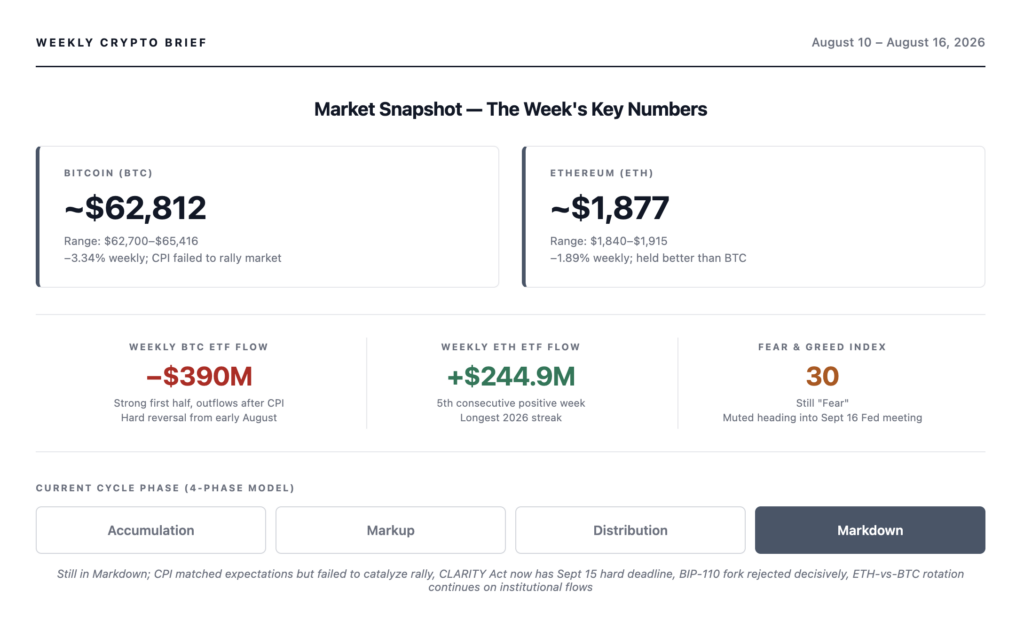
- July CPI came in exactly at expectations (0.1% MoM, 3.4% YoY headline, 0.2%/2.5% core) — and Bitcoin still slipped 3.34% on the week to around $62,800. The old cooling-inflation-equals-rally reflex is weakening.
- The CLARITY Act now has a September 15 procedural vote deadline. White House adviser Patrick Witt: “If they can’t get there by September 15, they never will.” Polymarket odds for 2026 passage have collapsed to about 10%.
- BIP-110 fork died on arrival. The controversial Bitcoin soft fork proposal designed to restrict Ordinals inscriptions attracted so little miner support that the forked chain mined just two blocks in eight hours before stalling. 99.85% of hashpower stayed with the main chain.
- Bitcoin ended the week at ~$62,812, down 3.34% weekly and still stuck in the $62-$65K range that has held since early August.
- Ethereum held up marginally better at ~$1,877, down 1.89% weekly, with ETH ETFs extending their positive streak to 5 consecutive weeks (~$244.9M inflows).
- BlackRock launched tokenized shares for six European money market funds on Ethereum — the tokenization theme keeps building regardless of price action.
- Fear & Greed Index sits around 30, still in “Fear” territory. Sentiment is muted heading into the September 16 Fed meeting.
The CPI print that didn’t rally the market
Wednesday’s July Consumer Price Index came in exactly where economists expected: headline inflation up 0.1% month-over-month and 3.4% year-over-year, with core inflation (excluding food and energy) up 0.2% monthly and 2.5% annually. On paper, that’s a soft, cooling inflation print — the kind of data that historically triggers relief rallies in risk assets.
Bitcoin’s response: a brief pop to $64,051 immediately after the release, then a slow bleed down to $62,812 by end of week. Not a rally. A rejection.
Two things worth understanding about this:
The old macro reflex is weakening. For most of 2024 and 2025, cooling inflation prints were a reliable buy signal for crypto — traders would front-run expected Fed cuts by piling into Bitcoin ETFs. That mechanical response has faded. As one analyst put it this week: “flows increasingly follow price momentum rather than macro releases.” A good CPI print no longer automatically triggers institutional buying.
Institutional flows reversed. US spot Bitcoin ETFs opened August with a strong $854M inflow week (the streak we covered last Sunday), then reversed hard after CPI. Strategy also added sell-side pressure with more Bitcoin disposals during the same window.
In plain English: In a normal cycle, in-line inflation would have Bitcoin at $67K+ right now. Instead it’s at $63K. That’s the market telling you it wants a different catalyst — probably a real Fed rate cut, not just data suggesting one might be coming.
What it means for beginners: If you were expecting the CPI report to change your investment thesis, you now have your answer. It didn’t. Watch the September 16 Fed meeting — that’s the next real catalyst.
September 15: CLARITY Act’s last real chance
Senate Majority Leader John Thune filed cloture on the CLARITY Act motion to proceed on August 8, just before the chamber left for recess. That sets up a procedural vote on Tuesday, September 15 — the day after senators return.
This is now a hard deadline. White House adviser Patrick Witt, executive director of the Presidential Council of Advisors for Digital Assets, put it bluntly this week: “If they can’t get there by September 15, they never will.”
Why the finality? A few reasons stack up:
- September and October are dominated by midterm campaign activity. Members don’t want to burn political capital on complex legislation.
- The bill’s political coalition is fragile. Democrats want stronger ethics provisions; Republicans want faster passage. Neither side has moved much.
- The next realistic window after mid-September is the November-December “lame duck” session — which is congressionally short and typically dominated by must-pass appropriations bills.
Prediction markets have priced in the collapse. Polymarket odds for 2026 passage now sit at about 10%, down from roughly 30% earlier this month and continuing to slide. That’s a meaningful shift in institutional expectations.
In plain English: If CLARITY doesn’t clear cloture on September 15, US crypto regulatory clarity gets pushed into 2027. Legal frameworks that companies like Coinbase, Kraken, and countless smaller firms have been planning around will remain agency-driven (SEC and CFTC interpretive guidance) rather than statute-driven.
What it means for beginners: This isn’t market-moving on its own. But it does mean the “CLARITY Act passes and crypto rallies” thesis you may have heard this year is largely dead for 2026. Base case now: it doesn’t pass this year.
BIP-110 dies on arrival
For the Bitcoin-focused readers, this week saw the most decisive rejection of a controversial protocol proposal in years.
BIP-110 was a proposed soft fork designed to restrict certain non-financial data on Bitcoin’s blockchain — specifically the Ordinals inscriptions that have generated intense community debate throughout 2025-2026. Supporters argued it would reduce what they called “abusive” use of block space. Critics, including Blockstream CEO Adam Back, argued it would create unnecessary risks and lacked consensus.
The market delivered its verdict. A splinter chain forming around BIP-110 launched this week, mined just two blocks in roughly eight hours, and stalled. 99.85% of Bitcoin’s hashpower stayed on the main chain. The forked branch is now more than 80 blocks behind and effectively dead.
Michael Saylor’s take: “Bitcoin worked exactly as designed. BIP-110 was free to fork, and the network was free not to follow. The result was decisive.”
In plain English: This is Bitcoin’s decentralized governance model working as intended. A controversial change was proposed. Supporters were free to build it. Miners and node operators voted with their compute — and the vote was overwhelming. No committee decided this. Just market consensus.
What it means for beginners: Bitcoin doesn’t have a CEO. It doesn’t have a foundation that can force changes. When someone tells you “Bitcoin is broken because X” or “Bitcoin needs to fix Y,” the response you’ll hear from long-time Bitcoiners is: propose the fork, see if anyone follows. This week was a live demonstration of that principle.
Bitcoin and Ethereum weekly recap
Bitcoin opened the week near $63,500 and briefly touched $65,416 on Sunday, August 9. The rest of the week was a slow grind lower — first on Middle East tensions, then failing to break out on CPI, ending at $62,812. Weekly return: -3.34%. BTC is still capped below the breakeven zone where many recent buyers would look to exit near cost.
Ethereum entered the week at $1,883, dipped to $1,840 mid-week, then held support and ended at $1,877.57. Weekly return: -1.89% — modestly outperforming Bitcoin. This is the fifth consecutive week ETH has held up better than BTC on relative terms, driven substantially by continued ETF inflows.
ETF flows tell the divergence story clearly:
- Bitcoin ETFs: Strong first half of the week, then a meaningful outflow session after CPI. Weekly net roughly -$390M in outflows — a hard reversal from early-August strength.
- Ethereum ETFs: Fifth consecutive week of positive inflows (~$244.9M for the week). BlackRock’s ETHA continues to dominate the category.
In plain English: Institutional capital is quietly rotating from Bitcoin toward Ethereum on the margin. This is a subtle trend, not a dramatic one — but four to five weeks of consistent divergence is not noise. It’s a signal about how large allocators are thinking about the ETH-vs-BTC ratio right now.
For the deeper context on what Ethereum actually is as a network and asset, see our full guide: what is Ethereum.
Quick hits
Ethereum staking hits an all-time high. ETH’s staking ratio reached 34.4% this week — more than 40 million ETH now locked in the Proof of Stake consensus. That’s the highest share of supply staked in Ethereum’s history, signaling long-term holder conviction even during a rough price stretch. It also raises subtle liquidity questions: less ETH available on exchanges means bigger price swings when large orders hit the market.
Bitpanda fined €70,000 in Austria’s first MiCA enforcement case. The Austrian regulator fined the exchange for failing to submit a mandatory white paper 20 days before publication and omitting required disclosures in marketing materials. The fine itself is modest, but the case is notable as the first published MiCA enforcement in Europe — meaning EU regulators are now actively policing the framework, not just publishing rules.
BlackRock launches tokenized Euro money market funds on Ethereum. Six European money market funds are now available as tokenized ERC-20 shares. This extends the tokenization theme that dominated July — real financial products, not vaporware, being issued on public blockchains by the largest asset manager in the world. Notably, some of these products are also being expanded onto Solana this month — a subject we’ve just covered in detail in our new guide: what is Solana.
Coinsbuy hack drains $7.9M. Wallets linked to crypto payment processor Coinsbuy were drained across Ethereum and TRON at approximately 13:00 UTC on August 9. No official post-mortem was published this week, but the incident adds to a growing list of custodian security breaches in 2026.
Ethereum EIP-8363 controversy. SharpLink CEO Joseph Chalom publicly opposed EIP-8363, warning it could undermine the roughly $35 billion DeFi collateral market tied to staking yields. Ethereum developers also published EIP-8361, which would progressively burn validator rewards. These are early-stage governance debates, not market-moving events, but worth flagging for readers tracking Ethereum’s protocol evolution.
Trump Media abandons CRO treasury plans. DJT dropped plans for a Crypto.com-backed CRO treasury company, extending a broader pattern of Trump-adjacent crypto entities scaling back rather than expanding.
Physical attacks on crypto holders rising. Criminals stole more than $30 million through physical attacks on crypto holders in the first half of 2026, putting the year on pace to exceed the record $58 million stolen in 2025. This is a reminder that operational security — not just cybersecurity — matters for anyone with significant self-custodied holdings. If people know you own crypto, that’s the vulnerability.
What this actually means, if you’re a beginner
Four takeaways from this week worth pulling out:
- The CPI-to-crypto-rally reflex is broken. In-line inflation didn’t move markets this week. If your mental model expected it would, update it. Fed rate action (not just data suggesting rate action) is the real catalyst.
- September 15 is the CLARITY Act’s last realistic chance in 2026. After that, base case is passage slips to 2027 or later. Don’t build investment theses that require CLARITY passing this year.
- The BIP-110 rejection is a rare live demonstration of Bitcoin’s governance. If you’ve been confused about how Bitcoin decisions get made without a CEO, this week was the answer: propose changes, see if the network follows. The verdict was decisive.
- Operational security matters as much as cybersecurity. Physical attacks on crypto holders are up sharply in 2026. If you have significant holdings, keeping quiet about them is part of protection — not just wallets and passphrases.
Bottom line
That’s your weekly crypto brief. CPI matched expectations but rally didn’t happen, CLARITY Act got a September 15 hard deadline, BIP-110 fork failed decisively, Bitcoin ended at $62,812 (down 3.34%), Ethereum held better at $1,877 (down 1.89%) with ETH ETFs extending a 5-week inflow streak, BlackRock launched tokenized Euro money market funds on Ethereum.
Don’t check the price on Monday morning. If you have a dollar-cost averaging plan, stick to it. If you’re still figuring out how crypto wallets work, how to buy safely, what a DEX actually is, or the differences between what Ethereum is and what Solana is, those are useful weekend reads.
See you next Sunday.
A note on financial advice
This article summarizes news, not recommendations. Nothing here is a suggestion to buy, sell, or hold any specific cryptocurrency. Crypto markets are volatile and genuinely risky. Only put in what you can afford to lose entirely, and make your own decisions based on your own situation.