Ethereum is a global computer that anyone can use — and ETH is the fuel that runs it. If Bitcoin is digital money, Ethereum is a decentralized platform where developers deploy programs that run without any company in charge. That’s the short version. Everything else in this article is the longer, more useful one.
This is Ethereum for beginners, written plainly. We’ll cover what Ethereum actually is (network vs asset), how it works, what smart contracts are and why anyone cares, how Ethereum compares to Bitcoin, what gas fees really cost in 2026, what Proof of Stake changed, what Layer 2s do, what’s built on top of it all, and the honest state of ETH the asset right now — which includes a rough stretch that deserves an honest look, not a spin job.
My own “aha” moment with Ethereum came in 2020. I’d been using Bitcoin since 2017 and had a mental model that all cryptocurrencies were basically variations of the same thing — different logos, same idea. Then I did my first swap on Uniswap. No account. No signup. No company processing the trade. Just a wallet, a website, and code that ran when I clicked the button. That’s when it clicked: Ethereum isn’t a currency with a network attached. It’s a network with a currency built in. Different tool, different purpose.
TL;DR
- Ethereum is a decentralized computer network. A global platform where developers deploy programs (smart contracts) that run without any single company controlling them.
- ETH is the network’s fuel token. You pay ETH to use the network, similar to how you pay gas to run a car. That’s why fees are called “gas.”
- Smart contracts are self-executing code. They trigger automatically when conditions are met, with no middleman needed to enforce the rules.
- Since September 2022, Ethereum uses Proof of Stake. Validators lock up ETH to secure the network, replacing the energy-intensive mining of the old Proof of Work era.
- Most DeFi runs on Ethereum. DEXes, lending, stablecoins, tokenized assets — they either live on Ethereum directly or on Layer 2 networks that settle back to it.
- ETH the asset has had three consecutive red quarters through mid-2026, the first time in Ethereum’s history. Institutional infrastructure and Layer 2 activity keep growing underneath the price.
- Ethereum isn’t “another Bitcoin.” It’s a different kind of tool for a different kind of job.
The one-sentence version
So, what is Ethereum in one sentence? A decentralized computer network that anyone can use to run programs, and ETH is the fuel that pays for that computation.
That’s the Ethereum meaning stripped to essentials. If you took nothing else from this article, that sentence gets you 80% of the way there.
Ethereum vs Bitcoin — different tools for different jobs
Beginners often frame this as a rivalry. It isn’t, really. Bitcoin and Ethereum are designed to do different things.
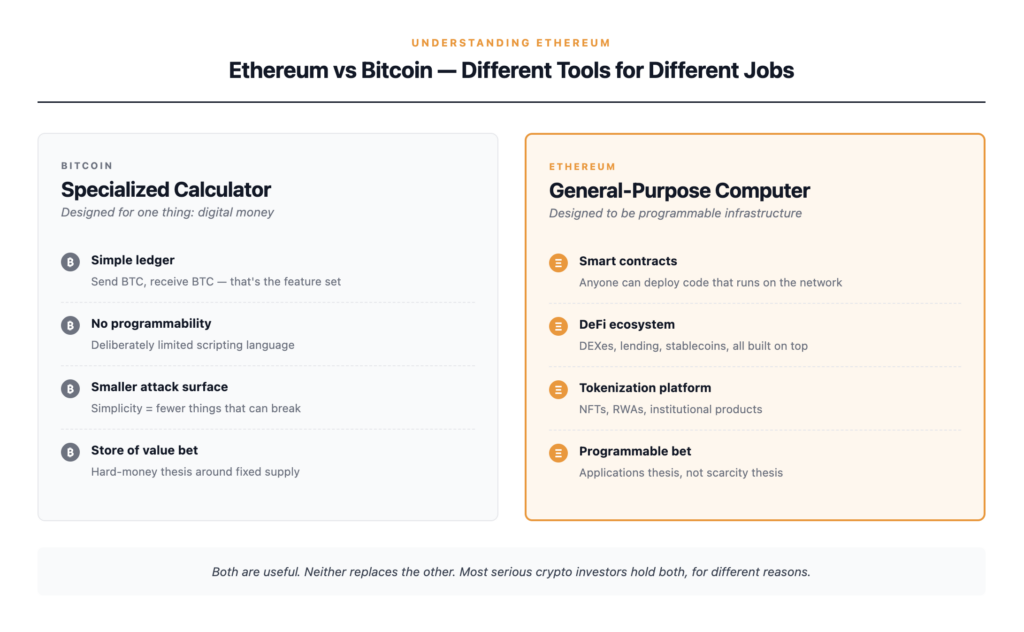
Bitcoin was built to do one thing extremely well: be digital money. Its ledger is deliberately simple. You can send BTC, receive BTC, and that’s essentially the whole feature set. There’s no programmability, no built-in scripting language for complex applications, no smart contract layer. That constraint is a feature, not a limitation. A simpler system has fewer attack surfaces and is easier to trust as a long-term store of value.
Ethereum was built to be programmable. Anyone can deploy code to the network, and that code becomes a permanent part of the system that anyone can interact with. A DEX, a lending protocol, a stablecoin, an NFT collection — none of these things are possible on Bitcoin in the way they are on Ethereum. That flexibility is Ethereum’s whole reason for existing.
A useful analogy: Bitcoin is a specialized calculator. Ethereum is a general-purpose computer. Both are useful. Neither replaces the other.
When people ask “ethereum vs bitcoin — which is better?” they’re usually asking the wrong question. Better for what? For a hard-money bet on scarcity, Bitcoin. For running decentralized applications, Ethereum. Most serious crypto investors hold both, for different reasons. For the fuller Bitcoin picture, see what is Bitcoin.
That’s the tradeoff. Simplicity vs flexibility. Both networks made a choice, and both are living with the consequences of it.
How Ethereum actually works
The Ethereum blockchain runs on thousands of computers around the world, all running the same software and all agreeing on the same current state. Here’s what that means without the jargon.
The network is the collection of computers (called nodes) that participate in Ethereum. Anyone can run one. Together, they maintain a shared record of what’s happening.
The state is what the network is tracking at any given moment: how much ETH each address holds, plus the internal data stored by every smart contract on the network. Think of it as one giant, constantly updating database that everyone has a copy of.
Transactions are how the state gets updated. You send ETH, you deploy a contract, you interact with an existing contract — every one of these is a transaction that changes something in the shared database.
Blocks are batches of transactions bundled together and confirmed roughly every 12 seconds. A new block gets added, everyone updates their copy of the state, and the process repeats.
Validators are the computers that produce those blocks. To become a validator, you lock up 32 ETH as a security deposit. The network randomly picks one validator to propose the next block, and rewards them with newly issued ETH and transaction fees. If a validator cheats or goes offline, they lose part of their stake. That’s how the network keeps honest people in charge of honest computers.
That’s what is Ethereum at the mechanism level: shared database, updated by transactions, batched into blocks, secured by validators who have money on the line. That’s also the answer to how does ethereum work, technically.
What smart contracts actually are
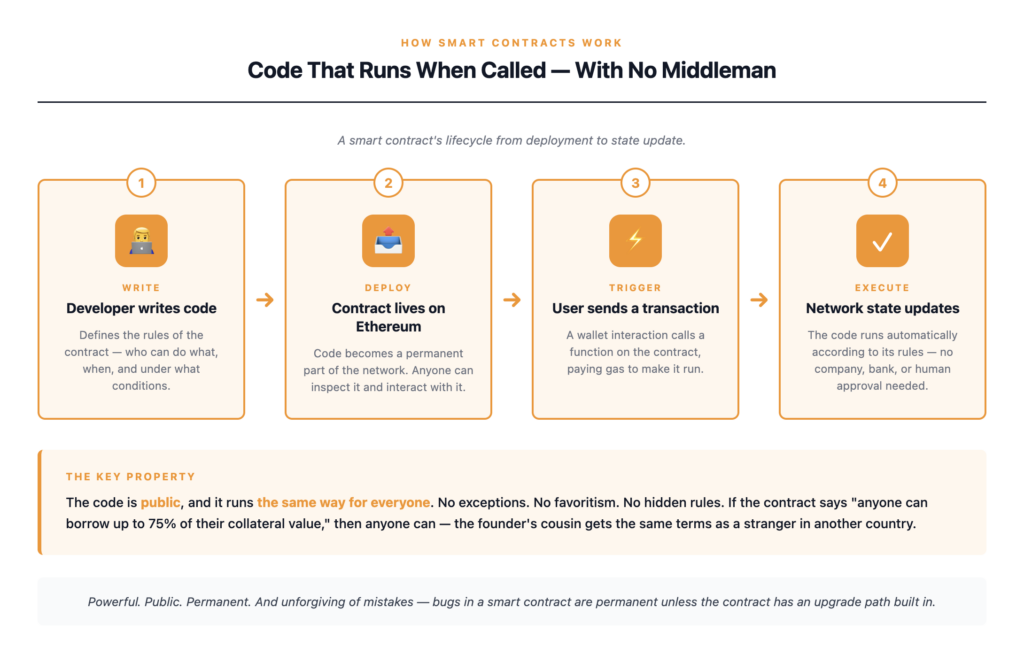
A smart contract is code that lives on the Ethereum network. When someone triggers it with a transaction, the code runs and updates the network’s state. It’s not smart, and it’s not really a contract. It’s just code that runs when called.
Some real examples of what smart contracts actually are in practice:
- A DEX pool is a smart contract. Anyone can trade against it. Read more in what is a DEX.
- A stablecoin like USDC is a smart contract that tracks who owns how many tokens.
- An NFT collection is a smart contract that tracks ownership of unique items.
- A DAO is a smart contract that lets a group vote on decisions and execute them automatically.
The key property that makes any of this interesting: the code is public, and it runs the same way for everyone. No exceptions. No favoritism. No hidden rules. If the contract says “anyone can borrow up to 75% of their collateral value,” then anyone can — the founder’s cousin gets the same terms as a stranger in another country.
That’s the model. And it’s genuinely different from how the traditional financial system works.
The tradeoff is real, though. Smart contract bugs are permanent unless the contract has an upgrade path built in. Over $10 billion has been lost to smart contract exploits and DeFi hacks across the industry’s history (Halborn’s Top 100 DeFi Hacks report tracks the largest incidents). The DAO hack in 2016, Parity Wallet losses in 2017, Ronin Bridge in 2022, Wormhole, Poly Network — the list is long. Code that runs without human intervention runs bugs without human intervention too.
Smart contracts explained honestly: powerful, public, permanent — and unforgiving of mistakes.
Gas fees — what you actually pay to use Ethereum
Every action on Ethereum costs gas — a fee paid to the validators who process your transaction. Simple transfers are cheap. Complex smart contract interactions cost more. Congested network = higher gas. Quiet network = lower gas.
Here’s the honest state of ethereum gas fees in 2026:
- Ethereum mainnet for a typical swap: roughly $0.25 to $3. Complex actions can go higher during busy periods.
- Layer 2 networks (Arbitrum, Base, Optimism): typically under $0.10 for the same action.
- The historical bad old days (2021 peak): $20 to $50, sometimes hundreds for a single transaction.
The March 2024 Dencun upgrade cut overall Ethereum gas costs by roughly 95%. That’s a genuinely huge change, and it’s why the “Ethereum is unusable because of gas fees” narrative you’ll still see in some corners of the internet is out of date.
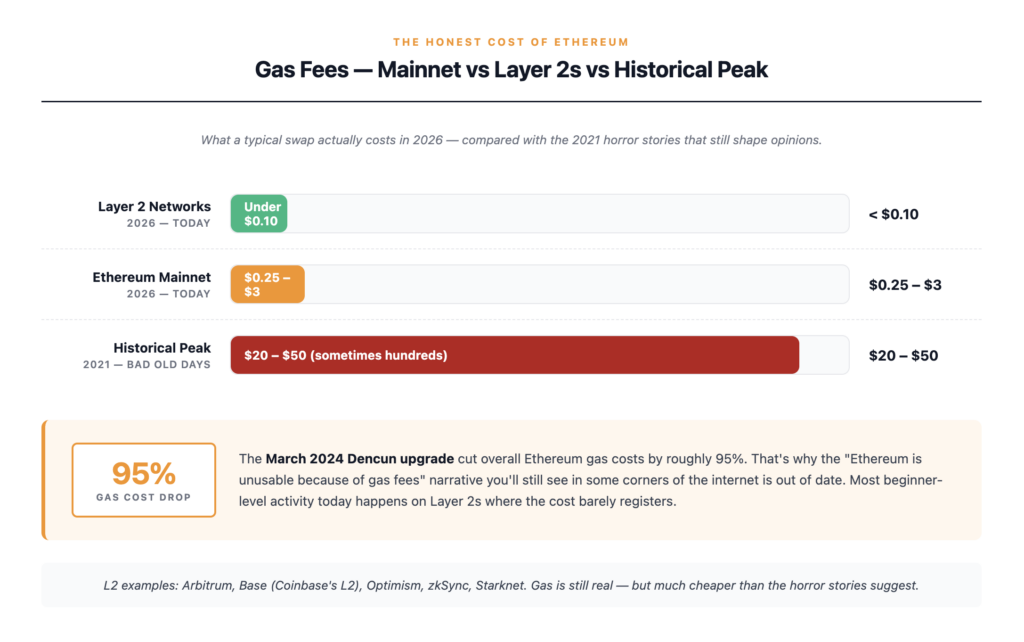
Gas is still real. It’s still something to think about. But it’s much cheaper than the horror stories suggest, and most beginner-level activity today happens on Layer 2s where the cost barely registers.
Proof of Stake — how Ethereum reaches agreement
Ethereum used to run on Proof of Work, the same energy-intensive mining system Bitcoin uses. Warehouses full of specialized computers racing to solve math problems, burning electricity, competing to add the next block.
On September 15, 2022, Ethereum switched to Proof of Stake in an upgrade called The Merge. This is the current model — proof of stake ethereum is what you’re using today.
Here’s how it works. Validators lock up 32 ETH each as a security deposit. The network randomly selects one to propose the next block. If they follow the rules, they earn ETH rewards. If they cheat or go offline, they lose part of their stake — a process called “slashing.”
Two things changed dramatically overnight when The Merge happened:
Energy usage dropped by about 99.95%. Ethereum went from consuming roughly as much electricity as a mid-sized country to consuming about as much as a small office building.
ETH became a yield-bearing asset. Stakers currently earn roughly 2.7% to 3.3% annually in ETH rewards depending on how they stake, similar to earning interest — though with real risks attached, including validator downtime and protocol changes.
What didn’t change is worth noting too. The network still processes the same transactions. The same smart contracts still run. Wallets didn’t need to be rebuilt. The price of ETH wasn’t automatically affected. The Merge was a mechanical change to how the network agrees on new blocks, not a change to what the network does.
Proof of Work → Proof of Stake. That’s the whole story. Anyone telling you The Merge was secretly a takeover or a conspiracy is selling you drama.
Layer 2s — Ethereum’s scaling solution
Ethereum mainnet has limits. It can process a few dozen transactions per second at most. When demand spikes, gas fees spike with it. That’s a problem for a network meant to be used by millions of people.
Ethereum Layer 2 networks are the fix. A Layer 2 (or “L2”) processes transactions off the main Ethereum chain, then periodically posts compressed proofs of those transactions back to Ethereum. You get most of Ethereum’s security at a fraction of the cost.
The dominant L2s by activity in 2026:
- Arbitrum — one of the oldest and largest general-purpose L2s.
- Base — Coinbase’s L2, tightly integrated with their exchange.
- Optimism — another early general-purpose rollup.
- zkSync and Starknet — using different technical approaches (zero-knowledge proofs) with slightly different tradeoffs.
For beginners, the practical point: most Ethereum activity is happening on L2s now, not on the mainnet. When people say “Ethereum” in 2026, they increasingly mean the whole ecosystem — mainnet plus Layer 2s working together.
L2s aren’t separate from Ethereum. They ARE Ethereum, at a lower price point.
What runs on Ethereum
The reason anyone cares about Ethereum is what people have built on top of it. A partial tour:
Stablecoins — USDC, USDT, and DAI are Ethereum-based tokens (they exist on other chains too, but Ethereum is the biggest by supply). If you’ve ever moved a “digital dollar” between wallets or exchanges, there’s a good chance you used an Ethereum smart contract to do it.
DEXes — Uniswap, Curve, SushiSwap, and others. These are decentralized exchanges that let you swap tokens without an account or intermediary. See what is a DEX for a deeper look.
Lending protocols — Aave, Compound, Morpho. Deposit tokens, earn interest, borrow against your holdings. All governed by smart contracts, not banks.
Real-world asset tokenization — BlackRock’s tokenized money market fund (BUIDL, which launched on Ethereum in March 2024 and now holds billions in AUM), Franklin Templeton’s on-chain money market fund (BENJI). Traditional finance is starting to issue actual regulated products on Ethereum.
NFTs — the entire NFT market is built on Ethereum standards (ERC-721 and ERC-1155). Even NFTs on other chains typically use standards that copied Ethereum’s originals.
Staking derivatives — Lido and EigenLayer let people stake ETH indirectly, without running their own validator, in exchange for receiving a liquid token that represents their staked position.
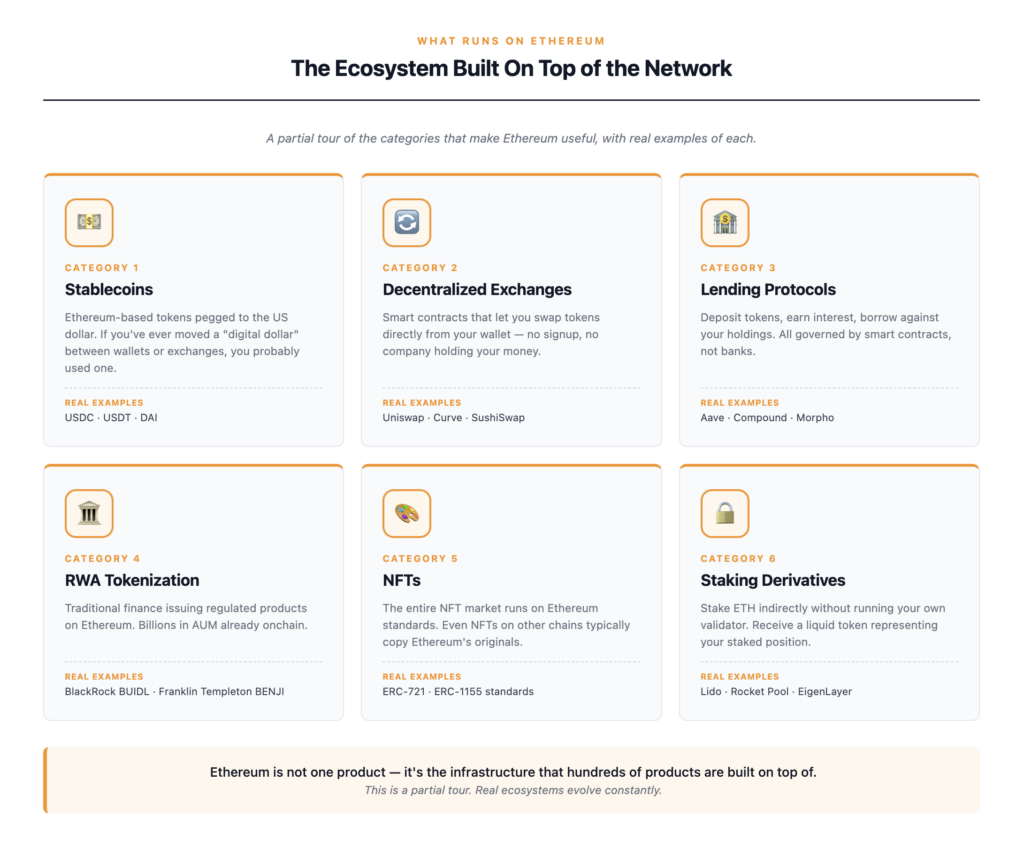
Ethereum is not one product. It’s the infrastructure that hundreds of products are built on top of.
The state of ETH in 2026 (honest edition)
Time for the part most beginner articles skip.
ETH the asset has had a rough stretch. From its 2025 peak near $4,946, the price has traded well below that for most of 2026, sitting in the $1,800-$1,900 range through mid-2026. As of mid-2026, ETH has posted three consecutive red quarters — the first time that’s happened in Ethereum’s history. This is one of the tougher stretches Ethereum crypto has been through in years.
ETF flows have been mixed. Spot ETH ETFs launched in the US in 2024. Since then they’ve had months of strong inflows and months of significant outflows. Not a straight line up. Not a straight line down. A wobble.
There’s real disagreement about what this means. Some people say it shows Ethereum has structural problems — that Layer 2s are cannibalizing mainnet fee revenue, that competing chains are eating market share, that ETH’s monetary policy isn’t as tight as promised. Others say the fundamentals are stronger than ever and the price will catch up. Both takes are extreme. The honest answer is: nobody knows yet.
Underneath the price, some things haven’t changed:
- Institutional adoption keeps building. BlackRock’s ETH ETF exists. Tokenization pilots continue. The Ethereum Institutional nonprofit launched in July 2026 to formalize enterprise engagement.
- The upgrade path is intact. The Glamsterdam upgrade is targeted for the second half of 2026, introducing EIP-7732 (proposer-builder separation) and EIP-7928 (block-level access lists).
- Layer 2 activity keeps growing. More transactions, more users, more applications — even during price weakness.
Price and fundamentals can diverge for extended periods. Ethereum’s are diverging right now. Whether they resolve up or down is something you’ll have to form your own view on. Anyone who claims certainty about it is guessing.
That’s the tradeoff of investing in a technology asset. You’re not just buying a piece of software — you’re buying a piece of a bet on adoption, on regulation, on competition, on execution. Only invest what you can afford to lose.
How to hold and use ETH
If you’re new to ether cryptocurrency and want to actually use it, here are the main paths.
On an exchange. The simplest option. You buy ETH on Coinbase, Kraken, or a similar platform, and it sits in your account there. Easiest for beginners, but you don’t control the keys — the exchange does. For guidance on choosing one, see how to buy crypto safely.
In a self-custody wallet. You control the private keys. MetaMask is the most common Ethereum wallet, but there are many alternatives (Rabby, Frame, hardware wallets like Ledger and Trezor). This is what you’ll want if you plan to actually use Ethereum applications — connecting to a DEX, interacting with a smart contract, holding NFTs. For a full explainer on how these work, see how crypto wallets work.
Staking. To run your own validator, you need 32 ETH — around $60,000 at current prices. To stake with any amount, you can use a liquid staking protocol (Lido, Rocket Pool) or stake through a centralized exchange. Each ethereum staking option has different tradeoffs around trust, decentralization, and yield.
Using it. Swap on a DEX. Lend it on Aave. Provide liquidity. Bridge it to a Layer 2. Buy an NFT. The whole point of holding ETH is that you can do things with it — not just watch a price chart.
Holding ETH is a starting point. What you can do with it is the network’s real value proposition.
Common questions
Is Ethereum a good investment?
We don’t give investment advice — but we can tell you what buying ETH is actually a bet on. It’s a bet that programmable smart contract networks will host more of the world’s financial activity over the next decade, and that Ethereum will remain the dominant one. That’s a thesis you can evaluate for yourself. It’s not a certainty. ETH has had three consecutive red quarters through mid-2026, and there are credible arguments on both sides about where it goes from here.
What’s the difference between Ethereum and ETH?
Ethereum is the network — the decentralized computer. ETH (sometimes called “ether”) is the network’s native token, used to pay for computation and secure the network via staking. When people say “I bought Ethereum,” they usually mean they bought ETH. Technically inaccurate, but everyone does it, so nobody cares.
Is Ethereum better than Bitcoin?
They’re different tools. Bitcoin is designed to be simple, stable digital money. Ethereum is designed to be programmable infrastructure for applications. Asking which is “better” is like asking whether a calculator or a computer is better — it depends on what you’re doing. Most serious investors hold both, for different reasons.
How much ETH do I need to stake?
To run your own validator, 32 ETH — around $60,000 at 2026 prices. To participate in staking with any amount, you can use a liquid staking protocol like Lido or Rocket Pool, or stake through a centralized exchange. Each option has different tradeoffs around trust, control, and returns. Solo staking gives you the most control and the full reward. Pool staking gets you exposure with less capital, but you’re trusting the pool operator.
Why do Ethereum gas fees change so much?
Gas fees rise when the network is busy and fall when it’s quiet — it’s basically an auction for block space. Post-Dencun (March 2024), overall Ethereum gas costs dropped roughly 95%, and Layer 2 rollups (Arbitrum, Base, Optimism) offer much cheaper alternatives to mainnet. In 2026, most everyday Ethereum activity happens on L2s where gas is under $0.10.
Where to go from here
You now have the answer to “what is Ethereum” — the network, the asset, the mechanism, and the honest state of it in 2026. Ethereum is easier to understand once you also understand the things it’s compared to and built on. A few natural next reads:
- What is Bitcoin — the natural comparison. Understanding both is essential to understanding either.
- What is a DEX — Ethereum is where most DEXes live, and DEXes are one of the clearest real-world uses of what Ethereum makes possible.
- How crypto wallets work — you need a wallet to actually use Ethereum. This article explains what a wallet actually is, how seed phrases work, and how to keep your ETH safe.
- What is blockchain — if you skipped the fundamentals, the concept of blockchain is essential to understanding Ethereum. Circle back to this one first if any of the earlier sections felt hazy.
- How to buy crypto safely — if you don’t have any ETH yet, this is where to start.
A note on financial advice
This article is for education, not financial advice. I’m explaining what Ethereum is as a network and what ETH is as an asset — not telling you whether to buy ETH, stake it, or use it in DeFi. Ethereum has real technical risks (smart contract exploits, network congestion, protocol upgrades that don’t go as planned), real economic risks (price volatility, ETF flow fluctuations), and real regulatory risks around staking and asset classification. Only invest amounts you can afford to lose entirely, verify every URL before connecting your wallet to any application, and make your own decisions based on your own situation.