This was the week the bear market turned into whatever comes next. Bitcoin posted its biggest weekly gain in two years. Ethereum reclaimed $2,400. XRP tore up 40%. And it wasn’t crypto-native news that did it — it was three separate policy and macro moves that landed within 30 hours of each other and gave the market permission to reprice everything at once.
This is your weekly crypto brief for the week ending Sunday, August 23, 2026. What actually moved. What matters for beginners. What’s noise dressed up as news. Plus the CLARITY Act vote that’s now sitting three weeks out on the calendar.
What actually moved
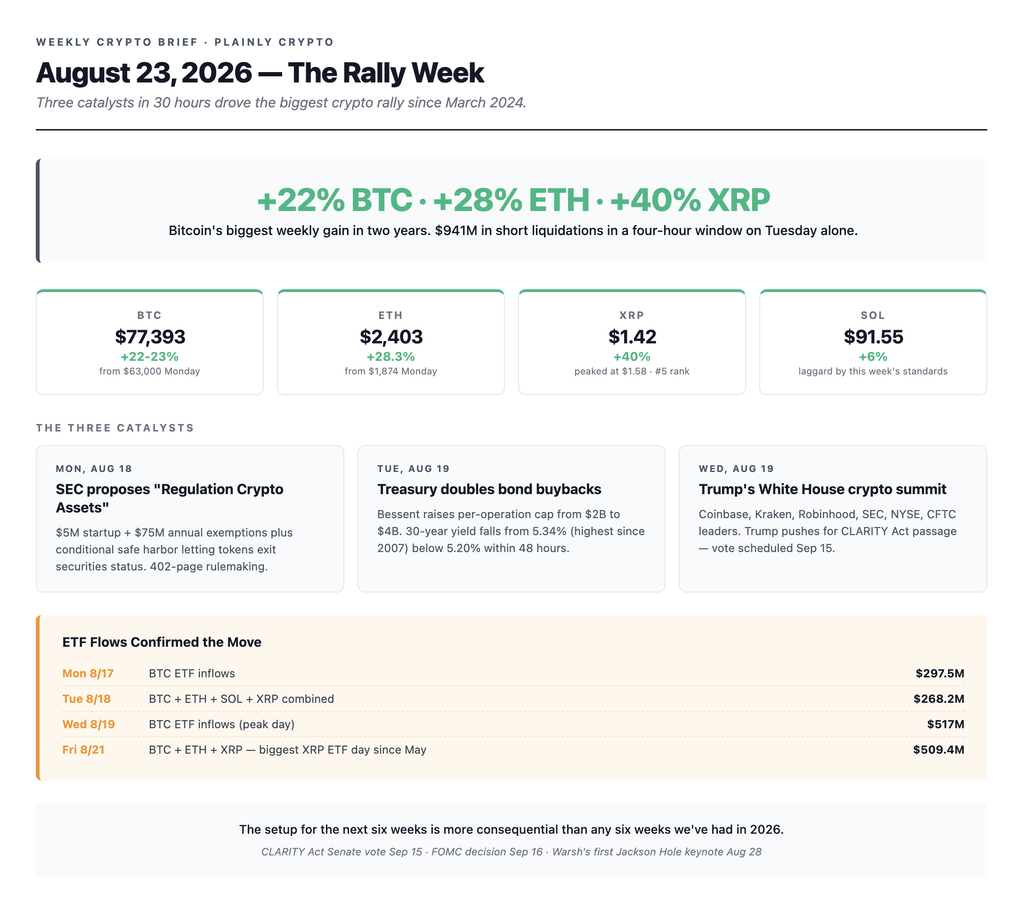
Bitcoin (BTC): $63,000 at Monday’s open → $77,393 by Friday’s peak (~$79,000 intraday), closing the week up ~22-23%. That’s the biggest weekly gain since March 2024, roughly two full years.
Ethereum (ETH): $1,874 Monday → $2,403 Friday. Up 28.3% on the week. First time above $2,400 since mid-July.
XRP: The outperformer of the week. Started Monday defending $1.00. Hit $1.58 intraday Friday. Up nearly 40% over the seven-day window, briefly moving past USDC to reclaim 5th place on total market cap rankings.
Solana (SOL): $86 → $91.55. Up ~6% — a laggard by this week’s standards, though up in a market where “up” was the rule.
Others worth naming: Hyperliquid (HYPE), Zcash (ZEC), and Chainlink (LINK) all posted 30%+ weekly gains. This was a broad-based rally, not a narrow one — which is itself a signal.
The liquidation event: At roughly 20:00 UTC on Tuesday, August 19, $941 million in short positions were force-closed in a four-hour window as prices broke through resistance. Over the four days from Aug 17-21, short positions lost $3.79 billion versus $687 million in long liquidations. The market had been positioned bearishly. It got squeezed.
Total crypto market cap climbed from ~$2.30 trillion to ~$2.68 trillion across the week.
Why it moved — three catalysts in 30 hours
This wasn’t one story. It was three, and they compounded.
Catalyst 1: SEC proposes “Regulation Crypto Assets” (Monday, Aug 18)
SEC Chairman Paul Atkins unveiled a 402-page rulemaking proposal that would formally create two crypto-specific registration exemptions — a $5 million startup exemption and a $75 million annual fundraising exemption — plus a conditional investment contract safe harbor that would allow tokens to formally “graduate” out of securities classification once their issuer completes or ceases promised managerial efforts.
This is significant because it’s the first time the SEC has proposed a purpose-built regulatory framework for token offerings, rather than trying to squeeze them into 1930s-era Securities Act rules. The proposal includes federal preemption of state securities laws for covered offerings, addressing a long-standing complaint from crypto issuers about a 50-state compliance patchwork.
Two important caveats: (1) It’s a proposal, not law — the 60-day public comment period runs first, then rule finalization, then enforcement. (2) It complements rather than replaces the CLARITY Act still winding through Congress.
Catalyst 2: Treasury doubles bond buyback program (Tuesday, Aug 19)
Treasury Secretary Scott Bessent announced the Treasury would at least double its long-end bond buyback operations, raising the per-operation cap from $2 billion to at least $4 billion, running September 9 through November 4.
This matters for crypto because the 30-year Treasury yield had hit 5.34% the day before — its highest level since 2007. High yields on long-dated Treasuries pull capital out of risk assets (crypto included) and into bonds that suddenly pay well. Doubling the buyback program signals the Treasury will actively suppress those yields with fresh liquidity, which reverses the flow. The 30-year yield fell below 5.20% within 48 hours.
Catalyst 3: Trump’s White House crypto summit (Wednesday, Aug 19)
President Trump convened the leaders of Coinbase, Kraken, Robinhood, the SEC, the NYSE, and the CFTC at the White House and made the strongest public push yet for the Senate to pass the CLARITY Act. His framing: crypto regulation would “keep us ahead of China” and “open the door to the next wave of innovations.”
Combined with the SEC proposal from the day before, the summit signaled an unusually coordinated federal effort. Markets read it as reduced regulatory tail risk plus increased odds of the CLARITY Act clearing the Senate on its scheduled September 15 vote.
All three catalysts hit within about 30 hours of each other. The compounding effect explains why the rally was broad-based rather than concentrated — every crypto with meaningful US regulatory exposure got repriced upward simultaneously.
ETF flows: the money followed the news
The daily ETF flow data confirms institutional capital drove the move:
- Monday, Aug 17: $297.5M BTC net inflows
- Tuesday, Aug 18: $189.3M BTC + $71.5M ETH + $5.8M XRP + $1.6M SOL
- Wednesday, Aug 19: $517M BTC net inflows (the peak day)
- Thursday, Aug 20: $38.6M BTC (slower)
- Friday, Aug 21: $307M BTC + $184M ETH + $18.4M XRP (biggest XRP ETF day since May 2026)
Three-day cumulative BTC inflows through Wednesday exceeded $1 billion. XRP ETFs saw $8.16M inflows across the week’s first three sessions alone — more than the previous two weeks combined — pushing total XRP ETF assets past $1 billion and now sitting at approximately $1.53 billion in AUM.
The pattern is clear: on days when policy news broke positive, institutional capital moved in size. That’s the signature of allocation decisions, not retail momentum trading.
Stablecoin market: USDC quietly extends its lead
Away from the price action, the stablecoin market kept growing. USDC added $2 billion in market cap this week, reaching approximately $73 billion in circulation — now about 24% of the total stablecoin market. That’s the second-largest stablecoin behind Tether’s USDT ($183B).
Also on Aug 18: Coinbase and Circle renewed their revenue-sharing agreement for another three years, locking in their partnership through 2029. And Ripple continued RLUSD’s institutional buildout — the stablecoin now sits at $1.7 billion market cap with 84,189 holders, expanding beyond the XRP Ledger to Ethereum and Layer 2s via Wormhole.
Total stablecoin market cap: approximately $303-308 billion, up 14.3% year-over-year.
Security incidents: Sandbox exploit + Maya Protocol
Yesterday (Friday, Aug 22), metaverse project The Sandbox was hit by a cross-chain bridge exploit that caused a lot of alarming headlines but relatively small actual damage. Attackers hijacked LayerZero delegate permissions on the SAND cross-chain OFT (Omnichain Fungible Token) deployed on Base and BNB Smart Chain, using an approveAndCall function to bypass supply controls and mint approximately 14.9 billion unbacked SAND tokens — with Blockaid flagging $49 billion in face value across 400+ transactions.
Here’s the nuance that matters: the $49 billion figure is essentially meaningless. Those newly-minted tokens had no backing, meaning the attacker couldn’t actually sell them at market price without crashing SAND to zero. Actual extraction was ~$675,000 — the attacker withdrew about 14.75 million SAND from the Ethereum OFT adapter and swapped for roughly 80 ETH before the team froze bridging.
The Sandbox team contained the exploit quickly, disabled bridging on Base and BSC, and confirmed that SAND on Ethereum and Polygon remains completely safe. Total real damage: less than 0.01% of the 3 billion SAND supply. The team is preparing a compensation plan for affected liquidity providers based on a pre-attack network snapshot. Weirdly, SAND price actually rose 4.76% during the exploit on 400% volume surge — a reminder that price action during security incidents often defies logic.
This is part of a broader 2026 pattern: LayerZero OFT peer and delegate abuse has caused nominal token issuance in the trillions across at least three separate incidents this year, even where actual extractable dollar losses ranged from five to nine figures. The LayerZero protocol itself isn’t broken; it’s how projects configure their delegate permissions that keeps failing.
Earlier in the week (Monday, Aug 18), Maya Protocol on MAYAChain was exploited via six chained logic bugs, resulting in approximately $1.36-1.7 million in direct losses and roughly $11 million in broader market impact. Smaller and less well-known than Sandbox, but notable for the attack sophistication.
Total 2026 exploit losses now sit above $1.2 billion across 212+ incidents per Blockaid’s H1 2026 report, with private key and infrastructure compromises accounting for nearly three-quarters of the damage.
Business developments
Ripple issued $275 million in senior unsecured bonds on Aug 20, providing capital for further institutional infrastructure buildout — likely feeding RLUSD expansion and their acquisition pipeline (Hidden Road, Rail, GTreasury).
Ripple Mint launched — a web console and API for institutions to mint, redeem, and manage RLUSD directly. This is core plumbing for the “banks-and-brokers” business Ripple has been building since 2024.
What to watch this coming week
Aug 26 (Tuesday): Q2 2026 GDP second estimate, 8:30am ET. If the number confirms slowing growth, it strengthens the rate-cut case going into September.
Aug 26 evening: Nvidia earnings — the market’s biggest single-stock event, likely to affect broad risk sentiment.
Aug 27-29: Jackson Hole Economic Policy Symposium, hosted by the Kansas City Fed. Kevin Warsh delivers his first keynote as Fed Chair on Friday, Aug 28 — his first Jackson Hole address since succeeding Powell. The 2026 theme is “Financial Innovation: Implications for Payments and Policy,” which is unusually crypto-relevant. Markets will parse every word for September rate-cut signals.
Sep 15: CLARITY Act Senate cloture vote — the vote that determines whether the market structure bill has a real path to passage this year. Odds have been sitting at roughly 50-50 on prediction markets, though this week’s momentum likely improved them.
Sep 16: FOMC decision on interest rates. Rate cut probability now sits at approximately 88-94% for a 25 basis point cut based on fed funds futures.
The bigger picture
This week’s rally has real fundamentals underneath it. Three separate policy catalysts hit simultaneously, and the ETF flow data confirms institutions actually moved capital rather than retail chasing a wick.
But it’s also worth naming what didn’t change. The rally happened despite the CLARITY Act still not being law. Despite the SEC’s Regulation Crypto Assets proposal being 60 days of comment period plus rulemaking away from taking effect. Despite the September rate cut being priced in but not decided. Every one of those things could still go the other way.
The market bet this week that Washington will deliver on regulatory clarity. If it does — meaning CLARITY passes in September or October and the SEC rules survive comment period intact — this week’s rally will look like the start of something. If any of those pieces fall apart, the compression of three catalysts into 30 hours means the unwind could be equally sharp.
Reasonable people can look at the same evidence and disagree about which scenario is more likely. What’s not disagreeable: the setup for the next six weeks is more consequential than any six weeks we’ve had in 2026. Next Sunday’s weekly crypto brief will cover what the September CLARITY vote, Jackson Hole speeches, and FOMC decision actually mean once the events land.
Where to go next:
- New here? Start with our beginner path or read our guide on dollar-cost averaging crypto — the strategy that works best in weeks like this one, when everyone else is chasing.
- Want to understand what’s driving XRP’s move? Our new What is XRP explainer covers Ripple, RLUSD, and the honest state of the token.
- Curious about the tech behind Solana’s institutional traction? Read What is Solana.
- If this week made you want to actually buy some crypto for the first time, our guide on how to buy crypto safely walks through the sober version of that decision. Pair it with our crypto wallets guide if you plan to self-custody.
- And if you’re curious how decentralized exchanges (DEXs) fit into the picture as more institutional flow moves onchain, our DEX explainer covers the basics.
See you next Sunday.
A note on financial advice
This brief is for education, not investment advice. Rallies driven by policy anticipation can reverse quickly when the underlying policy doesn’t materialize on the expected timeline. The September 15 CLARITY vote and September 16 FOMC decision are the two events most likely to determine whether this week’s move sticks. Trade sizes and time horizons should reflect that uncertainty. Only invest what you can afford to lose entirely, and make your own decisions based on your own situation.