Cardano is the blockchain that promised to do crypto slowly and carefully — and delivered on both halves of that promise.
That’s the honest one-line summary. Cardano’s whole design philosophy is built around peer-reviewed academic research, meaning every major protocol change gets published, reviewed by outside academics, and only then implemented on the network. It’s a genuinely different bet about how blockchain infrastructure should be built. It has produced real security wins. It has also produced an ecosystem that, in 2026, is visibly contracting while competitors keep growing.
I’ve watched Cardano since the 2017 launch. It’s the coin most beginners hear the strongest opinions about — either “the most technically sound blockchain in crypto” or “all research, no users.” Both camps have a point. This guide walks you through what Cardano actually is, how it works, what happened to its ecosystem in 2026, and what ADA holders should honestly weigh right now.
TL;DR
- Cardano is a blockchain and ADA is its native cryptocurrency, launched in September 2017.
- Founded by Charles Hoskinson, one of Ethereum’s original co-founders, who left Ethereum in 2014 over governance disagreements.
- Cardano’s core differentiator: every major protocol change goes through academic peer review before implementation.
- Uses Ouroboros — the first academically peer-reviewed proof-of-stake consensus mechanism, with 200+ published research papers behind it.
- Real security benefits (no major protocol exploits since 2017) come with real ecosystem costs (slower shipping, smaller DeFi and NFT ecosystems).
- 2026 has been rough: two major ecosystem shutdowns (JPG.Store on May 23, TapTools on June 2), and total value locked has fallen to roughly $70 million from over $126 million earlier in the year.
- ADA is down roughly 78% year-to-date in 2026, trading around $0.20 after briefly rallying above $0.21 during the mid-August market surge.
The one-sentence version
So, what is Cardano in one sentence?
Cardano is a proof-of-stake blockchain built on peer-reviewed academic research, designed to prioritize security and formal verification over shipping speed — an approach that has delivered fewer exploits than any other major smart contract platform, and also fewer users than most of them.
That sentence is doing a lot of work. Let’s unpack it.
Cardano vs Bitcoin, Ethereum, Solana, Polkadot — a different design philosophy
Every major blockchain represents a different bet about what matters most. Understanding Cardano means understanding what it chose to prioritize — and what it deliberately traded away.
Bitcoin is decentralization-first. It’s slow, expensive, and doesn’t run smart contracts, because its whole design centers on being the hardest money possible. Simple by choice. [related article: what is bitcoin]
Ethereum is programmability-first. It sacrifices some speed and simplicity to be a general-purpose computer that anyone can build applications on. Most of DeFi and NFTs live here. [related article: what is ethereum]
Solana is speed-first. It’s built to handle thousands of transactions per second at sub-cent fees, which is why it dominates memecoins and high-frequency on-chain trading. The tradeoff has been occasional network outages. [related article: what is solana]
Polkadot is interoperability-first. It’s designed around connecting multiple specialized blockchains (“parachains”) together, so different chains can talk to each other and share security. Less about being one big chain, more about being a network of chains.
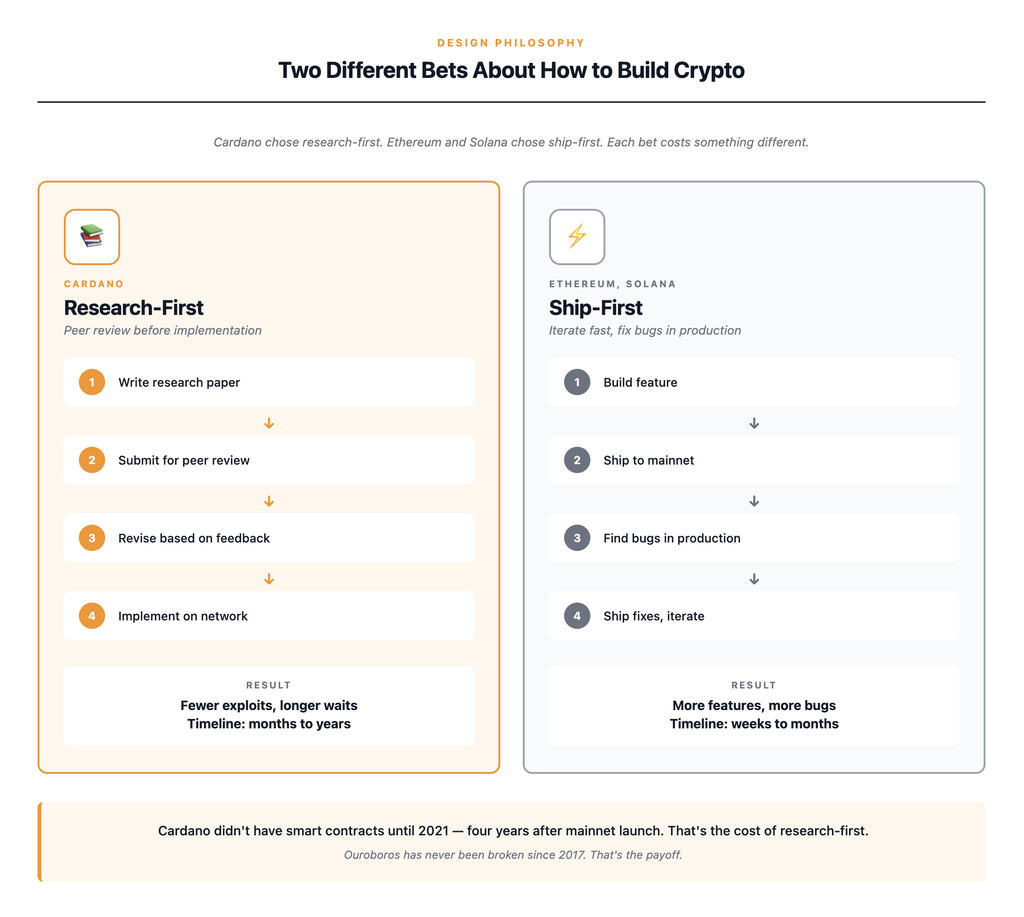
Cardano is research-first. Every meaningful change goes through peer review before it ships. That means fewer critical bugs and fewer surprises — and also longer waits for features that competitors ship in months. Cardano didn’t have smart contracts until 2021, four years after mainnet launch.
None of these is objectively “right.” They’re different bets about what infrastructure crypto actually needs. Bitcoin bets money should be slow and boring. Ethereum bets on general-purpose programmability. Solana bets speed unlocks new use cases. Polkadot bets specialization plus interoperability wins. Cardano bets that formal, provable correctness will matter more over decades than fast shipping does today.
That’s the tradeoff. Research-first vs ship-first.
Where you land on that question tells you a lot about how you’ll feel about Cardano.
Charles Hoskinson and Cardano’s origin
You can’t explain Cardano without explaining Charles Hoskinson.
Hoskinson was one of Ethereum’s original co-founders. He left in 2014 over governance disagreements — the short version is that he wanted Ethereum to be run as a venture-backed company, and Vitalik Buterin and the other founders wanted a nonprofit foundation. Hoskinson lost that argument and walked away.
The next year, he founded IOHK (now called IOG, or Input Output Global) with the explicit mission of building a blockchain the “right” way — meaning, in his framing, with academic rigor instead of what he saw as Ethereum’s move-fast-and-break-things culture. Cardano’s mainnet launched in September 2017.
Development of Cardano is split across three organizations. IOG does the core protocol engineering and research. The Cardano Foundation handles ecosystem governance and adoption. EMURGO is the commercial arm, focused on partnerships and enterprise use cases. This structure is unusual in crypto — most chains have one dominant foundation or company.
Hoskinson himself remains highly visible. He runs a near-daily YouTube channel, is active on X (Twitter), and openly steers IOG’s development priorities. That visibility cuts both ways. Supporters see engaged, transparent leadership. Critics see a single personality shaping too much of Cardano’s direction. Both descriptions can be true simultaneously.
The fair framing: Hoskinson’s influence on Cardano is real, ongoing, and not universally positive or negative. Ouroboros has never been broken since 2017, which is a genuine technical achievement traceable to the peer-review culture he insisted on. Cardano also spent four years without smart contracts because of that same culture — a delay that let Ethereum and, later, Solana build ecosystems Cardano has never come close to matching.
How Cardano actually works — peer review, Ouroboros, and Hydra
That’s what Cardano is philosophically. Here’s what is Cardano at the mechanism level.
Ouroboros is Cardano’s proof-of-stake consensus mechanism — the process by which the network agrees which transactions are valid. Instead of miners competing to solve puzzles (Bitcoin’s approach), Ouroboros divides time into “epochs” and “slots,” and randomly selects a stake pool operator to produce each block based on how much ADA is delegated to them. More delegation, higher chance of being picked.
The name “Ouroboros” is the ancient symbol of a snake eating its own tail — a nod to self-sustaining cycles. ADA itself is named after Ada Lovelace, generally credited as the first computer programmer.
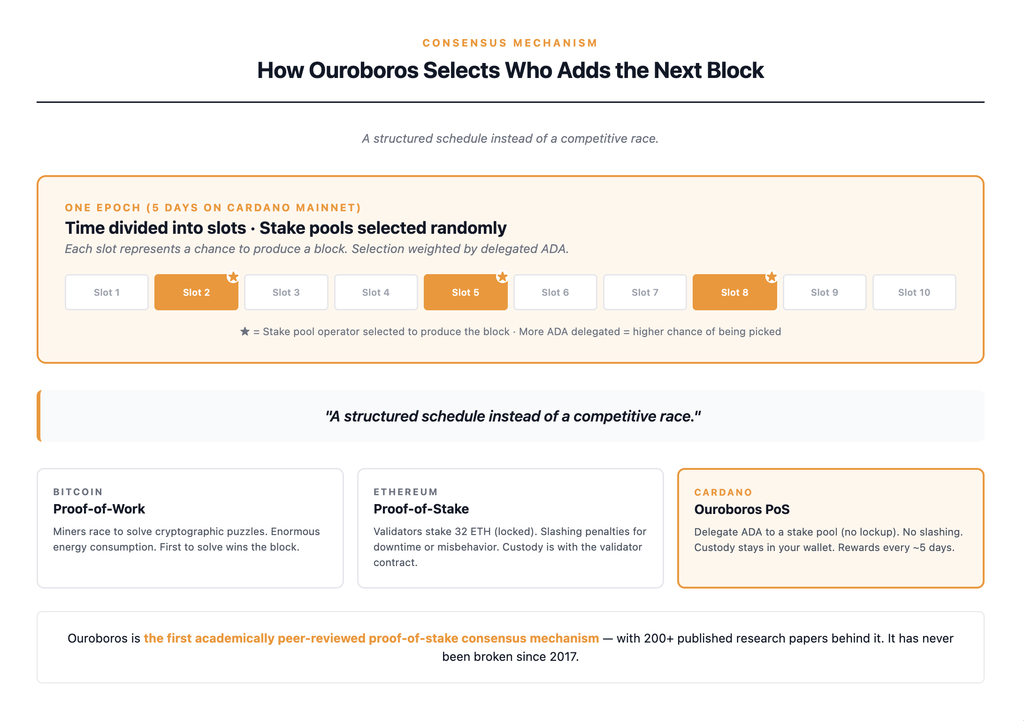
Underneath Ouroboros sit 200+ peer-reviewed academic papers, covering everything from the consensus mechanism itself to smart contract semantics to governance models. That corpus is Cardano’s actual moat. It’s why Ouroboros has never been broken since 2017 — a claim you can’t make about most competing platforms.
Smart contracts on Cardano run on Plutus, a smart contract platform based on Haskell (a functional programming language). Plutus is mathematically rigorous — provably correct behavior is the whole point. It’s also famously developer-unfriendly, which is one reason Cardano’s dApp ecosystem grew slowly. In response, two more approachable languages have emerged: Aiken, which is easier for developers coming from mainstream languages, and Marlowe, a domain-specific language for financial contracts.
Hydra is Cardano’s Layer 2 scaling solution — the “how do we handle more transactions” answer. A Hydra Head is a small group of participants who spin up a fast side-channel, process transactions among themselves, and then settle the final result back to the main chain. In theory, each Head can handle up to 1 million transactions per second. It’s conceptually similar to Bitcoin’s Lightning Network. It’s live on mainnet, but real-world adoption remains limited.
The whole Cardano roadmap is organized into five “eras,” each named after a literary or scientific figure:
- Byron — the foundation era. Basic transactions and ADA.
- Shelley — decentralization. Introducing stake pools and staking.
- Goguen — smart contracts. The Alonzo hard fork in 2021 added Plutus.
- Basho — scaling. Hydra and performance improvements.
- Voltaire — governance. On-chain treasury and community control.
Voltaire is the current era. It was activated by the Chang hard fork in September 2024, which introduced Delegated Representatives (DReps). DReps are community members who can be delegated voting power to decide on treasury spending and protocol changes — an attempt to make Cardano governed by its holders rather than its foundation. See the Cardano Foundation’s governance page for the official framework.
Voltaire actually runs on two governance mechanisms. DReps handle protocol changes and major treasury decisions. Project Catalyst is the community funding side — ADA holders vote on which ecosystem proposals get funded from a dedicated treasury allocation. Catalyst has been running since 2020 and has funded thousands of projects across multiple “Funds” (voting rounds), directing hundreds of millions of ADA into community-built tools, dApps, and initiatives. That’s a real accomplishment. It also has real problems in 2026 — declining voter participation, funding dilution across recent Funds, and a growing pile of funded proposals that never shipped anything. Catalyst works, but “works” now means something more modest than it did in 2022.
On July 18, 2026, Cardano activated the Van Rossem hard fork — the first hard fork in its history ratified entirely through on-chain governance rather than being coordinated top-down by IOG. It moved the network to Protocol Version 11, reduced smart contract execution costs, and set the stage for the upcoming Dijkstra era, expected later in 2026, which will introduce Ouroboros Leios — a scaling upgrade aimed at significantly increasing throughput without weakening the network’s security guarantees.
That’s a real accomplishment for the Voltaire model on the protocol side. Whether it can execute equally well on ecosystem coordination is the harder question — we’ll come back to that shortly. Spoiler: it’s complicated.
What Cardano is used for — narrative vs reality
Cardano’s marketing story is compelling: a research-backed blockchain for global financial infrastructure, especially in developing markets where traditional banking is weak. It’s the kind of mission statement that resonates. But if you’re asking what is Cardano actually used for in practice, the reality is narrower than the marketing suggests.
ADA staking is the biggest actual use case. Roughly 60% of circulating ADA is delegated to stake pools, earning holders yield while helping secure the network. That’s a genuinely high participation rate compared to peer chains.
DeFi on Cardano is real but small. The main players are Minswap (a decentralized exchange), Liqwid (lending), and Indigo (synthetic assets). Total value locked across Cardano DeFi has fallen to roughly $70 million as of August 2026(per DefiLlama), down from around $126 million in June — a contraction that tracks the broader ecosystem story. For scale, Ethereum’s DeFi TVL is roughly $50 billion and Solana’s is around $5 billion. Cardano is now less than 1/700th the size of Ethereum in DeFi terms.
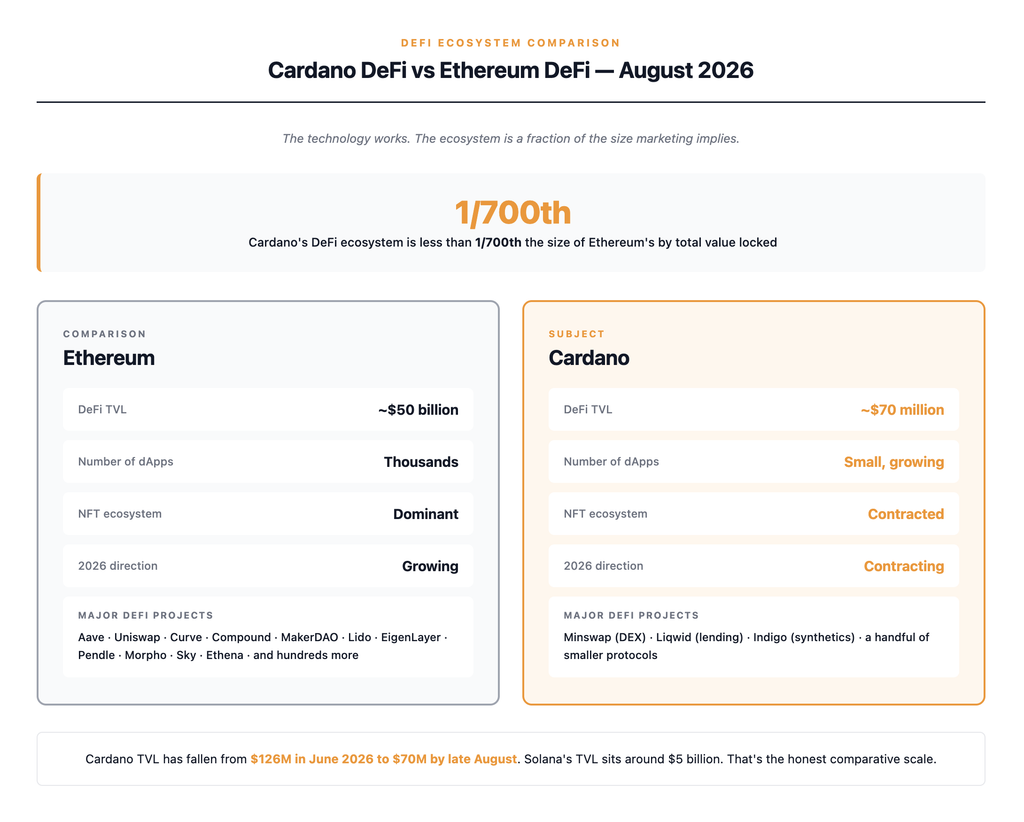
NFTs were significant on Cardano through 2023–2024, mostly traded on JPG.Store. That ecosystem has contracted sharply in 2026 — more on that in the next section.
Africa strategy is where Cardano’s mission language lives loudest. IOG signed a widely-covered partnership with Ethiopia in 2021 to deploy Atala PRISM, a digital identity system aimed at students. World Mobile, a decentralized telecom project building infrastructure in African markets, launched a Cardano-integrated network in Q1 2026. These initiatives are real, but they’ve produced more press coverage than measurable adoption. Fair framing: the Africa strategy demonstrates Cardano’s stated mission but hasn’t yet delivered a breakthrough moment.
The honest read on Cardano’s use cases: they exist, they work, and they’re modest compared to what peer chains are running. Staking is the strong spot. Everything else is smaller than the marketing suggests.
The ecosystem contraction
This is where the story gets uncomfortable for Cardano holders.
Through spring and early summer of 2026, two of Cardano’s most important pieces of ecosystem infrastructure shut down within a two-week window.
JPG.Store was Cardano’s dominant NFT marketplace, live since 2021 and the primary trading venue for Cardano NFTs by a wide margin. On April 23, 2026, it transitioned into restricted mode. On May 23, 2026, it shut down completely. The Cardano NFT trading ecosystem effectively lost its main square overnight.
TapTools was Cardano’s most-used analytics and discovery platform — the equivalent of what DexScreener is for Solana or DeFiLlama is for Ethereum. It had roughly one million users. On June 2, 2026, its team announced a two-week wind-down, citing rising infrastructure costs and unsustainable operations. Five executives had departed the company across 2026, including the co-founding CTO and COO. ADA dropped roughly 10% the day of the announcement.
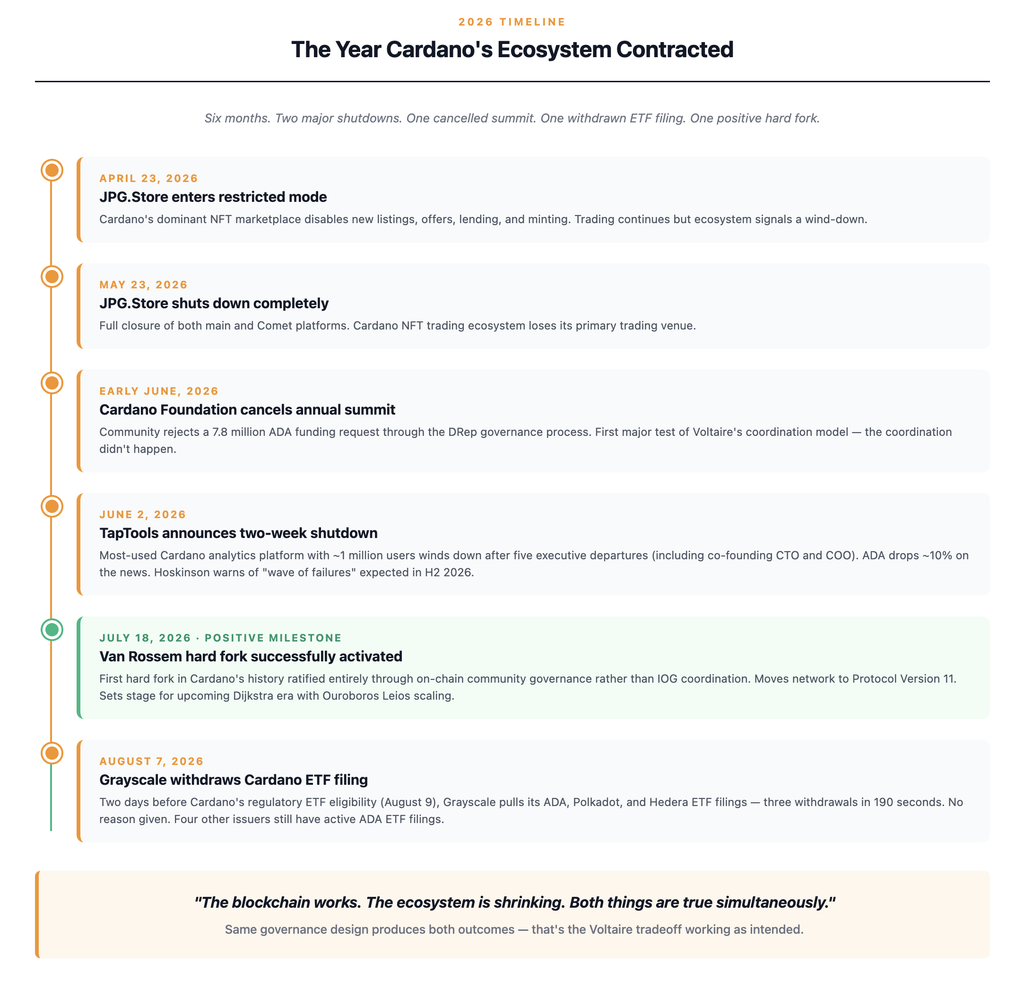
Around the same time, the Cardano Foundation cancelled its 2026 annual summit after the community rejected a 7.8 million ADA funding request through the DRep governance process. This is where Voltaire’s promise ran into real-world stress-testing. The governance model was designed to give the community control over treasury spending. In practice, it also made rapid coordinated response much harder. Foundation-led chains like Avalanche or Polygon can push through emergency funding for struggling ecosystem projects in days. Cardano’s DRep model routes those decisions through community voting, which is slower.
The Voltaire paradox: the same governance design that made the Van Rossem hard fork possible (community-ratified protocol upgrades) also made it slower to respond during a contraction (community-rejected rescue funding). Both outcomes are the same design working as intended. That’s not a bug — it’s the tradeoff working as designed. Whether that tradeoff was worth it is now an open question.
On June 2, 2026, Charles Hoskinson publicly warned that a “wave of failures” was likely in H2 2026 across the Cardano ecosystem. He called for consolidation and acquisitions to backstop struggling projects, and acknowledged that his own proposed treasury index fund proposal had failed to secure funding through the DRep process. Hoskinson has personally stepped in to acquire two struggling Cardano projects — the Nami wallet and Blockfrost API service — but noted that not every project can be rescued that way.
Here’s the pattern that matters:
- The technology is sound. Ouroboros hasn’t been broken. Peer review has delivered on its security promises.
- The ecosystem’s momentum is going the wrong direction. Key infrastructure is disappearing. TVL has fallen from $126 million in June to around $70 million by late August. No major new consumer-facing product has launched in 2026.
- The governance model designed to fix this hasn’t fixed it.
The blockchain works. The ecosystem is shrinking. Both things are true simultaneously.
The state of Cardano in 2026 (honest edition)
Here’s what is Cardano’s actual state today, in fair terms.
Price: ADA peaked around $1.00 in early 2026 before falling to roughly $0.23 by early June — a drawdown of about 77% from that 2026 high. It continued sliding through July to trade in the $0.17-0.19 range for most of the summer, then briefly surged over 15% to $0.2175 on August 21 during the broader crypto rally sparked by President Trump’s regulatory remarks. As of late August 2026, ADA trades in a range around $0.19-0.22 — down roughly 78% year-to-date. Crypto prices are highly volatile; that range could change materially by the time you read this.
For historical context: ADA’s all-time high is $3.09, reached in September 2021. Cardano has spent five years without breaking that high, while Bitcoin and Solana have both set new records in that window.
ETF status: The Cardano ETF story turned into an unusual anticlimax in August 2026. ADA officially cleared its six-month CME futures seasoning period on August 9, 2026, becoming eligible for a US spot ETF under the SEC’s streamlined listing standards. But two days earlier, on August 7, Grayscale voluntarily withdrew its Cardano Trust ETF Form S-1 registration — pulling its Cardano, Polkadot, and Hedera ETF filings in a span of 190 seconds late that Thursday afternoon. Grayscale gave no specific reason. That said, four other issuers still have active ADA ETF filings — Bitwise, Canary Capital, VanEck, and 21Shares — with the earliest possible SEC decision window falling around October 23, 2026. So the honest status: Cardano is regulatory-eligible for a spot ETF, but the biggest asset manager walked away from its filing right before the door opened. Bitcoin, Ethereum, XRP, and Solana all already have live spot ETFs on US exchanges. Cardano still doesn’t, and the path to one is now less certain than it looked six weeks ago.
Supply: 45 billion ADA total supply cap, with roughly 35 billion currently circulating. The remaining supply is released gradually as staking rewards, funded partly from the treasury.
Development activity: Still real. Aiken adoption is growing among Cardano developers. Hydra continues to ship incremental releases. IOG is actively researching post-quantum cryptography approaches. This isn’t a dead chain.
Staking: Roughly 60% of circulating ADA is staked — one of the highest participation rates of any major PoS network. That’s a genuine strength.
What ADA holders should honestly weigh:
- The technology is sound (real strength).
- The ecosystem is contracting (real weakness).
- Voltaire governance is a bet on long-term community coordination that hasn’t paid off short-term (real uncertainty).
- No ETF catalyst is on the visible horizon (real gap versus peers).
None of that tells you what ADA will do. Nobody can. But it’s the honest information environment.
How to hold and use ADA
If you want to actually hold or use ADA, here’s the practical walkthrough.
Buying: Coinbase, Kraken, and Binance all support ADA on their main exchanges. It’s one of the most widely-listed cryptocurrencies. [related article: how to buy crypto safely]
Self-custody wallets — meaning wallets where you control your own keys instead of leaving your ADA on an exchange:
- Lace is my primary recommendation for new users. It’s the official light wallet built by IOG, and as of March 2025 it added multi-chain support including Bitcoin. Clean interface, hardware wallet integration, native staking support. If you’re new to Cardano, start here.
- Daedalus is Cardano’s full-node wallet — also from IOG. It downloads the entire Cardano blockchain (10+ GB) to your computer, which makes it technically robust but slow to sync. Better suited to advanced users.
- Yoroi (from EMURGO) is the historical light wallet. Still supported, still works. Lace has largely replaced it as the default recommendation for new users.
Hardware wallets: Ledger Nano S, Nano S Plus, Nano X, and Trezor Model T all support ADA. If you’re holding more than a few hundred dollars worth, a hardware wallet is worth the investment. [related article: how crypto wallets work]
Cardano staking
Cardano’s staking model is beginner-friendly in ways Ethereum’s isn’t.
You don’t stake directly. You delegate your ADA to a stake pool — an operator who runs the actual validating infrastructure. Your ADA never leaves your wallet. There is no lockup period, meaning you can undelegate and move your ADA whenever you want. There is no slashing, meaning you can’t lose your ADA if the pool misbehaves (you just miss out on rewards).
Realistic staking yields are currently around 2–3% APY. That’s lower than the 4–5% often quoted in older marketing materials — network changes and inflation schedule adjustments have brought yields down over time.
Choosing a stake pool matters, but not enormously. Look at three things: saturation (avoid pools that are already at max capacity — they earn lower rewards), operator fees (typically 340 ADA fixed + a small margin), and uptime (higher is better). Lace, Daedalus, and Yoroi all have built-in pool browsers.
One quick risk note: staking rewards are still crypto exposure. If ADA’s price drops 30%, your 3% yield doesn’t offset that. Yield is not the same as guaranteed return.
Common questions
Is Cardano the same as ADA?
No — and this trips up a lot of beginners. Cardano is the blockchain (the underlying network and technology). ADA is the native cryptocurrency that runs on it. It’s the same distinction as Ethereum (the blockchain) versus ETH (the token). When someone says “Cardano’s price went up,” they mean ADA. When someone says “Cardano launched a new feature,” they mean the network.
Is Cardano a good investment?
That’s a personal financial question and I can’t answer it for you. What I can say honestly: ADA is down roughly 77% from its 2026 high, the ecosystem has contracted meaningfully in 2026 with two major infrastructure shutdowns, and there’s no ETF catalyst visible. On the other side, the underlying technology has never been exploited, staking participation is healthy, and development continues. Whether that risk/reward matches your situation depends on your time horizon, your existing portfolio, and your tolerance for further drawdowns. Nothing about crypto is a guaranteed anything, and Cardano specifically carries ecosystem-momentum risk that peer chains carry less of right now.
What happened to Cardano’s ecosystem in 2026?
Two key pieces of infrastructure shut down within two weeks. JPG.Store, Cardano’s dominant NFT marketplace, closed fully on May 23, 2026 after transitioning to restricted mode in April. TapTools, the most-used Cardano analytics platform with roughly 1 million users, announced a two-week wind-down on June 2, 2026 due to unsustainable infrastructure costs and executive departures. Around the same time, the Cardano Foundation cancelled its annual summit after the community DRep vote rejected the funding proposal. Charles Hoskinson publicly warned of a “wave of failures” expected in H2 2026 and called for consolidation across struggling ecosystem projects.
How does Cardano staking work?
You delegate your ADA to a stake pool through a wallet like Lace, Daedalus, or Yoroi. Your ADA stays in your own wallet the entire time — you’re not sending it anywhere. There’s no lockup period (you can undelegate any time), no slashing risk (you can’t lose your ADA if the pool misbehaves), and rewards are paid out roughly every five days. Current realistic yields are 2–3% APY. Compared to Ethereum staking, Cardano’s model is significantly more beginner-friendly because you keep custody the entire time.
Why is Cardano slower than Ethereum or Solana?
By design. Every major Cardano protocol change goes through academic peer review — meaning research papers are written, submitted to conferences or journals, reviewed by outside academics, and revised before the change is implemented. That process takes months to years. Ethereum and Solana ship changes on much faster cycles, sometimes with more bugs but also with much faster feature velocity. Cardano is betting that formal correctness matters more over decades than fast shipping does today. It’s a real philosophical difference, not just execution.
Where to go from here
If you want to compare Cardano to the other major Layer 1 blockchains, read the programmability-first take in What is Ethereum, the speed-first take in What is Solana, and the institutional-first take in What is XRP.
If you’re setting up your first Cardano wallet, how crypto wallets work walks through how self-custody actually functions and what to watch out for.
If you don’t own any ADA yet and want to understand the safe way to buy crypto in general, start with how to buy crypto safely.
A note on financial advice
This is educational content, not financial advice. Cardano carries specific risks beyond the usual crypto volatility: ecosystem contraction risk (the pattern of 2026 shutdowns could continue), governance execution risk (the Voltaire DRep model may keep struggling to coordinate rapid responses), no-ETF-catalyst risk (peers have spot ETFs, Cardano doesn’t), and long-term price stagnation risk (five years without breaking the 2021 all-time high).
Do your own research, size positions to what you can afford to lose, and remember that a technically sound blockchain and a healthy ecosystem are two different things. Right now Cardano has the first and is working through problems with the second.