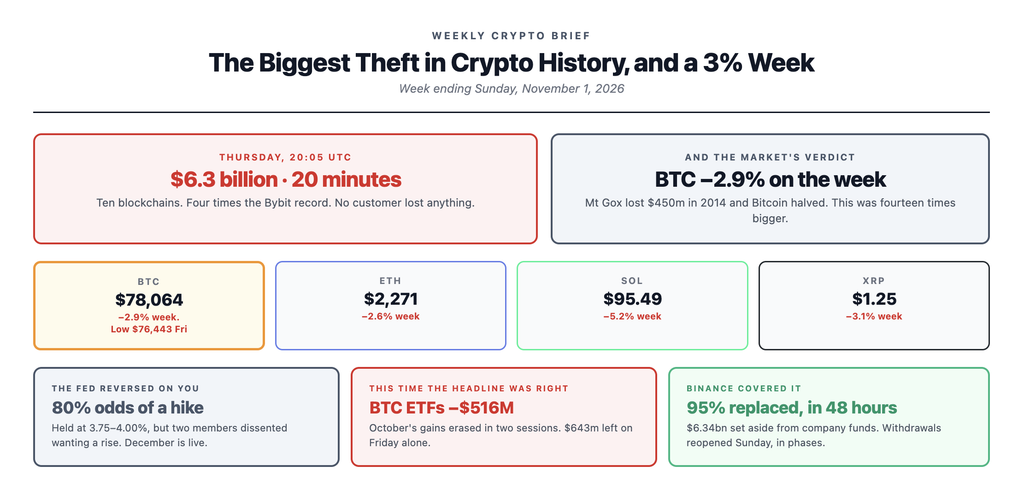
On Thursday night, attackers took $6.3 billion from Binance in about twenty minutes. The Binance hack is the largest theft in the history of this asset class, more than four times the previous record. Bitcoin finished the week down 2.9%.
Both of those facts are true, and the gap between them is the most interesting thing that happened this week.
What happened at Binance
From 20:05 UTC on Thursday, attackers drained Binance wallets across ten blockchains. Blockchain analysis firms put the total at about $6.36 billion; Binance says $6.3 billion. Most of it left inside twenty minutes.
For scale: the previous record was $1.5 billion, taken from Bybit in February 2025. This was more than four times larger. It was also about 4% of everything Binance was holding.
Binance’s first explanation was a compromised laptop belonging to one of its DevOps engineers, which gave the attacker access to a service container and from there the ability to push through withdrawals. By Friday that account had changed. Co-CEO Richard Teng said investigators had found “additional points of breach” and that “this was not a single ‘one-click’ action.” Binance maintains no wallet private key was leaked. Mark Karpeles, who ran Mt Gox when it collapsed, told Reuters he thinks the attackers had keys to at least two wallets. That disagreement is unresolved and worth leaving unresolved.
One detail stands out. 18,270 BTC — about $1.42 billion — moved from a cold wallet into nineteen fresh addresses, seventeen of which hold exactly 1,000 BTC each. CryptoQuant’s Julio Moreno noted that none of it has touched an exchange, a bridge or a mixer. It is simply sitting there.
TRM Labs assessed with high confidence that the attacker was TraderTraitor, a North Korean unit linked to the Lazarus Group. Chainalysis reached the same conclusion, noting that funds from September’s Bitget exploit were mixed in with the Binance money. Binance itself has been more careful: Teng said on X that “our investigation has not attributed responsibility to any individual.”
Nobody lost their money, and that is worth understanding properly
About $3 billion was frozen within hours, most of it by Tether and Circle, who can freeze their own stablecoins. Bitcoin and ether cannot be frozen that way, which is why roughly $2.9 billion is still sitting in the attacker’s wallets.
Binance set aside more than $6.34 billion to cover the gap. By Saturday it said 90% of the stolen assets had been replaced; by Sunday, 95%. The remaining 5% is in less liquid tokens it is still buying on open markets. The money came from corporate treasury, part of the futures insurance fund, and a partial deployment of SAFU — the emergency fund, which held around 15,000 bitcoin, less than a fifth of what was taken.
Withdrawals reopened on Sunday between 06:00 and 09:00 UTC, in phases, starting with bitcoin, ether, USDT, USDC, BNB and XRP plus fifteen other chains. Later phases have no dates yet; each blockchain has to pass its own checks first. “Resuming withdrawals is a major milestone,” a Binance spokesperson said, “but our work continues.”
So no customer lost anything. That outcome deserves to be stated precisely, because the precise version is the useful one: your balance on an exchange is that company’s promise to you, not your property. This week the promise was honoured, by a company large enough to write a $6.34 billion cheque out of its own pocket. An exchange without that balance sheet would be insolvent this morning, and its users would be creditors in a bankruptcy rather than account holders.
The lesson isn’t that exchanges are unsafe. It is that “my coins are on Binance” and “I own coins” are different sentences, and the difference only becomes visible on a week like this one.
Why the Binance hack barely moved the price
Bitcoin fell about 4.2% on Thursday after the Binance hack, touched a six-week low of $76,443 overnight, and spent the rest of the week recovering. On the week it is down 2.9%.
Set that against history. Mt Gox lost roughly $450 million in 2014 and bitcoin fell by about half. This was fourteen times larger in dollar terms and produced a bad Thursday.
Part of that is real: the market is deeper, the loss fell on a company rather than on users, and the response was fast enough that solvency was never seriously in question. Part of it is that something else was already dragging the tape down, which makes the hack harder to isolate.
On Thursday, Alphabet fell 12.6% — its worst day since listing in 2004 — on heavy AI spending and negative free cash flow. On Friday the Nasdaq dropped 2.86% and the S&P 500 1.8%, with Intel down 28.6%, Reddit down 29.2% and Roblox down 18.1%. Gold fell 3.6%. That was not the hack. That was a repricing of the AI trade, and crypto went with it, as it has every week for a month now.
The Fed, and the thing that changed
On Wednesday the Federal Reserve held rates at 3.75%–4.00%. Two members dissented — Governor Lisa Cook and Cleveland Fed President Beth Hammack — and both wanted a rise, not a cut. Chair Kevin Warsh offered little guidance beyond “I feel good about the sign posts,” and the statement said only that “the accumulation of more information will help the Committee determine the policy stance.”
After the press conference, futures priced roughly an 80% chance of a rate hike in December.
If you have been reading about crypto for a couple of years and have absorbed the idea that the Fed is cutting and that this is good for risk assets, update that. The direction has reversed. A hiking cycle makes cash and bonds more attractive and speculative assets less so, and it is the simplest available explanation for why crypto spent October going down while the industry’s own news was mostly fine.
The ETF flows, which this week really were bad
For three weeks running we have pointed out that the alarming ETF headline missed the week. This week it didn’t.
Bitcoin ETFs saw $643.2 million leave on Friday alone, led by BlackRock’s IBIT at $233.7 million and Fidelity’s FBTC at $201 million. Not a single fund took money in that day. The week ended at −$202.4 million, and October closed at −$515.9 million — a month that had been up $111.2 million through the 28th, wiped out in two sessions. September, for comparison, was +$2.65 billion.
Ethereum ETFs are worse: eleven consecutive days of outflows, $431.5 million for the week and about $1.61 billion for October.
We will go on saying it when the headline overstates things. It would be worth nothing if we said it when the headline was right.
The echo nobody quite wants to mention
There is a historical rhyme here, and it cuts in an unexpected direction.
Crypto’s total market value peaked near $4.3 trillion on 7 October 2025 and sits about 39% below that today. The last three bear markets bottomed eleven to thirteen months after their peaks — January 2015, December 2018, November 2022. The Binance hack landed nearly thirteen months into this one.
The closest parallel is FTX, which halted withdrawals on 8 November 2022, roughly a year after that cycle’s top. The market bottomed two weeks later. Six months after the freeze, total crypto value was up about 18% and bitcoin about 40%.
Treat that as a pattern with three data points, which is what it is, and not as a forecast. The differences matter as much as the echoes: FTX was insolvent and its users lost their money, while Binance is solvent and covered the loss from its own funds. One was a run on a company; this was a theft from one. But the timing is close enough that you will see the comparison made all week, and now you know what it rests on.
Where prices sit
BTC $78,064 · −2.9% week · six-week low $76,443
ETH $2,271 · −2.6% · SOL $95.49 · −5.2% · XRP $1.25 · −3.1%
Total market cap $2.69T, down from $2.76T. Bitcoin dominance 58.3%. Fear & Greed has fallen to 30 — “Fear” — from 51 a week ago and 74 a month ago.
Bitcoin is now about 38% below its record high of $126,000 set on 6 October 2025.
In Tuesday’s article on bull runs and bear markets we set out the five tests people use to decide which one they are in. Four of them now read bear: the drawdown from the high, the 50-day average at roughly $80,600, the 365-day average, and sentiment, which has moved out of neutral into fear. One still reads bull — price remains above the 200-day average.
Two corrections, both ours. That article put the 200-day average at around $72,900 and said bitcoin sat about 10% above it. Better sources this week put it near $76,300, which means the margin is closer to 2% than 10%. The verdict on that test is unchanged — price is above it — but the comfort implied by “10% above” was not real, and the article is being corrected. Separately, last Sunday we said Friday’s options expiry would be $12.3 billion with a max pain of $79,000. It came in at $10.92 billion with max pain at $78,000, and settled at $78,119 — $119 above the line. Max pain drifts as positions close, but we printed the numbers, so here are the right ones.
Also this week
Kraken went down for an hour on Friday morning, 02:42 to 03:42 UTC, blocking some customers from placing spot and derivatives orders. No cause given. Second exchange failure in a week, both during volatile hours.
Washington reacted fast. CFTC Chair Michael Selig said “the real issue here is that these are unregulated offshore exchanges.” The Digital Chamber wrote to Congress urging immediate passage of a bill giving the CFTC authority over crypto exchanges, with customer funds segregated in bankruptcy: “we urge you to act before this Congress adjourns.” President Trump, asked about North Korea, said “we don’t know” and that the government is “looking at that.”
The OCC approved Ripple National Trust Bank on Monday, which will manage the reserves backing the RLUSD stablecoin and provide custody. The same day it encouraged community banks to become stablecoin issuers under the GENIUS Act.
New on the site. We published a guide to checking a token before you buy it — honeypots, mint and freeze authority, locked liquidity and holder concentration, each one shown by hand on a block explorer before any tool gets involved. It is the first guest article we have run. It was written by DexTrading, carries their byline and a disclosure at the top, and we edited it before publishing, including stripping out the names of the small tokens used as examples. Those rules are now standing policy for anything written by someone else.
What to watch
Mon 2 Nov Binance proof-of-reserves results; full cryptographic proof expected by the 3rd · Tue 3 Nov US midterms — all 435 House seats and 35 Senate seats · Fri 6 Nov October jobs report, which feeds December’s Fed decision · Mon 11 Nov MSCI final exclusion list · Mon 30 Nov exclusions effective · Wed8–9 Dec FOMC
On the midterms: prediction markets on Thursday had Democrats at 92–94% to take the House and 69% for the Senate, which would mean a divided Congress and slower legislation, leaving the SEC and CFTC to keep making the rules themselves. The CLARITY Act, which failed a Senate procedural vote 49–50 in September, expires on 3 January if nothing happens in the lame-duck session.
Resist anyone telling you what the result does to the price. Bitcoin’s thirty-day move after the last six US elections ranges from −45.2% to +43.5%. There is no pattern there, only six coincidences.
The bigger picture
The Binance hack was the largest theft in the history of crypto, and the market’s verdict was a 3% week and a Sunday morning recovery. That is a genuine sign of a deeper, more resilient market than the one that existed in 2014.
It is also a sign of something less comfortable. It held because one very large private company chose to absorb a $6.3 billion loss, and could. No rule required it. No insurance covered it. Nothing about the structure of the market made it inevitable — it was a decision, made by a company with the balance sheet to make it.
Meanwhile the thing actually moving prices was a Fed that may raise rates in December and a stock market reconsidering how much artificial intelligence is worth. Crypto spent the week being a high-beta technology asset that happened to also get robbed.
Where to go next
New to this and wondering what any of it means for you:
- How crypto wallets work — the difference between an exchange balance and coins you control, which is the whole subject of this week
- How to buy crypto safely — choosing where to buy, and what to do after
- What is a DEX? — trading without an exchange holding anything
- Dollar-cost averaging — the approach that doesn’t require you to have a view on any of this
- Crypto bull run vs bear market — the five tests, and why they disagree
- How to check a token before you buy it — what you can verify on-chain before spending anything
See you next Sunday.
A note on financial advice
This is a summary of the week’s news, not advice. Nothing here is a recommendation to buy or sell anything. Crypto carries a real risk of total loss, and the events of this week are a reminder that risk includes places you may not have thought to look — not just the price of what you hold, but where you hold it. Only invest what you can afford to lose entirely, and make your own decisions based on your own circumstances.