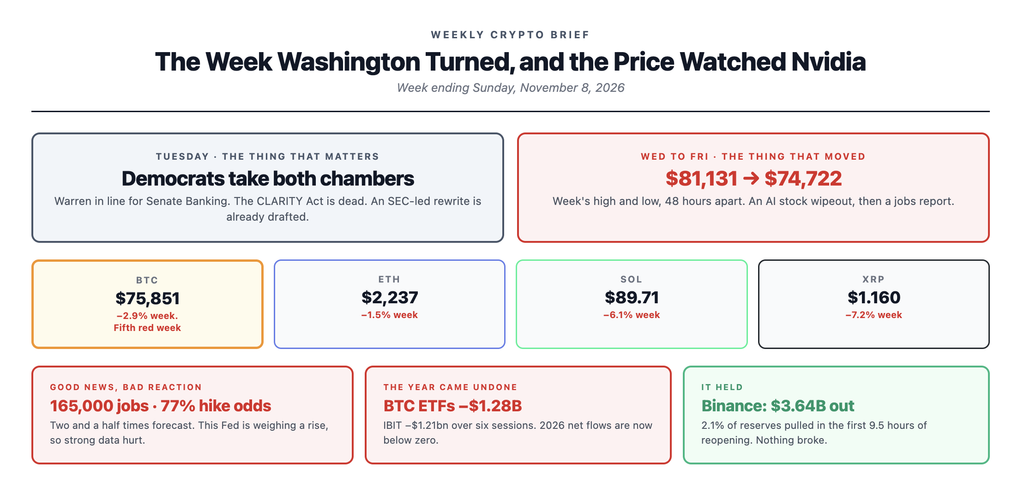
On Tuesday, the crypto industry lost almost everything it wanted in Washington, the CLARITY Act included. On Wednesday, Bitcoin hit the week’s high. On Thursday it fell with the semiconductor stocks, and on Friday a strong jobs report took it to the week’s low.
The high and the low were forty-eight hours apart. Neither had anything to do with crypto.
The CLARITY Act dies, and Washington turns
Democrats won the House and the Senate on Tuesday, taking control from January. CBS projects at least 54 Senate seats, with two races still uncalled: Alaska, and Mississippi, where Colom leads Hyde-Smith by around 2,500 votes and counties certify by 13 November.
For crypto, three things follow.
Elizabeth Warren is in line to chair the Senate Banking Committee. The industry’s most persistent critic takes the gavel over the committee that writes its rules. Maxine Waters is in line to chair House Financial Services.
The CLARITY Act is finished. The market-structure bill passed the House 294–134 in July 2025, then failed a Senate procedural vote 49–50 in September. It expires on 3 January 2027 unless the Senate moves it in the lame-duck session, which almost nobody now expects. Lee Reiners of Duke put it to CNBC in three words: “CLARITY is dead.” Nobody in the industry is disputing him.
A replacement is already being written. House Democrats have been drafting one since the summer, built on an amendment Waters proposed in 2025. Reporting describes it as SEC-led rather than CFTC-led — a reversal of the CLARITY Act’s entire structure — with insurance or SIPC-style coverage for customer assets, monthly proof-of-reserves attestations, stricter custody rules, limits on platforms trading against their own customers, and open questions about whether DeFi should be permitted at all. Republicans who have seen it call it a messaging bill. It is not public yet.
Whatever you think of any of that, it is the most consequential thing that happened to crypto this week, and it is the one thing on this page that will still matter in three years.
Why the price ignored it
Wednesday was the best post-midterm day on Wall Street in forty-four years. Bitcoin went above $80,000 and touched $81,131, the week’s high. US spot Bitcoin ETFs took in $74.6 million — the only inflow day of the week.
Thursday gave it all back and more. A chip and AI-stock wipeout sent the S&P 500 down 4.4%, the Dow down 1,800 points, and the Nasdaq into correction. The Magnificent Seven lost around a trillion dollars in a single session; roughly three trillion came off the market overall. Bitcoin fell to about $75,573 and ether lost more than 6%.
This is the same AI-valuation anxiety that knocked 12.6% off Alphabet the week before. It is now five weeks running that the best explanation for a move in crypto has been something happening in technology stocks.
Friday finished the job, and it finished it with good news.
The jobs report, and why good news hurt
The October employment report showed 165,000 jobs added against a prior twelve-month average of just 48,000 — roughly two and a half times what forecasters expected. Unemployment held at 4.1%. Average hourly earnings rose 0.4% on the month and 3.1% on the year. August and September were both revised up, adding another 84,000 between them.
By any ordinary measure that is a good report. Markets fell anyway.
The reason is the one we flagged last week: this Fed is considering a rate rise, not a cut. Two members already dissented in October wanting one. A labour market this strong removes the main argument against moving, and futures priced the odds of a December hike at 76.8% after the release — up from about 67% a week earlier.
If you have internalised the idea that strong employment data is good for risk assets, this is the cycle where that stops being true. Higher rates make cash and bonds more attractive and speculative assets less so, and a jobs report that makes a hike more likely is a jobs report that makes Bitcoin less attractive on the margin. The next FOMC is 8–9 December.
Where prices sit
BTC $75,851 · −2.9% week · high $81,131 Wed · low $74,722 Fri
ETH $2,237 · −1.5% · SOL $89.71 · −6.1% · XRP $1.160 · −7.2%
Total market cap $2.56T, down from $2.69T. Bitcoin dominance 59.3%, up a point — the altcoins fell harder, which is the usual pattern when people are reducing risk rather than rotating it.
Fear & Greed reads 28, “Fear”, up from 25 on Saturday. It was 30 when we wrote last Sunday, and 50 as recently as Thursday.
Unless something unusual happens before the close, this is Bitcoin’s fifth consecutive losing week. It is now about 40% below the record high of $126,000 set on 6 October 2025.
One number worth knowing. Glassnode’s “short-term holder cost basis” is the average price paid by everyone who has bought in the last 155 days — since early June. It currently sits at $75,700, which is to say almost exactly where Bitcoin is trading. About 38% of those coins are in profit, against more than 97% in early October. That line tends to act as support when the market is rising and resistance when it is falling, and the market is currently falling.
In our article on bull runs and bear markets, four of the five tests now read bear. The 200-day moving average, at about $73,200, is the only one still reading bull — and Bitcoin is now 3.5% above it rather than the 10% it was a fortnight ago.
The ETF year went negative
US spot Bitcoin ETFs lost $1.28 billion across the week, six times last week’s outflow. Per Farside Investors, BlackRock’s IBIT alone accounted for about $1.21 billion of it across six consecutive sessions.
The consequence is worth stating plainly: the 2026 net balance for US spot Bitcoin ETFs is now below zero. Everything that went in this year has come back out.
We spent three weeks in October pointing out that scary ETF headlines were overstating things. They are not overstating things now.
Binance survived its own bank run
Withdrawals reopened on 1 November, a few days after the $6.3 billion theft. In the first nine and a half hours, customers pulled a net $3.64 billion — about 2.1% of the exchange’s reserves. Nothing broke. Remaining chains are expected back by around mid-November.
On 31 October the FBI formally attributed the hack to North Korea’s TraderTraitor group, matching what Chainalysis and TRM Labs had already concluded.
A fortnight ago the open question was whether Binance was solvent. It was.
Also this week
The US Treasury cut MEXC off from the dollar system. A FinCEN order on 6 November bars American financial institutions from moving money to or from the exchange, citing roughly $16 billion in illicit flows. It takes effect 30 days after publication. We excluded MEXC from our guide to buying crypto safely when we wrote it, on the grounds that its listings skewed speculative. That call has aged better than we expected.
Trump Media moved 4,259 bitcoin to Crypto.com on Wednesday, roughly $340 million, nearly matching the collateral pledged against $1 billion of convertible notes whose holders can demand repayment from 30 November. Reporting is split on whether this is a sale, a collateral transfer or routine custody. Nobody outside the company knows, and we are not going to guess.
Russia will let licensed firms offer retail trading in bitcoin, ether and USDT from 17 November.
Two corrections
The first is ours twice over. Last Sunday we told you that our article on bull runs and bear markets had the 200-day moving average wrong, and that it should read about $76,300 rather than $72,900. That correction was itself wrong. Two readings this week put the figure at $73,192 on 6 November, and a 200-day average cannot move thousands of dollars in a week — the arithmetic doesn’t allow it. The original number was right, the correction was not, and the article has been changed back.
The second is smaller. We said December rate-hike odds were running at about 80%. Futures markets had them at closer to 67% by the end of October, before Friday’s jobs report lifted them to 77%. The direction we described was right; the level was high.
We would rather print both of these than have you find them yourself.
What to watch
Tue 10 Nov October CPI, the last inflation reading before the Fed decides · Wed 11 Nov MSCI index review · Fri 13 Nov Mississippi certifies · Tue 17 Nov Russia opens retail trading · Wed 18 Nov October FOMC minutes · Wed 25 Nov PCE inflation and Q3 GDP · Mon 30 Nov MSCI changes effective; Trump Media note deadline · 8–9 Dec FOMC
Tuesday’s inflation print is the one that matters. With a hike already at 77%, a hot number makes December close to settled.
The bigger picture
This was the week the political ground shifted under crypto, and the chart didn’t notice.
That is worth sitting with, because it cuts against how most people are taught to read markets. The instinct is to treat the price as a running verdict on the asset — if something important happens to crypto, the price should say so. This week the single most important development in years for how crypto will be regulated in the United States produced a rally, then a selloff caused by Nvidia’s customers, then a further selloff caused by American employers hiring more people than expected.
The price is not a verdict on crypto. Most weeks it is a verdict on interest rates and technology stocks, with crypto along for the ride. And the things that will actually determine what this industry looks like in 2030 — who chairs which committee, which agency writes the rulebook, whether customer assets get insured — move no charts at all on the day they happen.
Where to go next
New to this and wondering what any of it means for you:
- How crypto wallets work — the difference between an exchange balance and coins you control
- How to buy crypto safely — choosing where to buy, and why we left some exchanges out
- Dollar-cost averaging — the approach that doesn’t require a view on rate decisions
- What is a DEX? — trading without an exchange holding anything
- Crypto bull run vs bear market — the five tests, and why they disagree
- How to check a token before you buy it — what you can verify on-chain before spending anything
See you next Sunday.
A note on financial advice
This is a summary of the week’s news, not advice. Nothing here is a recommendation to buy or sell anything. Crypto carries a real risk of total loss, and five consecutive losing weeks is a reminder that markets can keep going in one direction for longer than feels reasonable. Only invest what you can afford to lose entirely, and make your own decisions based on your own circumstances.