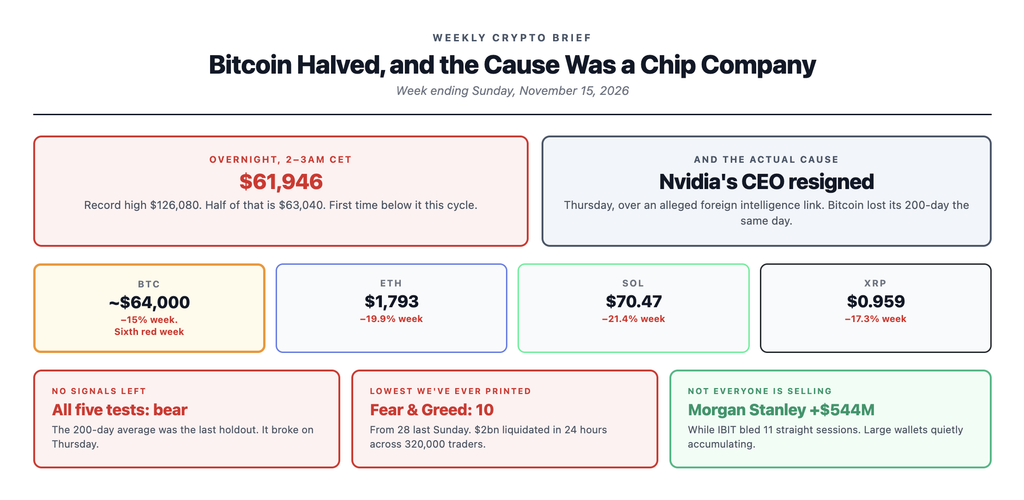
Somewhere between two and three o’clock this morning, Bitcoin traded at $61,946. Its record high, set on 6 October last year, was $126,080. Half of that is $63,040.
For the first time in this cycle, Bitcoin was worth less than half what it was worth at the peak.
It has since recovered to around $64,000, which still leaves it down about 15% on the week — the sixth consecutive losing week of this crypto bear market, and the worst of them. The clearest single cause was a resignation at a semiconductor company.
The resignation
Jensen Huang resigned as Nvidia’s chief executive on Thursday, effective immediately. Nvidia’s filing with the SEC confirms it and gives no reason. Colette Kress, the finance chief, is interim CEO while keeping her existing job. Harvey Jones becomes the company’s first-ever board chair.
The reason, reported by Al Jazeera, Reuters, the Washington Post and others, is a relationship with a woman described as an alleged Chinese intelligence asset — a former executive at Megaspeed, Nvidia’s main partner in Southeast Asia, which is itself under investigation over whether Chinese companies gained access to its $4.8 billion stock of Nvidia chips. The FBI, Congress and Nvidia’s own board are all investigating. Huang has agreed to testify before Congress.
Nvidia’s market value fell below $4 trillion for the first time since July 2025.
Bitcoin broke below its 200-day moving average the same day. On Friday it fell under $70,000 for the first time since August, then broke its 200-week line — a level that has held through most of Bitcoin’s history.
If you are wondering what a chip executive’s private life has to do with the price of Bitcoin, that is the right question, and we’ll come back to it.
Two inflation readings, both bad
Tuesday: October consumer prices rose 0.4% against the 0.3% expected, with core inflation at 0.3% against 0.2%. Energy rose 0.7%, food 0.5% — the biggest monthly food increase since April — and transportation services 0.8%.
One oddity worth knowing: the Bureau of Labor Statistics could not publish year-on-year figures, because last year’s government shutdown meant October 2025 was never collected. You will see an estimate of “around 4%” quoted. It is an economist’s estimate, not an official number.
Friday: producer prices rose 6.5% on the year — the largest twelve-month increase since November 2022.
The consequence was immediate. Futures now put the chance of a quarter-point rate rise on 8–9 December at about 90%, with a further 10% on a half-point move. The probability of the Fed doing nothing is zero. Governor Christopher Waller said he would back a quarter point and could push for a half if inflation runs hotter.
Where prices sit
BTC ~$64,000 · −15% week · overnight low $61,946
ETH $1,793 · −19.9% · SOL $70.47 · −21.4% · XRP $0.959 · −17.3%
Total market cap $2.27T, down from $2.56T. The altcoins fell considerably harder than Bitcoin, which is what tends to happen when people are reducing risk rather than moving between assets.
Fear & Greed stands at 10 — “Extreme Fear”. It was 13 yesterday, 20 on Friday, and 28 when we wrote last Sunday. That is the lowest reading we have ever published in this brief.
More than $2 billion of leveraged positions were liquidated in twenty-four hours, hitting over 320,000 traders. In Bitcoin alone, roughly $600 million of that was people betting the price would rise.
The crypto bear market is no longer in dispute
Three weeks ago we published an article on bull runs and bear markets built around a single observation: the five tests people use to decide which one they are in frequently disagree, which is why the labels arrive late and why nobody can tell you in the moment.
This week they stopped disagreeing.
| Test | Reading | Verdict |
|---|---|---|
| Drawdown from the high | ~49% below | Bear |
| 50-day average | far below | Bear |
| 200-day average | broke below Thursday | Bear |
| 365-day average | below | Bear |
| Sentiment | 10, Extreme Fear | Bear |
The 200-day average was the last one holding out. When we published on 28 October, Bitcoin sat about 10% above it. It lost that line on Thursday.
So the answer to “are we in a bear market” is now, finally, unambiguous. Which is exactly the point the article was making: by the time the measurements agree, the move has already happened.
On the halfway mark
Bitcoin trading below half its record high sounds like it should mean something. It is worth being careful about what.
The same article looked at how far previous crypto bear markets actually fell. The 2014–15 downturn took Bitcoin down 84%. The 2018–19 one, 84%. The 2022–23 one, 77%.
At roughly 49%, this is still the shallowest of the four. That is not a prediction that it will fall further — nobody knows that, and these are three data points, not a law. But “it has already halved, surely that’s the floor” has no support in the only history this asset has. Anyone telling you a specific number is the bottom is guessing, including the ones who turn out to be right.
The money leaving
US spot Bitcoin ETFs lost about $1.07 billion across the week, per Farside Investors, with Ethereum funds losing a further $399 million. BlackRock’s IBIT accounted for $908 million of the Bitcoin total and has now seen redemptions for eleven consecutive sessions, roughly $2.1 billion in November — about 90% of everything that has left US Bitcoin ETFs this month.
Across the seven sessions from 5 to 13 November there was not one day of inflows.
One counterpoint that deserves printing: Morgan Stanley’s new Bitcoin fund took in $544 million over the same stretch. And Glassnode reports steady buying from wallets holding between 100 and 10,000 BTC. Money is leaving, but not everyone is selling.
The Fed named the risk, and didn’t mention crypto
The Federal Reserve published its twice-yearly financial stability report on Friday. Its first and largest category of vulnerability was elevated asset valuations — equities, corporate credit and real estate. It also noted that hedge fund leverage has reached its highest level since records began in 2013, concentrated in a handful of large funds. The ten-year Treasury yield closed Friday at 5.15%.
The report does not mention Bitcoin anywhere.
That is the week in one detail. The institution describing the risk did not consider crypto part of the picture, and crypto is where the risk showed up hardest.
Also this week
MSCI confirmed it is removing Strategy from its global indexes, along with Japan’s Metaplanet, effective after the close on 30 November. The honest version is duller than the headlines: index funds would need to sell about 13 million shares, roughly 3.1% of the company, worth around $1.6 billion — less than a typical day’s trading. Strategy is not delisted and is not forced to sell any of its 850,364 bitcoin. The real pressure is on its funding model, which works by issuing shares at a premium to the bitcoin they buy; that premium has fallen from 3.4 times in late 2024 to about 1.08 today.
Coinbase completed its federal trust charter, putting its institutional custody business under US banking supervision.
The New York Stock Exchange picked Avalanche to run the ledger behind its planned tokenised securities venue, subject to approval.
Twenty-one banks including Goldman Sachs, Citi, Santander and Deutsche Bank committed around $270 million to a joint dollar stablecoin, targeting 2027. Deutsche Bank separately launched crypto custody for institutions in Europe.
Binance published a new reserve snapshot. The full cryptographic proof it promised for 3 November has still not appeared.
What to watch
Tue 17 Nov Nvidia reports earnings — the most important event of the week for crypto, which is itself the story · Tue 17 Nov Russia opens retail crypto trading · Wed 18 Nov October Fed minutes · Wed 25 Nov PCE inflation and GDP · Mon 30 Nov MSCI removals take effect · 8–9 Dec FOMC
The bigger picture
Bitcoin is marketed as an alternative to the financial system. Something outside it. A hedge against central banks, debased currencies, institutional failure.
This week it fell because a chip company’s chief executive resigned over a relationship with an alleged foreign intelligence asset, and because American consumer prices rose four tenths of one percent in a month.
Neither of those is a crypto event. Both of them moved crypto more than anything that happened on any blockchain. That is now six weeks in a row where the best explanation for the price has come from outside the industry entirely — and it is the single most useful thing a beginner can understand about this market right now.
You do not own a hedge against the system. You own a high-beta position inside it, one that rises faster when rates fall and falls harder when they rise. That is a perfectly reasonable thing to own, if it is what you meant to buy.
Where to go next
New to this and wondering what any of it means for you:
- Why do crypto prices move together? — the single most relevant thing we have written for a week like this one
- Crypto bull run vs bear market — the five tests, and why they only agree in hindsight
- Dollar-cost averaging — the approach that doesn’t require you to guess where the bottom is
- How crypto wallets work — the difference between an exchange balance and coins you control
- How to buy crypto safely — the basics, properly
- How to check a token before you buy it — what you can verify before spending anything
See you next Sunday.
A note on financial advice
This is a summary of the week’s news, not advice. Nothing here is a recommendation to buy or sell anything. Crypto carries a real risk of total loss. Six consecutive losing weeks and a 49% drawdown are a reminder that markets can keep moving in one direction for far longer than feels reasonable, and that previous crypto bear markets fell considerably further than this one has. Only invest what you can afford to lose entirely, and make your own decisions based on your own circumstances.