Welcome to the first Weekly Crypto Brief — our recurring summary of what actually mattered in crypto this past week. The plan is simple: once a week we’ll cover the market in plain English, point out what’s signal versus noise, and connect what’s happening today to the deeper patterns we cover in our pillar articles. No hype, no price predictions, no “top 10 coins to watch” lists.
This first edition lands during a stretch that demonstrates almost everything we just covered in our crypto market cycles guide. If you read that article and wondered what cycles actually look like from inside one — this week is your live example.
Market in brief
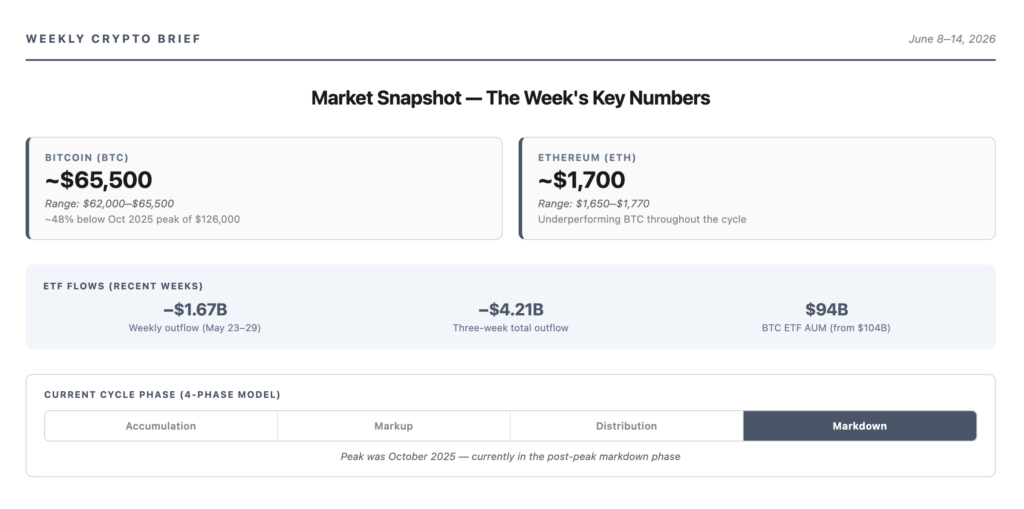
Bitcoin spent the week trading in the $62,000–$65,500 range, finishing around $65,500 by Sunday. That’s roughly half of October 2025’s peak near $126,000 — a clear continuation of the markdown phase that’s been underway since late last year. Bitcoin dropped to around $62,000 in early June as prices fell below pre-war levels.
Ethereum traded in the $1,650–$1,770 range. Below $2,000 for most of the week — significantly below its 2024-2025 highs. ETH has underperformed BTC throughout this cycle, a pattern worth noting if you hold both.
Total crypto market cap continued the consolidation pattern, with most major altcoins down sharply compared to a year ago. Smaller coins have fared even worse — typical of the markdown phase.
What actually mattered this week
1. ETF outflows continued at near-record pace
The single biggest story in crypto right now isn’t a coin pump or a tech upgrade — it’s that institutional money is leaving. Global cryptocurrency-based exchange-traded products lost $1.67 billion during the week of May 23-29, the second-largest weekly outflow of 2026. Over three weeks, total outflows exceeded $4.21 billion. US spot Bitcoin ETF assets under management dropped from $104B to $94B over a ten-day stretch.
This matters more than most weekly market stories because it’s the direct counter-evidence to “cycles are dead because institutions don’t sell.” Institutions absolutely do sell — they just sell more methodically than retail. The ETF wrapper hasn’t created a permanent floor; it’s created a more orderly form of cyclical demand. Which is exactly what we said to expect.
2. Geopolitics weighed on sentiment
Crypto markets opened June lower as tensions between the U.S. and Iran weighed on sentiment. News from the Middle East has been a major reason crypto prices have been falling, with Hezbollah rejecting Israel’s offer of a ceasefire and broader regional escalation continuing.
For anyone wondering whether “Bitcoin is digital gold” — meaning, whether it acts as a safe haven during geopolitical stress — this week’s data point is one of many showing that, at least for now, Bitcoin trades more like a risk asset than a hedge. When stocks fall on war headlines, crypto usually falls harder. That may change as the asset matures. It hasn’t yet.
3. Macro environment remained the dominant force
The broader macroeconomic landscape remains a key driver for crypto markets in June 2026. While the Federal Reserve has not yet aggressively shifted toward rate cuts, expectations around future easing continue to influence risk sentiment. Falling oil prices and a recovery in equities late in the week — including a strong Nasdaq debut by SpaceX, which surged 19% on its first trading day — provided some support, helping BTC recover from June’s lows.
The pattern is now consistent: crypto reacts to Fed signals, dollar strength, and major equity moves the same week they happen. Old-school “Bitcoin is uncorrelated” arguments don’t survive contact with the current data.
The bigger picture
If you read our market cycles article, this week is the markdown phase playing out in real time. The pattern is textbook:
- Prices well off the cycle peak (currently ~50% down from $126K)
- Sentiment ranging from anxious to despairing
- Institutional flows exiting at scale, not capitulating in panic
- Macro and geopolitical news driving most of the daily action
- “This time is different” arguments that were everywhere at the top are quieter now
What’s not textbook is the magnitude. Previous cycle drawdowns were often 75-85% from the peak. This time, we’re at roughly 50% with potentially more room down, but the violent capitulation moves of past cycles haven’t really arrived. That’s consistent with the thesis that cycles are flattening — same shape, smaller amplitude — driven by the institutional/ETF/macro forces we discussed last week.
It’s also a reminder that the “cycle is dying” narrative goes too far. The cycle isn’t dying. It’s just being absorbed into something bigger.
What this means for beginners
If you’re new to crypto and watching this week’s headlines, here’s the honest take:
This is what markdown looks like. It’s not exciting. The price keeps drifting lower in spurts, then sitting. There’s no obvious bottom. Smart-sounding people on Twitter are explaining why we’re going to $30,000 or $20,000 next. Other smart-sounding people are explaining why this is the buying opportunity of the decade. Neither group actually knows.
This is where conviction is built or broken. If you bought near the top in 2025, you’re underwater now and probably questioning everything. That’s normal. The question is whether you bought what you actually believed in (long-term) or what you got swept up in (short-term FOMO). The first is survivable. The second usually isn’t.
This is exactly when the principles from how to buy crypto safely matter most. Position size for sleep. Only what you can afford to lose. Time in the market beats timing the market. None of this changes because the market is down.
This is not the time to add leverage, chase small-cap altcoins, or “average down” with money you don’t have. Those decisions feel rational in the moment and almost always end badly.
Most importantly: this is not financial advice. If you’re stressed about your crypto position, the issue isn’t the market — it’s your position size. Adjust the second, not the first.
Looking ahead
A few things worth watching in the coming week, without predictions about how any of them will play out:
- Federal Reserve signals. Rate-cut expectations are pricing into everything. Any shift in Fed messaging will move crypto.
- Geopolitical de-escalation or escalation. Middle East developments continue to drive sentiment.
- ETF flow data. Weekly outflow reports will indicate whether institutional selling is exhausting itself or accelerating.
- Ethereum upgrade progress. Following the Pectra and Fusaka upgrades, network developments continue.
We’ll cover all of these in next week’s Weekly Crypto Brief.
Where to go after this Weekly Crypto Brief
If you’re new and the headlines are starting to feel overwhelming, the foundational articles are the right place to ground yourself: what cryptocurrency is, what Bitcoin actually is, how blockchains work, how to buy crypto safely, and the market cycles guide. Solid context beats reactive news consumption every time.
See you next week.
A note on financial advice
This article is education, not financial advice. Crypto is volatile and risky, and the prices and figures cited here will be out of date within hours of publication. Only put in what you can afford to lose entirely. Make your own decisions based on your own situation, your own research, and ideally a conversation with a financial professional who understands your circumstances.