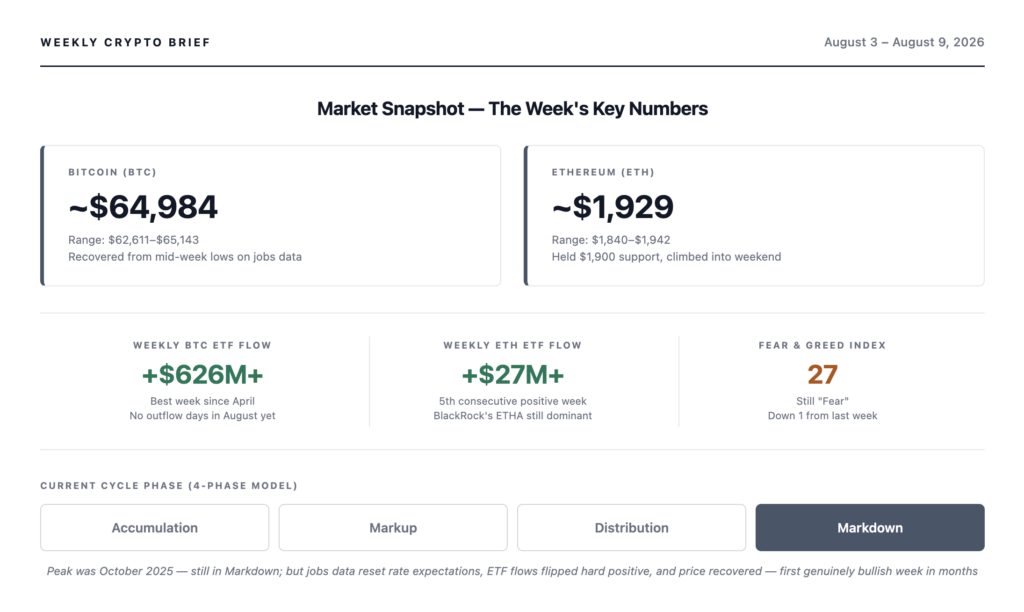
A very different week than last. This weekly crypto brief opens with a genuine surprise: the July US jobs report missed by so much that markets flipped their entire rate outlook overnight. Economists expected 80,000 new jobs. The actual number was negative 23,000 — jobs lost. That single data point reversed the hawkish tone from last week’s FOMC decision, sent Bitcoin ETF flows into their best week since April, and helped BTC climb back above $65,000. Ethereum held support at $1,900 and drifted higher into the weekend.
This is your week in crypto for the week ending Sunday, August 9, 2026. What actually moved. What matters for beginners. What’s noise dressed up as news.
The theme of the week: macro data has taken center stage again. A single labor market report reset rate-cut expectations in a way that no crypto-native news has managed all year. That’s a reminder that crypto still trades as a risk asset — Fed policy matters more than any individual crypto headline.
TL;DR
- The July jobs report missed by 103,000. Economists expected +80,000 new jobs; the actual print showed 23,000 jobs LOST. Unemployment ticked down to 4.1%. Rate cut odds jumped, Bitcoin rallied.
- Bitcoin ETFs had their best week since April with roughly $626-754M in net inflows across the four positive days. August has not yet recorded a single outflow day. BlackRock’s IBIT led with ~$479M.
- Bitcoin recovered to ~$65,000 from mid-week lows near $62,600. Ethereum held support at $1,900 and climbed to ~$1,942 on Friday.
- The Coldcard hack losses grew past $100M with 1,367+ BTC stolen across 4,585 addresses and possibly a fourth wave in progress. Move funds now if you set up a Coldcard on firmware 4.0.1 or later.
- The Bitcoin Red Team launched an emergency AI-driven security audit that filed 4,962 findings (85 critical, 635 high-severity) across 390 open-source Bitcoin projects in a 27.5-hour sprint. Verdict on ecosystem security: “extremely bad.”
- The Senate formally entered its August recess without a CLARITY Act vote. Congress returns September 11. Legislation is now “queued” for the return, per Senate Majority Leader Thune.
- Trump Media (DJT) sold another 2,628 BTC for approximately $165M, extending a seven-month liquidation of 7,281 BTC total (63% of its original treasury position).
- Fear & Greed Index at 27 (down from 28 last week). Still fear, but the ETF and price action suggest sentiment is turning.
The jobs report that changed the story
Every Friday of the first week of a new month, the Bureau of Labor Statistics releases nonfarm payrolls data. Most months, this is background noise for crypto markets. Not this month.
Economists surveyed by Bloomberg expected roughly 80,000 new jobs in July. The actual print showed 23,000 jobs LOST — a miss of over 100,000 relative to consensus. Unemployment ticked down to 4.1%, which sounds good but was primarily driven by workers leaving the labor force rather than finding new employment.
Markets moved fast:
- Rate hike expectations collapsed. The three FOMC dissents in favor of a hike (from last week’s meeting) suddenly looked less relevant. Fed funds futures repriced toward cuts rather than hikes.
- Bitcoin climbed above $65,000 within hours of the print, up 1.3% from the day’s earlier levels.
- Ethereum broke back above $1,900 and climbed to $1,942 into the weekend.
- Bitcoin ETF inflows accelerated — Wednesday alone brought $244.4M, and the week’s total reached the highest level since April.
In plain English: One month of bad jobs data doesn’t guarantee rate cuts. The Fed will want to see multiple data points confirming a slowdown before pivoting policy. But this single print materially shifted the probability distribution — markets now assign meaningfully higher odds to rate cuts by year-end. That’s the exact macro environment risk assets like crypto tend to perform in.
What it means for beginners: A bad jobs number was, paradoxically, good for crypto prices this week. That’s counterintuitive but important — because it demonstrates that crypto is currently trading on Fed policy expectations rather than crypto-specific fundamentals. When you see a big price move, ask: was there a crypto-native reason (adoption, regulation, hack, network upgrade) or a macro reason (Fed, jobs, inflation, geopolitics)? This week was macro. Understanding which is which builds real fluency over time.
ETF flows flip hard positive
Last week’s brief flagged that Bitcoin ETFs had recorded $61.53M in net outflows for the week ending July 31, with a $265.4M single-day sell-off on the final trading day of the month. That momentum reversed hard this week.
Bitcoin ETF flows for the week ending August 8 (approximate):
- 4 consecutive positive days
- Wednesday inflow: $244.4M
- Weekly total: roughly $626-754M
- The best week since April
BlackRock’s IBIT dominated inflows again, capturing approximately $479M of the total. Cumulative IBIT inflows are approaching $61 billion.
Ethereum ETFs also extended their streak. Positive weeks now stand at 5 consecutive weeks, with $27M+ added this week alone.
One important caveat: August has not yet recorded a single outflow day for Bitcoin ETFs. That’s a rarity, but it also means the current pattern is untested against negative macro data. If next Friday’s data comes in stronger than expected, we could see the streak break quickly. Don’t extrapolate a four-day trend into a permanent condition.
Bitcoin and Ethereum weekly recap
Bitcoin started the week near $63,000, dipped to $62,611 mid-week on continued weak sentiment, then reversed sharply after the jobs report. It ended the week around $64,984 — up modestly on the week overall, but recovering meaningfully from the mid-week lows.
Ethereum entered the week at $1,883, dipped to $1,840 mid-week, then held the $1,900 support level and pushed up to $1,942 by Friday. Ethereum ETF flows kept building. On-chain data showed stablecoin supply on Ethereum rose $700 million to $156.7 billion in the first week of August, and new smart contract deployments increased 18.5% — indicators of genuine network usage growing regardless of price.
For beginners: Ethereum’s ability to hold above $1,900 while Bitcoin dominated headlines is a subtle but real signal. Assets that hold support during risk-off periods often outperform when sentiment shifts. Whether that dynamic continues through August is next week’s question.
The Coldcard hack expands
Last week we covered the Coldcard hardware wallet firmware vulnerability that drained approximately $70M from 1,196 wallets in a 41-minute sweep. This week the numbers grew significantly.
Updated losses (per Galaxy Research and follow-up analyses):
- Total BTC stolen: 1,367 BTC in three confirmed waves, with Galaxy Digital’s Alex Thorn estimating losses have now exceeded $100M across roughly 1,600 BTC before a possible fourth wave.
- Affected addresses: 4,585 (up from 1,196)
- Additional wave: 207.73 BTC in a third theft wave identified this week
- The bug sat undetected in public code for five years before anyone caught it — a fact many security researchers described as the most alarming detail of the whole incident.
Coinkite issued a formal security advisory this week specifically warning users who generated seeds on Coldcard Mk3 firmware 4.0.1 or later. The company confirmed that the vulnerability affects any seeds generated on firmware from the March 2021 build forward, regardless of hardware model.
If you set up a Coldcard between March 2021 and now without adding your own dice entropy or a passphrase, treat this as urgent. Move funds to a new wallet generated on updated firmware with proper entropy sources. For a broader explainer on how hardware wallet security actually works, see how crypto wallets work.
The Bitcoin Red Team — AI-driven security review kicks off
The most interesting follow-up to the Coldcard incident is this: a volunteer group of Bitcoin developers formed an emergency security audit initiative called the Bitcoin Red Team, co-led by Bitcoin developer Calle and Rob Hamilton (CEO of self-custody insurer AnchorWatch). Their goal was straightforward — audit the broader Bitcoin open-source ecosystem to see whether other widely-used wallets and libraries share weaknesses similar to the one that sank Coldcard users.
The results after a 27.5-hour sprint are worth reading twice:
- 4,962 total security findings across 390 open-source Bitcoin projects
- 85 classified as critical
- 635 rated high-severity
- 16 security researchers working simultaneously, at an average of 2.31 critical-or-high findings per researcher per hour
- Privacy and coinjoin tools carried the highest share of serious findings — 24% of critical issues
The AI angle is the story-within-the-story. The Red Team combined manual review with frontier AI models — specifically Kimi K3, GPT Sol, Fable, Opus, and GLM5.2 — some of the most capable models currently available. Initial audits over-relied on Chinese open-source models (Kimi K3, GLM5.2) because access to OpenAI and Anthropic frontier models was limited at first. As the effort’s profile grew, both companies extended access, giving the Red Team broader model coverage. Total AI token costs so far: roughly $40,000, covered by OpenSats (a 501(c)(3) nonprofit that funds open-source Bitcoin development).
Calle summarized the ecosystem’s state in two words: “extremely bad.” Only about one in five findings had been independently verified at the time of his last update, meaning the true rate of confirmed critical bugs may be lower — but the scale of what’s been flagged is a serious signal about the maturity gap between Bitcoin’s decade of adoption and the level of code review its infrastructure has received.
One immediate downstream effect: Boltz exchange announced this week that it would pause operations to catch up with AI-driven hacking attempts that its security team can no longer keep pace with manually.
In plain English: For the past decade, most Bitcoin open-source software has been reviewed the traditional way — humans reading code, spotting problems, filing pull requests. That process works, but slowly. When frontier AI models are pointed at the same codebases, they find things nobody noticed for years. Some of those findings will turn out to be false positives; some will turn out to be genuinely dangerous. Either way, the tempo of security discovery just changed permanently.
What it means for beginners: The Bitcoin Red Team effort is genuinely good news. Vulnerabilities being found and disclosed responsibly is exactly how security is supposed to work — better AI catching bugs early than attackers catching them later. But it also means the era of “Bitcoin has been running for years so its software must be fine” is over. Assume every piece of self-custody software you use will get more scrutiny in the coming months, and that some of it will need patching. Keep firmware current, keep entropy sources diverse, and don’t put all your holdings behind a single line of code.
CLARITY Act status: officially recessed
Confirmed this week: the Senate left Washington on August 8 for its state work period without voting on the CLARITY Act. Congress returns September 11.
Senate Majority Leader John Thune said the legislation would be “queued” when lawmakers return, meaning it stays on the calendar rather than being pulled entirely. But queued isn’t voted, and September through November is going to be dominated by midterm campaigning. The realistic 2026 window is now the November-December “lame duck” session after the elections.
Polymarket odds for 2026 passage sit around 37% — roughly the same as last week. Prediction markets have already priced in the delay.
Anti-Corruption Bureau bill introduced
Senate leaders introduced the Anti-Corruption Bureau Creation Act this week. The bill specifically targets Trump’s disclosed $1.4B in crypto-related profits from 2025 and proposes replacing existing ethics oversight entities with an independent bureau focused on political ethics enforcement.
This isn’t likely to pass either, but its introduction complicates the CLARITY Act negotiations further. Democrats who were pushing for stronger ethics provisions in CLARITY now have an alternative vehicle they can point to. Republicans who were negotiating in good faith on ethics compromise now have less incentive to concede.
In plain English: More political noise, less political progress. The regulatory framework crypto is operating under (SEC and CFTC interpretive guidance from March 17, 2026) isn’t changing anytime soon.
Corporate treasury moves: DJT sells, Strategy pauses
Two notable corporate treasury stories this week:
Trump Media Group (DJT) transferred another 2,628 BTC (worth ~$165M) to Crypto.com for liquidation. This extends a seven-month pattern of Bitcoin sales — DJT has now liquidated 7,281 BTC total, representing a 63% reduction of its original treasury position. The company realized an average price of $74,855 per coin. Remaining treasury: 4,261 BTC. DJT stock closed the week at $9.86.
Strategy (formerly MicroStrategy) did not buy Bitcoin this week — the fifth consecutive week without a purchase. Instead, the company raised $544.5M through MSTR share sales to bolster cash reserves. Michael Saylor’s position: still 843,775 BTC, still underwater on average acquisition cost of $75,476.
Corporate treasury demand — which was a major structural support for Bitcoin in 2024-2025 — has clearly softened. Whether that’s a temporary pause during a rough price stretch or a longer-term shift is one of the most important open questions in the market.
Quick hits
Iran de-escalation. Trump paused planned airstrikes against Iran on Sunday, August 3. Tail risk reduced but not eliminated — Strait of Hormuz negotiations continue.
Storj Labs Chapter 11. Decentralized storage protocol filed for bankruptcy, extending a heavy month for crypto failures that also included BitMEX’s permanent shutdown and Movement Labs’ bankruptcy filing last month.
Jackson Hole preview. The Federal Reserve’s annual Jackson Hole Symposium runs August 27-29. The 2026 theme is “Financial Innovation and Its Implications for Payments and Policy” — a focus on digital assets specifically. Fed speeches from that event will materially shape crypto sentiment heading into September.
What this actually means, if you’re a beginner
Five takeaways from this week worth pulling out:
- Macro data is the real story in 2026. A single jobs report moved crypto markets more than any crypto-native news this year. If your investment thesis doesn’t account for Fed policy, it’s incomplete.
- Bitcoin ETF flows are the clearest institutional signal. When BTC ETFs are inflowing consistently, institutional demand is real. When they’re outflowing, be more cautious. This week’s reversal from outflows to inflows is a genuine sentiment shift.
- The Coldcard incident keeps growing. If you self-custody with a Coldcard, don’t wait to check your firmware and setup method. Losses are still being discovered. This is a lesson in why hardware wallet security depends on more than just the device staying offline.
- AI-driven security review is now a permanent feature of crypto. The Bitcoin Red Team’s 4,962 findings in 27.5 hours is a preview of the next few years. Expect to see more vulnerability disclosures, more emergency patches, and more temporary service pauses like Boltz. Assume any self-custody software you use will be re-audited by AI tooling that didn’t exist two years ago.
- Corporate treasury demand is softening. DJT selling, Strategy pausing purchases — these are meaningful shifts from the “corporate treasuries buy every dip” narrative that dominated 2024-2025. Watch this trend.
Bottom line
That’s your weekly crypto brief. A weak jobs report reset macro expectations, Bitcoin ETFs had their best week since April, Bitcoin recovered to $65K, Ethereum held $1,900 and climbed to $1,942, the Coldcard hack grew past $100M, the Bitcoin Red Team launched an AI-driven ecosystem audit and found nearly 5,000 flaws in 27.5 hours, and the CLARITY Act formally entered recess.
Don’t check the price on Monday morning. If you have a dollar-cost averaging plan, stick to it. If you’re still figuring out how crypto wallets work, how to buy safely, what a DEX actually is, or what Ethereum actually is, those are useful weekend reads.
See you next Sunday.
A note on financial advice
This article summarizes news, not recommendations. Nothing here is a suggestion to buy, sell, or hold any specific cryptocurrency. Crypto markets are volatile and genuinely risky. Only put in what you can afford to lose entirely, and make your own decisions based on your own situation.