Last week, Bitcoin posted its biggest rally in two years and we called the coming six weeks “more consequential than any six weeks we’ve had in 2026.” This week, the Fed Chair proved us right — by taking most of it back.
This is your weekly crypto brief for the week ending Sunday, August 30, 2026. Kevin Warsh’s first Jackson Hole speech as Fed Chair flipped rate-cut expectations from near-certain to genuinely uncertain, Bitcoin dropped 3% on the news, and the CLARITY Act vote sitting three weeks out on the calendar now has to do a lot more work than it did seven days ago.
What actually moved
Here’s the price action across the majors, followed by the story that drove all of it. If you’ve been reading this weekly crypto brief for a while, you’ll recognize the pattern: one big Fed catalyst, one big price reaction, everything else secondary.
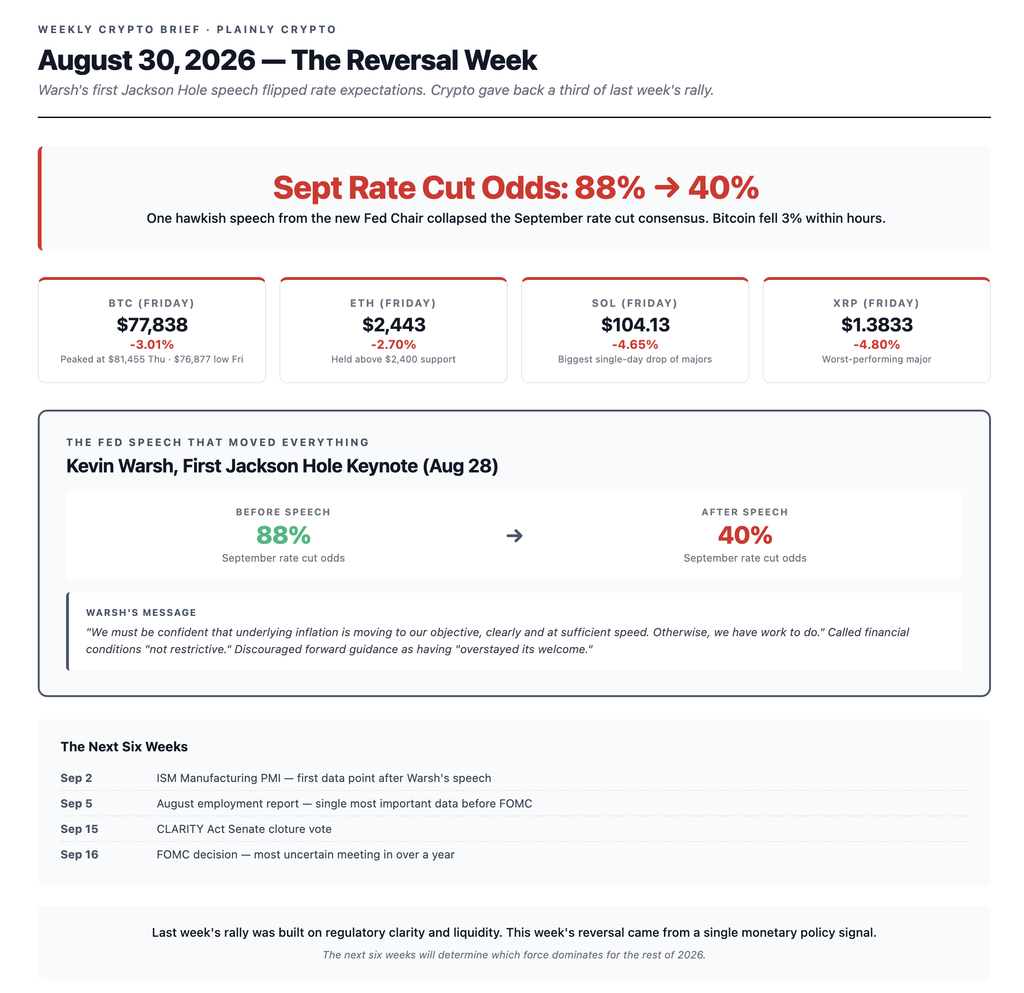
Bitcoin (BTC): Opened the week around $77,000. Rallied on Nvidia earnings to hit $81,455 on Thursday. Dropped to $76,877 intraday Friday after Warsh’s speech, closing at $77,838. Net weekly performance: roughly flat, with all the drama compressed into one 24-hour Friday window.
Ethereum (ETH): Down 2.7% Friday to $2,443. Held above the $2,400 support level from last week but with reduced conviction.
Solana (SOL): Down 4.65% Friday to $104.13 — the biggest single-day drop among the majors, extending its pattern of being more macro-sensitive than the top two.
XRP: Down 4.8% Friday to $1.3833 — the worst-performing major, unwinding some of last week’s 40% surge. Still holding well above where it started the month.
Liquidations: $488 million in crypto positions were force-closed Friday, with $138 million in Bitcoin longs alone. The pattern of the week: crypto had positioned bullishly on rate-cut expectations, then had to rapidly reposition when Warsh signaled the opposite.
Total crypto market cap fell approximately 3% on Friday alone, giving back a meaningful portion of the previous week’s $380 billion increase.
Why it moved — Warsh’s hawkish first Jackson Hole
On Friday, August 28, Fed Chair Kevin Warsh delivered his first Jackson Hole keynote — titled “In Our Time” — marking his 100th day as Chair since succeeding Jerome Powell. The speech didn’t produce a policy pivot. It produced something more consequential: a clear signal that the Fed under Warsh is more hawkish than the market had been pricing.
Three specific things Warsh said that moved markets:
First, he called current financial conditions “not restrictive.” In Fed language, that’s code for: markets are too comfortable, credit is too easy, and the case for cutting rates isn’t as strong as the market thinks. He backed this by pointing to friendly lending standards, liberal credit markets, and tight credit spreads.
Second, he explicitly discouraged forward guidance. Warsh said the practice has “overstayed its welcome” and told markets to stop looking to the Fed for clues. This is a significant departure from the Powell era, when forward guidance was a core tool. Practically, it means markets have less certainty about what the Fed will do next.
Third, he owned the inflation record and vowed to fix it. Warsh noted PCE inflation at 3.7% year-over-year and 4.1% annualized over the past six months, with unemployment near 4.1%. He referenced more than five years of inflation running above the Fed’s 2% target and said the Fed “must be confident that underlying inflation is moving to our objective, clearly and at sufficient speed. Otherwise, we have work to do.”
The market reaction was immediate. According to CME FedWatch, the probability of a September rate cut dropped from about 88% before the speech to roughly 40% after — with September rate-hike odds jumping from 35% to about 60%. The 2-year Treasury yield spiked 12 basis points to 4.35%. Bitcoin, which had been testing $81,000 resistance, sold off to $77,000 support within hours.
The context matters. Last week’s rally was built on three catalysts that reduced regulatory risk (SEC proposal, White House summit) and increased expected liquidity (Treasury bond buybacks). Warsh’s speech didn’t reverse any of those. What it did was reintroduce monetary policy uncertainty, which the market had largely dismissed. The Fed’s hawkish tilt doesn’t cancel the SEC’s crypto-friendly moves, but it does mean the macro tailwind crypto was counting on for September may not arrive.
Nvidia earnings — a beat that couldn’t save the week
On Wednesday, August 26, Nvidia reported Q2 FY2027 revenue of $96.2 billion (up 106% year-over-year), beating the $92.2 billion Wall Street consensus. Data center revenue hit $89 billion (up 117%), guided Q3 revenue to $108 billion (versus $104 billion expected), and CEO Jensen Huang delivered the memorable line: “AI has reached its inflection point… compute is revenue, and demand is accelerating.”
The company also announced a major AWS deal: 2 million Nvidia GPUs plus Vera CPUs, with CFO Colette Kress noting that top-five hyperscaler capex is expected to reach $1.3 trillion in 2027, up from $800 billion in 2026.
And yet the stock fell. Nvidia dropped 1.6% in regular trading Wednesday and another 1.8% after-hours after the earnings release, as management guided gross margins to compress from 75% to 71-72% by fiscal Q4 due to rising memory costs.
The pattern is important for crypto: even a genuinely great earnings report from the most-watched company in the market couldn’t sustain risk-on sentiment when the Fed narrative shifted two days later. When Warsh spoke Friday, Nvidia’s rally momentum was already fading, and crypto had to face the hawkish repricing without the AI risk-on tailwind that had helped drive Thursday’s Bitcoin peak.
Q2 GDP revised — inflation trending the wrong way
The Bureau of Economic Analysis released its second Q2 2026 GDP estimate Wednesday morning, and the details reinforced the inflation concerns Warsh cited two days later:
- Real GDP growth: 1.5% (unchanged from advance estimate)
- Consumer spending: 3.4% (revised UP from 3.2%)
- Real final sales to private domestic purchasers: 4.2% (revised UP from 3.9%)
- PCE inflation: 5.3% (revised UP from 5.1%)
- Core PCE: 3.6% (revised UP from 3.4%)
Translation: The economy is growing slower than desired, but private demand is stronger than first thought AND inflation is running hotter than first thought. That’s the specific combination that gives the Fed cover to hold rates steady — or even consider hiking — rather than cutting.
Core PCE at 3.6% (annualized) sits 80% above the Fed’s 2% target. That’s the number Warsh cited when saying “underlying inflation” needs to move to the objective “clearly and at sufficient speed.” Nothing in this GDP revision made that easier.
ETF flows: the nine-day streak ends
Spot Bitcoin ETFs had been on a nine-day consecutive inflow streak heading into Friday, one of the strongest institutional signals of the year. That streak ended abruptly on August 28 with $202 million in outflows — the largest single-day outflow in over a month.
Data across the week:
- Aug 24-27 (Mon-Thu): Continued strong inflows, part of the 9-day streak
- Aug 28 (Fri): -$202M outflows (streak broken by Warsh reaction)
- Aug 29: Additional -$105.6M in BTC ETF outflows continuing the pattern
The nine-day streak had been the marginal bid stabilizing Bitcoin near $80,000. When it broke, so did the price support level. Institutional flows are now the crypto market’s most reliable macro tell — when they turn, price follows within hours.
Also notable this week: BlackRock announced a 1-for-3 reverse share split for its iShares Ethereum Trust ETF (ETHA), effective October 6. The reverse split will increase per-share NAV without changing the fund’s total value. It comes as the ETF has fallen roughly 40% year-to-date, reflecting Ethereum’s underperformance versus Bitcoin in 2026.
Solana this week — a governance milestone and a hack
Two Solana-specific stories worth understanding, one significant on the positive side and one on the negative.
The positive: Solana’s first formal onchain governance vote passed. Voting opened August 22 on three bundled proposals — SGP-0001 (a Solana Constitution formalizing the governance framework), SGP-0002 (doubling the annual disinflation rate from 15% to 30%), and SGP-0003 (reworking how transaction fees get burned). Voting closed at epoch 1023 (approximately 15:30 UTC on August 27).
SGP-0002 passed with 176.29 million SOL voting For, 66.19 million Against, and 20.63 million Abstaining. This gives validators a mandate to cut future SOL issuance by approximately 18.9 million SOL over six years — worth roughly $1.4-1.5 billion at current prices. The change isn’t live yet; it still needs implementation and client coordination. But the mandate itself is historic — Solana’s first real on-chain governance decision, and a meaningful bet on scarcity as a long-term value driver.
The negative: Solana neobank Avici was hacked on August 28 — the same day as Warsh’s speech. An attacker drained approximately $653,000 from Avici’s card vaults, affecting over 9,000 users. The AVICI token fell roughly 40% within hours. Because each Avici customer holds a separate escrow contract, the drain happened account-by-account rather than as a single pot theft — a pattern that’s becoming increasingly common in social-engineering attacks against crypto infrastructure.
The context that matters: Solana had a genuinely historic governance week AND a fresh security incident in the same seven days. This mirrors the broader crypto pattern of 2026: real ecosystem progress happening alongside real security failures. The token price mostly reflected the macro backdrop (Warsh) rather than either Solana-specific story, but both are worth tracking for readers evaluating Solana’s long-term trajectory.
CLARITY Act — still delayed, still coming
The CLARITY Act vote remains scheduled for September 15, though the Senate ultimately postponed its August consideration. White House crypto advisor Patrick Witt notably threatened this week that regulators in the executive agencies — specifically the SEC and CFTC — would “break glass” (use emergency mechanisms) if Congress didn’t deliver on CLARITY.
That threat matters because it establishes a fallback: even if CLARITY doesn’t pass, the SEC’s August 18 “Regulation Crypto Assets” proposal is now the executive-branch backup plan. The industry gets regulatory clarity either through Congress or through the SEC — the White House is making clear it will happen one way or the other.
For markets, this reduces the tail risk of a CLARITY failure. It doesn’t eliminate the base-case importance of the September 15 vote, but it does provide floor. Expect this weekly crypto brief to track the CLARITY progress every Sunday until the vote lands.
What to watch this coming week
Sept 1 (Monday): Labor Day — US markets closed. Light volume expected.
Sept 2 (Tuesday): ISM Manufacturing PMI for August. If the number confirms slowing manufacturing, it strengthens the “the economy is weakening” case that argues for Fed cuts — which would partially offset Warsh’s hawkish framing.
Sept 5 (Friday): August employment report. This is the single most important data point before the FOMC decision. A weak jobs number could force the Fed to cut despite Warsh’s rhetoric. A hot jobs number would confirm his stance and price out cut expectations completely.
Sept 15: CLARITY Act Senate cloture vote. Odds have been sitting at roughly 50-50 on prediction markets. This week’s Warsh speech doesn’t directly affect crypto legislation odds, but the overall risk-off tone may reduce urgency in Congress.
Sept 16: FOMC decision. The most uncertain FOMC meeting in over a year. Rate cut probability sits at approximately 40% now (down from 88% before Warsh’s speech), with hold probability at 58% and hike probability at 2%.
The bigger picture
Two weeks ago, we said the setup for the next six weeks was “more consequential than any six weeks we’ve had in 2026.” Nothing this week changes that assessment. What changed is which direction the consequential outcomes point.
Last week, three catalysts landed inside 30 hours to drive a 22% Bitcoin rally: SEC crypto proposal, Treasury bond buyback expansion, Trump White House summit. This week, one catalyst — a single hawkish speech — undid roughly one-third of that rally in a single trading session. That’s the current market: highly sensitive to policy signals, positioned for a specific outcome, vulnerable to sharp reversals when reality diverges from expectation.
The Fed is now signaling higher-for-longer. The White House is pushing for regulatory clarity. The SEC is preparing enforcement backup. The Treasury is providing liquidity. These forces don’t all point the same direction. The next six weeks will determine which of them dominates. Next Sunday’s weekly crypto brief will cover the August jobs number, ISM data, and whether the market has stabilized after Friday’s shock — or whether the September 15 CLARITY vote and September 16 FOMC decision are heading into an even more uncertain setup.
Where to go next:
- New here? Start with our beginner path or read our guide on dollar-cost averaging crypto — the strategy specifically designed for weeks like this one, when the news changes faster than your conviction should.
- Want to understand what Bitcoin actually is beyond the price ticker? Our What is Bitcoin explainer covers the fundamentals honestly.
- Curious about the technical differences between the major Layer 1 blockchains? Read What is Ethereum, What is Solana, or our new What is Cardano explainer that completes our five-piece Coin Explainers series.
- If this week made you want to actually buy some crypto, our guide on how to buy crypto safely walks through the sober version of that decision. Pair it with our crypto wallets guide if you plan to self-custody.
- And if you’re curious how decentralized exchanges (DEXs) fit into the picture as more flow moves onchain, our DEX explainer covers the basics.
See you next Sunday.
A note on financial advice
This brief is for education, not investment advice. Weeks like this one — where a single Fed speech reverses market direction — are exactly why sizing positions to what you can afford to lose entirely, and maintaining a long-term time horizon, matter more than trying to predict the next 24-hour move. The September 15 CLARITY vote and September 16 FOMC decision remain the two events most likely to determine whether last week’s rally or this week’s reversal defines the next quarter. Only invest what you can afford to lose entirely, and make your own decisions based on your own situation.