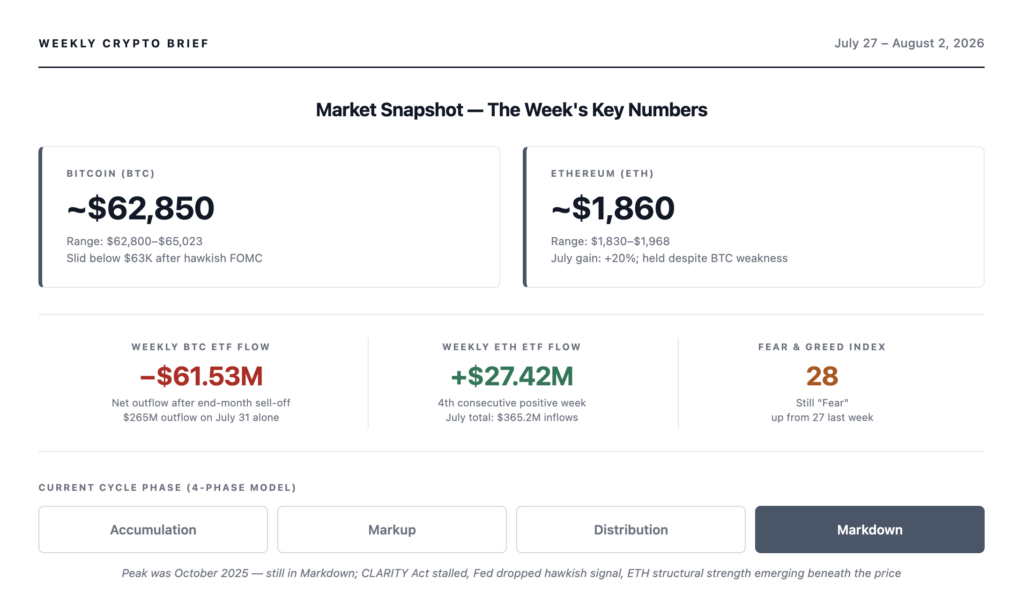
This weekly crypto brief opens with the two biggest stories of the summer. First: Senate Majority Leader John Thune confirmed this week that the CLARITY Act — the biggest US crypto legislation attempt in a decade — will not receive a Senate vote before the August recess. Second: a firmware vulnerability discovered on July 30 drained approximately $70 million from 1,196 Coldcard hardware wallets in a 41-minute sweep. It was the largest self-custody incident in years. Bitcoin ended the week under $63,000, down from $65,000 highs earlier in the week. Ethereum held near $1,860 despite Bitcoin’s weakness, capping off a July in which it gained roughly 20%.
This is your week in crypto for the week ending Sunday, August 2, 2026. What actually moved. What matters for beginners. What’s noise dressed up as news.
The theme of the week: regulatory certainty is now genuinely delayed. Not “delayed again” — actually delayed by the calendar. When Congress returns in September, midterm election politics will dominate. Anyone telling you crypto legislation is still on track for 2026 is not reading the same news the rest of us are.
TL;DR
- The CLARITY Act is not passing before August recess. Senate Majority Leader Thune has effectively conceded. Debate resumes in September, but midterm politics will dominate the fall. Polymarket odds for 2026 passage now at 33-37%.
- The Coldcard hardware wallet hack drained ~$70M from 1,196 Bitcoin wallets in 41 minutes on July 30. Root cause: a 2021 firmware bug that used predictable device data instead of true randomness for seed generation.
- Bitcoin slid below $63,000 by end of week — down from $65,000 highs — after a hawkish FOMC decision with three dissents in favor of a rate hike.
- Ethereum ended July up 20% ($1,600 → $1,910), the strongest monthly performance across major crypto assets. This week ETH held near $1,860 despite Bitcoin’s weakness.
- ETF flow divergence continues. Bitcoin ETFs recorded $61.53M in net outflows for the week; Ethereum ETFs extended their positive streak to 4 consecutive weeks with $27.42M in net inflows.
- Strategy reported an $8.22B Q2 net loss driven almost entirely by non-cash accounting adjustments on Bitcoin holdings. Michael Saylor’s company still holds 843,775 BTC.
- Coinbase’s Q2 revenue fell 19% year-over-year to $1.22B; stock dropped 10% on earnings miss. Base network volume was up 7x YoY, one of the report’s few bright spots.
- Fear & Greed Index at 28 (up from 27 last week). Still fear, still improving slowly.
The CLARITY Act stalls out
The story that dominated the weekly briefs for the past six weeks has now been settled — not by a vote, but by a calendar.
Senate Majority Leader John Thune confirmed this week that the CLARITY Act will not receive a Senate floor vote before the August 7-8 recess. His words: “I would like to at least get Clarity started. We’ll see where the votes are.” Translation: the votes aren’t there, and Thune isn’t going to burn political capital on a losing floor vote before the break.
The immediate blocking issue remains ethics provisions. The revised bill includes temporary ethics restrictions (with a 2029 sunset) on senior federal officials profiting from digital asset activity. Democrats — led by Sens. Elizabeth Warren, Chris Murphy, Chris Van Hollen, and Jeff Merkley — say temporary isn’t good enough. They want permanent restrictions, and they view Trump’s disclosed $1.4B in 2025 crypto income as evidence that ethics enforcement is essential.
Meanwhile, New York Attorney General Letitia James publicly opposed the bill this week, arguing it would weaken states’ ability to regulate crypto and investigate fraud. James cited a tripling of crypto scam complaints to her office over three years, with losses approaching $500M over five years.
Prediction markets have priced in the delay. Polymarket odds for 2026 passage now sit at 33-37%, down from above 80% earlier this year. Galaxy Research revised its estimate down to 30%.
In plain English: This bill will now either come back in September for another try, or die completely until 2027. When Congress returns after Labor Day, they’ll have about six weeks before midterm campaigning consumes attention. In practice, that means the next real window is post-election “lame duck” session in November-December, when defeated and retiring lawmakers serve out their final weeks. That’s not impossible, but it’s not likely either.
What it means for beginners: US crypto continues to be governed by SEC and CFTC interpretive guidance rather than statute. That’s not a crisis — agencies have been running things this way for years — but it does mean regulatory certainty for institutional adoption remains one election cycle away. Don’t invest based on the CLARITY Act passing this year. The base case is now that it doesn’t.
The Coldcard hack — what happened and why it matters
On July 30, an attacker drained 1,082.65 Bitcoin (worth approximately $70.2 million at the time) from 1,196 Coldcard hardware wallets in a 41-minute sweep. Coldcard is one of the most popular Bitcoin-only hardware wallets, made by the Canadian company Coinkite. It has a strong reputation in the Bitcoin community. This is the largest single self-custody incident in years — being compared to the 2023 Milk Sad PRNG failure by security researchers.
What actually happened (in plain English): Hardware wallets protect your Bitcoin by generating a random “seed” — a secret string of words that controls your funds. Security depends on that seed being truly unpredictable. Coldcard firmware version 4.0.0, released in March 2021, contained a bug that told the device to skip its hardware random number generator (the chip that actually produces true randomness) and fall back to a software-based generator. That software generator built seeds from predictable device data: the device’s unique ID, its internal timer state, and its RNG-call history. All of that is data an attacker can either guess or brute-force offline.
The practical consequence: instead of the intended 128 bits of entropy, seeds ended up with roughly 72 bits — a range small enough that a determined attacker with adequate computing resources could reproduce candidate seeds offline, derive their Bitcoin addresses, and check them against the public blockchain. When one matched, they’d sweep the funds.
Who is affected: Coldcard Mk2, Mk3, Mk4, Q, and Mk5 models running firmware version 4.0.1 or later (released after March 2021) are potentially vulnerable. Coinkite is still assessing the full scope.
Who is protected: Users who added extra entropy during setup by rolling dice (50+ rolls is a documented Coldcard practice) generated seeds outside the attacker’s predictable range and were not affected. Users who added a passphrase to their seed also have substantially lower risk — the passphrase acts as an extra layer the attacker couldn’t have guessed.
What Coinkite says to do: If you set up a Coldcard between March 2021 and now without adding your own dice entropy or a passphrase, assume your funds are at risk. Generate a new seed on updated firmware, move funds to fresh addresses, and start over. Simply updating the firmware doesn’t fix an already-affected seed — the seed itself is the problem, so you need a new one.
In plain English: This is the sharpest reminder in years that self-custody protection depends on more than the physical device staying offline. Cold storage does two jobs — keeping your key where no hacker can reach it, and generating a key no computer can guess. This attack broke the second job while the first held perfectly. Every drained wallet stayed offline and untouched while its seed was rebuilt on someone else’s machine.
What it means for beginners: If you own a Coldcard, check your firmware version and setup method today, not tomorrow. If you own a different hardware wallet, this incident doesn’t affect you directly — but it’s worth understanding that any hardware wallet’s security ultimately depends on firmware that users don’t inspect. Reasonable protection: never rely on a single device’s built-in randomness for large amounts. Roll physical dice for extra entropy. Add a passphrase. Consider multi-signature setups for significant holdings. For a broader explainer of how these tradeoffs work, see how crypto wallets work.
Some analysts argue this incident will push cautious investors toward Bitcoin ETFs, where security is handled by regulated custodians. Others argue self-custody remains the right long-term answer with better setup discipline. Both perspectives have merit — the honest answer is that self-custody just got measurably harder to do right.
FOMC delivers a hawkish surprise
The Federal Reserve met on July 29 and left rates unchanged, which was expected. What wasn’t expected: three FOMC members dissented in favor of a rate hike — a significantly hawkish signal from a committee that’s typically unanimous.
Bitcoin lost the $64,000 level immediately after the decision. Risk assets across markets came under pressure. Market pricing now implies roughly one further rate hike in 2026 and one in March 2027, according to CoinDesk analysis.
Two days later, the Fed’s preferred inflation gauge (core PCE) cooled slightly — from 3.4% to 3.3% year-over-year in June. That softer print helped calm markets modestly, but it doesn’t undo the hawkish signal from the meeting itself.
In plain English: When multiple Fed governors publicly want to raise rates, it means the Fed is not close to cutting rates. That matters for crypto because Bitcoin and Ethereum have traded as risk assets throughout 2026 — they respond to Fed policy the way tech stocks and emerging market currencies do. Higher-for-longer rates create headwinds. Lower rates create tailwinds. This week said: don’t expect tailwinds anytime soon.
What it means for beginners: A hawkish Fed print is not a crypto-specific story. It’s a macro story that affects every risk asset. If your investment thesis depends on rate cuts happening quickly, this week’s data undercut that thesis. Adjust expectations accordingly.
Ethereum’s massive July
While Bitcoin spent July trapped in the low $60,000s, Ethereum quietly had its best month in over a year. ETH entered July near $1,600 and traded near $1,910-$1,950 by month-end — a gain of roughly 20% at the peak.
Two things drove this outperformance:
ETF flows kept flipping positive. Spot Ethereum ETFs closed July with $365.2M in net inflows, marking four consecutive positive weeks. Bitcoin ETFs, by contrast, closed July with $172.4M in inflows offset by a $265M sell-off on the final trading day.
Corporate treasury demand held up. BitMine, SharpLink Gaming, and other public companies with ETH treasury strategies kept buying through the month, providing steady structural demand independent of ETF flows.
The ETH/BTC ratio climbed toward 0.030 — its highest level in months. Ethereum outperforming Bitcoin for four consecutive weeks isn’t just a rotation trade; it’s what analysts flag as a leading indicator during transitions between crypto market phases.
None of this means ETH is going to keep outperforming. Two months from now, this could reverse. But for the whole story of Article 010 (see below), this is the current empirical state: Ethereum’s structural fundamentals — Layer 2 activity, ETF flows, corporate demand — are holding up better than the price would suggest.
In plain English: Ethereum finally had a good month. But one good month doesn’t erase three consecutive red quarters. Watch whether the momentum carries into August or fades.
ETF flows: a genuine divergence
For the week ending July 31:
- Bitcoin ETFs: -$61.53M net outflow
- Ethereum ETFs: +$27.42M net inflow
Ethereum ETFs extended their positive streak to four consecutive weeks. Bitcoin ETFs had their worst end-of-month sell-off in weeks — $265.4M in outflows on the final trading day of July alone.
BlackRock’s ETHA dominates Ethereum ETF inflows — accounting for 37,424 of the week’s 37,959 ETH inflows, effectively the entire category’s gains flowing through one fund. That’s concentration risk worth naming: if BlackRock’s institutional client base rotates the other direction, the whole ETH ETF flow picture reverses fast.
Keep the scale in perspective:
- Bitcoin ETF total AUM: ~$76.22 billion
- Ethereum ETF total AUM: ~$9.72 billion
- Ratio: more than 7:1
Ethereum ETF flows leading Bitcoin ETF flows in a given week is a meaningful signal about incremental capital direction — but it does not mean Ethereum is taking over institutional crypto allocation. That gap won’t close in a quarter.
Strategy’s Q2 earnings — a big loss with a small caveat
Michael Saylor’s Strategy reported Q2 2026 results this week: an $8.22 billion net loss. Diluted earnings per share came in at negative $24.45.
Read the fine print before panicking. The loss is driven almost entirely by an $8.32 billion non-cash unrealized loss on digital asset holdings — accounting-driven, not cash-flow driven. Under fair value accounting, Strategy has to mark its Bitcoin to market each quarter. When BTC is down for the quarter, that shows up as a paper loss regardless of whether Strategy actually sold anything.
The underlying business is still positioned as it has been:
- Total Bitcoin holdings: 843,775 BTC (worth ~$54.77 billion at week-end prices)
- Average acquisition cost: $75,476 per Bitcoin
- Position size: 4% of Bitcoin’s total maximum supply
- Capital raised in Q2: $8.41 billion via at-the-market equity issuance
- Additional capital in July: $1.28 billion
Strategy is currently underwater on its average cost basis — but that doesn’t matter unless it needs to sell, and its balance sheet suggests it doesn’t.
In plain English: An $8B net loss headline sounds terrible. In this case it’s mostly an accounting artifact. Real question for the company: can they keep raising capital at prices that make sense? So far, yes.
Coinbase’s Q2: revenue down 19%, stock down 10%
Coinbase reported Q2 2026 revenue of $1.22 billion — down 19% year-over-year. The stock dropped 10% on the report.
Trading revenue declined significantly. Subscription and services revenue held up better ($555 million). Base network — Coinbase’s Layer 2 — had transaction volume up 7x year-over-year, one of the report’s few genuinely strong data points.
The stablecoin business continues to grow:
- Average USDC balances: $20 billion
- Stablecoin revenue: $292 million in Q2
- Derivatives suite crossed $100M in annualized recurring revenue
In plain English: Coinbase’s core business (retail trading) is under pressure because the market has been range-bound and volumes are down. Their newer business lines (Base, derivatives, stablecoins) are growing. That’s a company in transition, not a company in crisis.
Quick hits
Binance.US targeting derivatives. The exchange is applying to the CFTC for designation as a contract market, which would allow it to list regulated futures, options, and event contracts (prediction markets). Part of a broader strategy to rebuild toward the 20% US market share position the company held pre-regulatory-crisis.
Project Agorá cross-border payments test succeeded. The BIS-led project completed real-money cross-border payment testing involving 5 central banks and 28 commercial banks. This is central banking infrastructure being publicly tested using tokenization and shared ledgers — a genuinely major long-term signal.
IRS scam warning. The IRS issued a public warning about fake letters directing crypto holders to a fraudulent “Digital Asset Compliance Portal” designed to steal personal information. If you get anything like this, it’s not from the IRS. Don’t click.
Wanchain-Cardano bridge exploit response continues. The Wanchain bridge (attacked July 20 with NIGHT token losses) has offered the attacker a white-hat settlement deadline of August 6. Standard modern bridge exploit playbook — negotiate before criminalizing.
What this actually means, if you’re a beginner
Five takeaways from this week worth pulling out:
- The CLARITY Act’s failure to pass this summer is a real story, not a hypothetical one. US crypto continues to operate under agency guidance rather than statute. That’s fine for now, but it means the “regulatory catalyst” thesis you’ve read about is not showing up in 2026.
- The Coldcard incident is a real self-custody lesson. Hardware wallets are still the safer path for most people compared to leaving funds on an exchange — but this week proved that “safer” isn’t “safe by default.” If you self-custody, extra dice entropy at setup and a passphrase on your seed are worth the extra 15 minutes. If you don’t self-custody yet, this isn’t the week to start without doing the research first.
- Fed policy still drives crypto prices more than crypto-specific news. Three FOMC dissents in favor of hiking sent Bitcoin below $64K faster than any crypto-native headline. Watch the Fed, not the tweets.
- Ethereum quietly had a great July. One month doesn’t make a trend, but four consecutive weeks of ETF inflows plus corporate treasury demand plus a 20% price move is worth noticing. Whether it holds through August is next month’s story.
- Accounting losses aren’t real losses. Strategy’s $8B “loss” is an accounting quirk of fair-value marking. Understanding the difference between mark-to-market accounting and actual cash flow is one of the most valuable financial skills you can build.
Bottom line
CLARITY Act stalled, Fed dropped a hawkish surprise, Bitcoin slid below $63K, Ethereum finished July up 20%, ETH ETFs extended a 4-week streak, Strategy posted a big accounting loss, and Coinbase’s stock dropped 10% on soft earnings. That’s your week.
Don’t check the price on Monday morning. If you have a dollar-cost averaging plan, stick to it. If you’re still figuring out how crypto wallets work, how to buy safely, or what a DEX actually is, those are useful weekend reads. And if you want to understand what is Ethereum at the network level — that’s this week’s newest evergreen guide.
See you next Sunday.
A note on financial advice
This article summarizes news, not recommendations. Nothing here is a suggestion to buy, sell, or hold any specific cryptocurrency. Crypto markets are volatile and genuinely risky. Only put in what you can afford to lose entirely, and make your own decisions based on your own situation.