Solana is a blockchain that bet everything on speed. Where Bitcoin optimized for decentralization and Ethereum optimized for programmability, Solana optimized for throughput — the ability to process thousands of transactions per second at costs that round to zero. That single design choice explains almost everything about Solana: what it does well, what it does badly, and why people either love it or roll their eyes at it.
This guide walks you through what is Solana, how it actually works, what runs on it, and what to make of it in 2026 — the good and the ugly. If you’re new to crypto, you don’t need to read the Bitcoin and Ethereum guides first, but it helps.
I’ve been in crypto since 2017, and Solana was the first chain that felt genuinely different to use. Sending Bitcoin felt like a wire transfer — deliberate, slow, expensive. Sending on Ethereum in 2021 felt like paying rent to move a fiver. The first time I swapped tokens on Solana, the transaction confirmed before I could tab back to check. It also, in the same year, broke entirely and stopped producing blocks. Both experiences are Solana. You can’t understand it without holding both in your head at once.
TL;DR
- Solana is a decentralized blockchain optimized for speed and low transaction fees.
- SOL is the network’s native token, used to pay fees and to stake.
- Solana processes roughly 65,000 transactions per second in bursts and 3,000–4,000 sustained — around 10–15x Ethereum’s base layer.
- Proof of History plus Proof of Stake is Solana’s unusual consensus design — it’s what makes the network fast.
- Since 2020, Solana has hosted major DeFi, real-world asset, DePIN, payments, and consumer apps — plus a lot of memecoin activity.
- SOL hit its all-time high near $293 in January 2025 and has traded in the $60–80 range through mid-2026 — a drawdown of roughly 74% from the top.
- Solana isn’t an “Ethereum killer” — it’s a different design philosophy for a different set of use cases.
The one-sentence version
So, what is Solana in one sentence? A high-speed blockchain optimized for consumer applications, payments, and high-frequency use cases — with real tradeoffs around network reliability that beginners should understand upfront, not after they’ve committed money.
That’s the honest version. The marketing version will tell you it’s the fastest, cheapest, best chain in crypto. The honest version says: yes, it’s fast, yes, it’s cheap, and the tradeoffs are real.
Solana vs Ethereum — different design philosophies
The internet loves a rivalry, so it decided Solana and Ethereum are at war. They’re not. They’re two different bets about how a blockchain should be built.
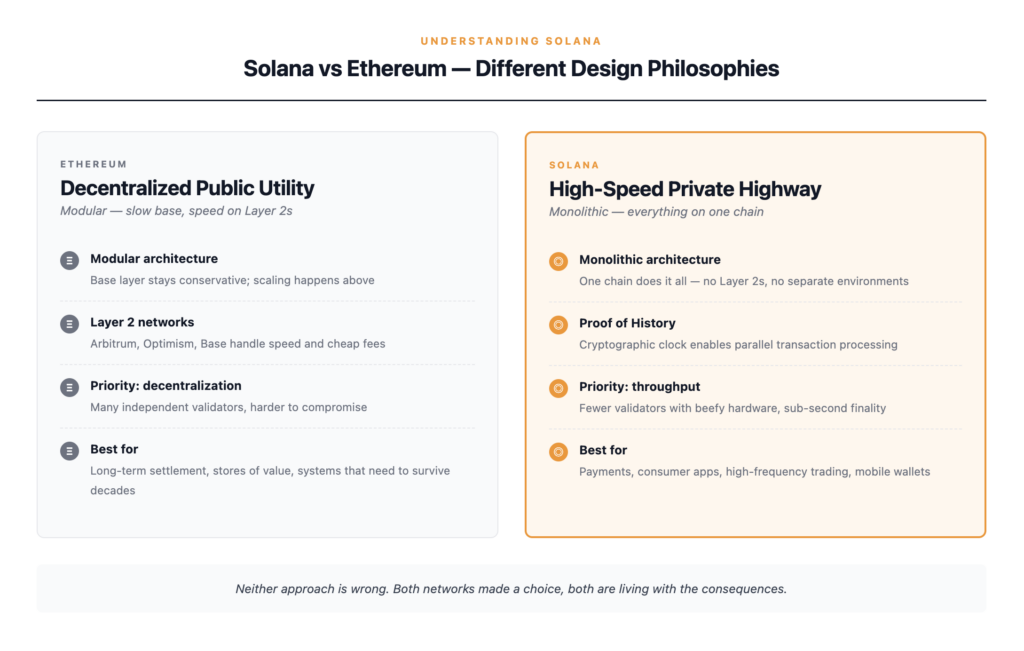
Ethereum is modular. The base layer (mainnet) stays deliberately conservative — slow, expensive, decentralized. Speed and cheap transactions happen on Layer 2 networks like Arbitrum, Optimism, and Base, which post their data back to Ethereum for security. The philosophy: prioritize decentralization at the base, and let scaling happen in layers above it.
Solana is monolithic. Everything happens on a single high-speed chain. No Layer 2s, no separate execution environments — one network that tries to do it all, fast. The philosophy: prioritize throughput at the base, and accept the tradeoffs that come with that (fewer validators, higher hardware costs, occasional outages).
A rough analogy: Ethereum is a decentralized public utility — slower, redundant, hard to break. Solana is a high-speed private highway — you get where you’re going in seconds, but if there’s a pileup, the whole road closes for a bit.
Neither approach is wrong. Ethereum’s design is better if you’re building things where credible neutrality and censorship-resistance matter more than latency (large financial settlement, long-term stores of value, systems that need to survive decades). Solana’s design is better if you’re building things where user experience matters more than absolute decentralization (payments, consumer apps, high-frequency trading, mobile wallets).
If you want the deeper Ethereum context, I’ve written a full guide on that: what is Ethereum.
That’s the tradeoff. Modular vs monolithic. Both networks made a choice, both are living with the consequences.
How Solana actually works
At the mechanism level, the Solana blockchain runs on validators — computers around the world running the Solana software, storing the network’s history, and taking turns producing blocks. So far, that’s normal. Every blockchain does this.
What’s not normal is how Solana coordinates them.
Most Proof of Stake blockchains have a problem: before validators can agree on the order of transactions, they have to agree on when things happened. That’s harder than it sounds. Computers don’t share a clock, and messages travel through the internet at unpredictable speeds. So validators end up doing a lot of back-and-forth chatter just to establish a shared sense of time — which slows everything down.
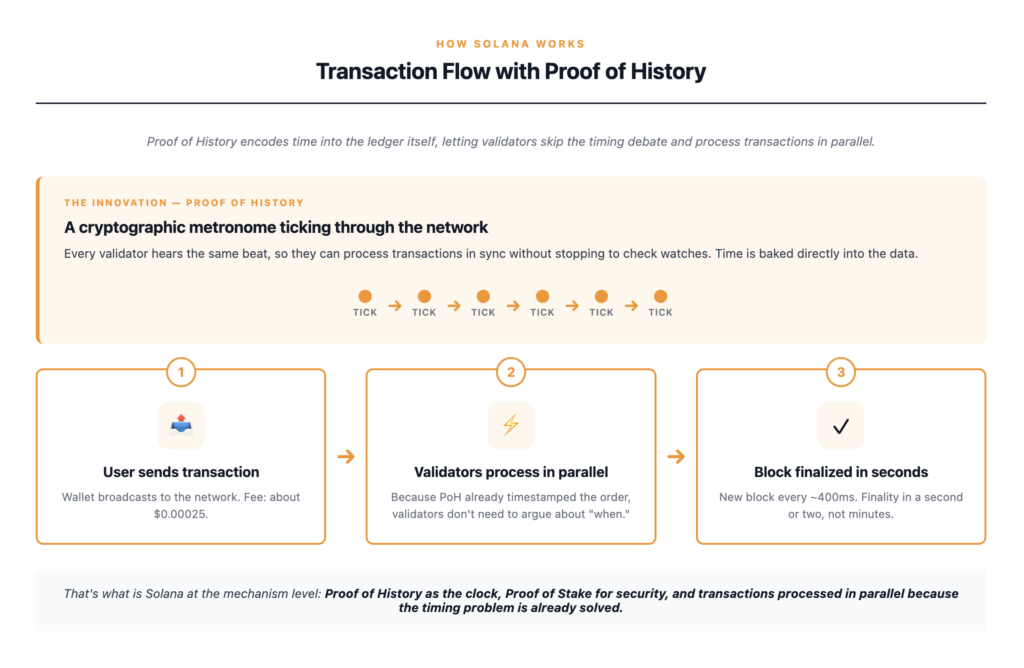
Solana’s key innovation is called Proof of History (PoH). Instead of validators arguing about timestamps, PoH encodes time directly into the ledger itself, using a cryptographic function that can only be computed sequentially. Each output proves that a certain amount of time passed between two events. Every validator sees the same timeline baked into the data.
The metronome analogy is the one that clicked for me. PoH is like a metronome ticking in the background of the entire network — every validator hears the same beat, so they can process transactions in sync without stopping to check watches. That’s what is Solana at the mechanism level: Proof of History as the clock, Proof of Stake for security, and validators processing transactions in parallel because the timing problem is already solved.
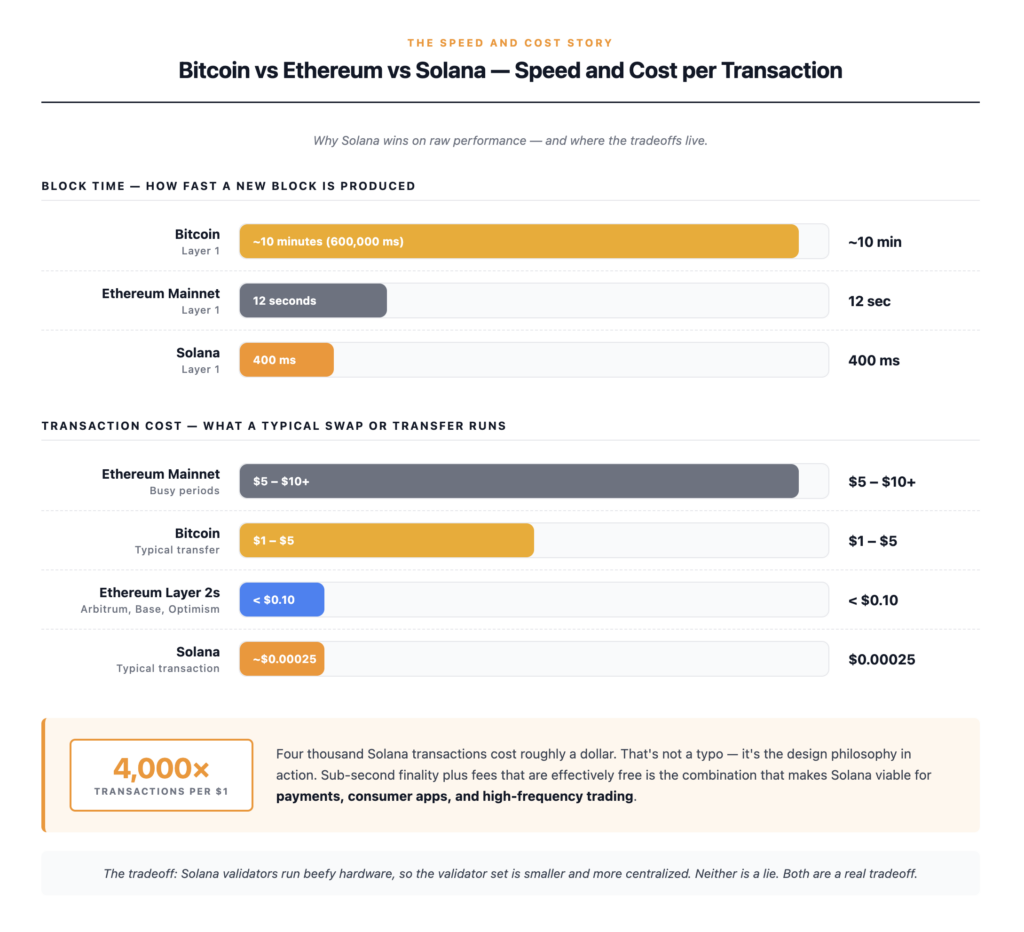
The practical result: Solana produces a new block roughly every 400 milliseconds, compared to Ethereum’s 12 seconds. Finality — the point where a transaction is considered permanent — happens in a second or two, not minutes.
The speed and cost story
A single Solana transaction costs around $0.00025. That’s not a typo. Four thousand transactions on Solana cost roughly a dollar. On Ethereum mainnet, a single token swap during busy periods can run $5, $10, sometimes more. Layer 2s bring that down to under ten cents, but Solana is still an order of magnitude cheaper.
That combination — sub-second finality plus fees that are effectively free — matters most for a specific set of use cases. Payments where you don’t want the customer waiting. Trading strategies that live and die on latency. Consumer apps where a $2 fee would kill the entire product. Memecoin trading where users are placing dozens of transactions in a session.
The honest framing: this speed doesn’t come from nowhere. Solana validators run beefy hardware — high-end CPUs, lots of RAM, fast SSDs, serious bandwidth. The requirements are substantially higher than Ethereum’s, which means the validator set is smaller and skews toward better-resourced operators. That’s a form of centralization tradeoff. Fewer, more powerful validators can move faster; more, weaker validators are harder to compromise. Solana chose the first path deliberately. Ethereum chose the second.
Neither is a lie. Both are a real tradeoff.
What runs on Solana
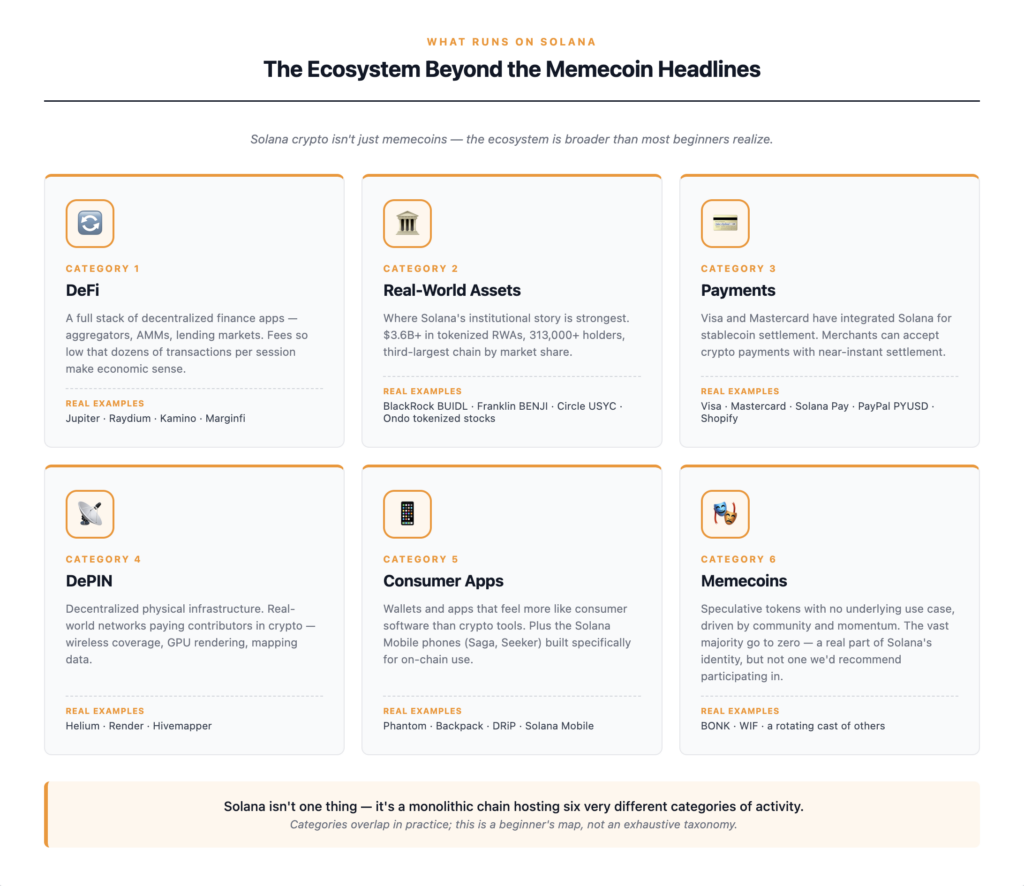
The Solana blockchain ecosystem is broader than most people realize. Solana crypto isn’t just memecoins, even if that gets the loudest headlines.
DeFi. Solana has a full stack of decentralized finance apps. Jupiter is the main DEX aggregator — it routes your swap across every liquidity source on the chain to find the best price. Raydium is a large automated market maker (a type of decentralized exchange). Kamino and Marginfi handle lending and borrowing. If you want the deeper primer on how decentralized exchanges work, that’s over here: what is a DEX.
Real-world assets (RWA). This is where Solana’s institutional story is the strongest. By mid-2026, roughly $3.62–3.7 billion in tokenized real-world assets sit on Solana, up from $873 million in January — with more than 313,000 holders. That makes Solana the third-largest blockchain by RWA market share. BlackRock’s BUIDL — a tokenized US Treasury fund — holds around $600–615 million on Solana, its largest single-chain position. Franklin Templeton’s BENJI, launched on Solana in February 2025, was the first US-registered mutual fund on a public blockchain. Circle’s USYC launched in October 2025. Ondo Finance runs more than 200 tokenized US stocks and ETFs on Solana — Tesla, Nvidia, SPY, QQQ, all wrapped as blockchain-native assets. The institutional partner list includes BlackRock, JPMorgan, Visa, Mastercard, Franklin Templeton, VanEck, WisdomTree, SoFi, and R3.
Payments. Visa and Mastercard have both integrated Solana for stablecoin settlement. PayPal’s stablecoin PYUSD is available on Solana. Solana Pay lets merchants accept crypto payments with near-instant settlement. Shopify has an integration.
DePIN (Decentralized Physical Infrastructure Networks). This is a category where Solana genuinely leads. Helium runs a decentralized wireless network. Render coordinates GPU rendering across a global pool of contributors. Hivemapper builds mapping data from a fleet of dashcam contributors. The common thread: real-world networks that pay contributors in crypto.
Consumer apps. DRiP distributes free digital art to millions of collectors. Wallets like Phantom and Backpack feel more like consumer apps than crypto tools.
Memecoins. BONK, WIF, and a rotating cast of others live on Solana — a lot of them. Memecoins are essentially speculative tokens with no underlying use case, driven by community, memes, and momentum. The vast majority go to zero. Some early holders make a lot of money; most participants lose. Memecoin activity is a real part of Solana’s identity in 2026, and pretending it isn’t would be dishonest. So would recommending you participate.
The Solana Mobile experiment
Most blockchain founders don’t build consumer hardware. Anatoly Yakovenko, Solana’s co-founder, does.
Solana Mobile launched the Saga phone in May 2023 at $1,000. The thesis: crypto adoption is stuck in a duopoly (Apple and Google) that takes 30% cuts and can ban apps on a whim, so the fix is a phone built around crypto from the operating system up. The Saga initially flopped — only around 2,400–2,500 units sold in the first six months. Then a memecoin (BONK) airdropped enough tokens to Saga owners to make the phone free in retrospect, and it sold out.
The follow-up, Seeker, was announced in May 2025 and shipped on August 4, 2025 at $450–500. Preorders came in from more than 150,000 buyers across 50-plus countries. Seeker owners received the SKR token in January 2026.
The fair assessment: it’s a bold, weird bet. Most L1 blockchains stick to being an L1. Yakovenko’s argument is that if crypto is going to reach a billion users, it has to work well on mobile, and that means someone eventually has to challenge the app-store gatekeepers. Whether that turns into a lasting product line or a footnote is genuinely undecided. I don’t own a Seeker. I’m curious about them.
The state of Solana in 2026 (honest edition)
This is the section that matters. Anyone can tell you Solana is fast. What you actually need is a straight read on where the network is right now — good and bad.
Price. SOL hit an all-time high of $293 on January 19, 2025 during the post-election crypto rally. Since then it’s been a rough ride down. SOL ended 2025 around $125–138 after a brutal Q4 (down roughly 39%), and it’s fallen further through 2026 — trading in a $60–80 range by August, roughly 74% below the January 2025 peak. That’s not a modest drawdown; that’s a serious bear market for SOL specifically. Price isn’t the network, but it’s a real proxy for market conviction, and market conviction in SOL has cooled significantly. If you’re looking at Solana for the first time and wondering why the vibes seem off, the price chart is a big part of the answer.
Outages — the historical record. Solana has gone down. Not once. Per an outage history compiled by infrastructure provider Helius, Solana has had seven full or partial mainnet incidents since 2021 — five of them traced back to bugs in a single validator client. The major public outages happened in September 2021, January 2022, June 2022, and February 2024. Each time, the network stopped producing blocks and had to be restarted through coordinated validator action. Ethereum has never had a comparable outage. If you’re using Solana, that history matters.
Outages — the current reality. Here’s what’s changed. Solana has now operated for roughly 30 consecutive months without a network-wide outage — the February 2024 incident was the last one. That’s a genuinely different network from the one that stalled twice inside eighteen months during 2021–2022. The reliability story has quietly improved while the price story has gotten worse.
Firedancer is live. The biggest reason for that improvement is Firedancer, an independent validator client built by Jump Crypto in C from scratch. Jump Crypto announced the full Firedancer mainnet launch on December 12, 2025 at Solana Breakpoint in Abu Dhabi. As of mid-2026, roughly 40% of Solana’s staked SOL runs on non-Agave clients — about 26% on the Frankendancer hybrid variant and about 14% on pure Firedancer. For the first time in Solana’s history, a meaningful share of the network isn’t running the same software. A bug in one client no longer takes down the whole chain. Firedancer has also demonstrated 600,000+ TPS in production benchmarks, with a stated target of 1 million TPS as the rollout continues.
Alpenglow is next. A consensus-layer upgrade called Alpenglow passed a validator governance vote in September 2025 with 98.27% approval — one of the strongest community mandates in Solana’s history. Once shipped in 2026, it aims to reduce block finality from the current 400–800 milliseconds down to roughly 150 milliseconds. At 150ms, Solana settlement would start to feel like a normal mobile app.
The Drift Protocol hack. On April 1, 2026, attackers drained roughly $285 million from Drift Protocol, a large Solana perpetuals exchange. The attackers, attributed to North Korean state-affiliated group UNC4736 (also known as AppleJeus), spent months on social engineering, then exploited a mechanism called “durable nonces” alongside a fake collateral token to drain funds in 12–20 minutes. It’s the second-largest hack in Solana’s history, after the Wormhole bridge exploit in 2022. Solana Foundation President Lily Liu summed up the lesson bluntly: “smart contracts held up. The real targets now are humans.” That’s an honest read. The chain didn’t break. The people running the app did.
Hyperliquid pressure. Perpetual futures trading — high-frequency, latency-sensitive derivatives — has been one of Solana’s strongest use cases. But Hyperliquid, an app-specific Layer 1 built purpose-first for perps, has been eating into that lead. In May 2026, Hyperliquid’s 7-day protocol fees surpassed Solana’s ($12.6M vs $11.8M), and its fully-diluted valuation briefly overtook Solana’s ($56B vs $50B). Analysts described this as implausible twelve months earlier. Yakovenko has publicly backed development of a new SVM-native perpetuals DEX to close the gap. This is a real competitive story — a specialized competitor beating a general-purpose chain at a specific vertical.
Institutional infrastructure keeps building. The counterweight to the price weakness is real. The tokenized real-world asset numbers from earlier — $3.6-plus billion, 313,000-plus holders, third-largest chain by RWA share, BlackRock and Franklin Templeton and Circle live — represent genuine institutional adoption. Spot Solana ETFs launched in late 2025 with Bitwise (BSOL) and Fidelity (FSOL) leading, and total Solana ETF assets have surpassed $1 billion. Corporate treasury adoption is starting too — Forward Industries (NASDAQ: FORD) transitioned into a Solana-focused treasury company holding 6.9 million SOL. And on August 11, 2026, MoneyGram announced expanded Solana integration for global crypto-to-cash services, one more sign of consumer payment infrastructure being taken seriously.
The honest read. Underneath the price weakness, the Solana blockchain has real tailwinds (RWA growth, DePIN adoption, institutional ETFs, MoneyGram-scale payments deals, 30 months of uptime, Firedancer client diversity) and real headwinds (the ~74% drawdown from ATH, the Drift hack, Hyperliquid pressure on perps, memecoin-heavy on-chain culture that turns off institutional participants). Whether these net out positive or negative is something you’ll have to form your own view on. I don’t have a strong one, and anyone who tells you they do with confidence is selling something.
How to hold and use SOL
If you want SOL, the practical path is straightforward.
Buy through an exchange. Coinbase, Kraken, and other regulated exchanges list SOL. If you’re new to buying crypto in general, the safer-onboarding guide is over here: how to buy crypto safely.
Move it to a self-custody wallet. Leaving crypto on an exchange means the exchange holds it, not you — and exchanges have failed. Phantom is the most common Solana wallet, followed by Solflare and Backpack. For larger amounts, use a hardware wallet like Ledger, which physically stores your private keys offline. The general wallet primer is here: how crypto wallets work.
Staking. Base Solana staking earns roughly 5.3% APY, paid in more SOL, for helping secure the network. Liquid staking protocols that capture MEV (like Jito) can push effective yields somewhat higher. Running your own validator isn’t really an option for individuals — the hardware requirements are steep and the operational burden is real. The practical path is liquid staking: you deposit SOL into a protocol like Marinade (which gives you mSOL) or Jito (which gives you JitoSOL), and the protocol handles validator selection. You keep a tradeable token that represents your staked SOL plus rewards. Liquid staking adds smart contract risk — if the protocol has a bug or gets exploited, your funds are exposed — so it’s a real tradeoff versus direct staking. For beginners with small amounts, staking through a reputable exchange like Kraken (currently around 5.29% APY) is a reasonable middle path.
Using it. Swap on Jupiter. Buy tokenized US Treasuries through Ondo. Send SOL as payment via Solana Pay. Bridge to another chain if you need to. Buy a decentralized dashcam if you want to earn while you drive. The whole point of holding SOL isn’t to watch a price chart — it’s to actually use the network.
Holding SOL is a starting point. What you can actually do with it is the network’s real value proposition.
Common questions
Is Solana a good investment?
We don’t give investment advice — but we can tell you what buying SOL is actually a bet on. It’s a bet that a high-throughput, monolithic blockchain will host a meaningful share of consumer crypto applications, payments, and institutional tokenization over the next decade, and that Solana will remain the dominant one in that lane. That’s a thesis you can evaluate for yourself. It’s not a certainty. SOL is down roughly 74% from its January 2025 all-time high, and there are credible arguments on both sides about where it goes from here — the price weakness is real, the infrastructure improvements are also real, and reasonable people disagree on how those net out.
Is Solana faster than Ethereum?
Yes, materially. Solana produces a new block roughly every 400 milliseconds. Ethereum’s base layer takes 12 seconds. In practical terms: a Solana payment feels instant, an Ethereum mainnet transaction feels like waiting. On Layer 2 networks like Arbitrum or Base, Ethereum transactions feel much faster — closer to Solana — but Solana still wins on raw base-layer speed. Faster isn’t always better; it comes with the tradeoffs described above.
Why does Solana keep having outages?
Historically: because Solana runs almost everything on a single chain, and until recently, almost every validator ran the same software client. When that shared software had a bug, the whole network stopped. Solana has had seven mainnet incidents since 2021, with the last major one in February 2024. Currently: the situation has meaningfully improved. Jump Crypto’s Firedancer client went fully live on mainnet in December 2025, and by mid-2026 roughly 40% of staked SOL runs on non-Agave clients. Solana has now had about 30 consecutive months of network-wide uptime — the longest reliability stretch in its history. That’s not zero risk. But it’s a materially different network than the one that stalled repeatedly in 2021-2022.
What’s the difference between Solana and Ethereum?
They’re designed to do different things. Ethereum is modular — the base layer stays deliberately slow and decentralized, and speed happens on Layer 2s built on top. Solana is monolithic — everything runs on one high-speed chain, with no separate scaling layers. Ethereum optimizes for credible neutrality and long-term censorship-resistance. Solana optimizes for consumer-app performance and low fees. Asking which is “better” is like asking whether a public utility or a private highway is better — it depends on what you’re doing.
How much SOL do I need to stake?
There’s no hard minimum for liquid staking — you can deposit any amount into Marinade or Jito and start earning. Running your own validator is a different story: hardware costs several thousand dollars, and you need enough SOL delegated to your validator to make block production economical. Most individuals don’t run validators. Liquid staking gets you the yield without the operational burden, at the cost of adding smart contract risk on top of the underlying staking risk.
Where to go from here
You now have the answer to “what is Solana” — the network, the asset, the mechanism, and the honest state of it in 2026. Solana is easier to understand once you also understand the things it’s compared to and built alongside. A few natural next reads:
- What is Ethereum — the natural comparison. Understanding both is essential to understanding either.
- What is Bitcoin — the original crypto. Different tradeoffs from either Solana or Ethereum.
- What is a DEX — most Solana activity happens on decentralized exchanges. This is what they actually are.
- How crypto wallets work — you need a wallet like Phantom to actually use Solana. This is the general primer on how wallets, seed phrases, and self-custody work.
- How to buy crypto safely — if you don’t have any SOL yet, this is where to start.
A note on financial advice
This article is for education, not financial advice. I’m explaining what Solana is as a network and what SOL is as an asset — not telling you whether to buy SOL, stake it, use it for payments, or hold it. Solana has real technical risks (network outages, validator centralization, protocol bugs), real economic risks (price volatility, competitive pressure from purpose-built chains like Hyperliquid), and real ecosystem risks (large state-attributed hacks like the Drift Protocol incident, memecoin speculation that can wipe out participants entirely). Only invest amounts you can afford to lose entirely, verify every URL before connecting your wallet to any application, and make your own decisions based on your own situation.