Why is Bitcoin falling? This week the most useful answer has nothing to do with Bitcoin.
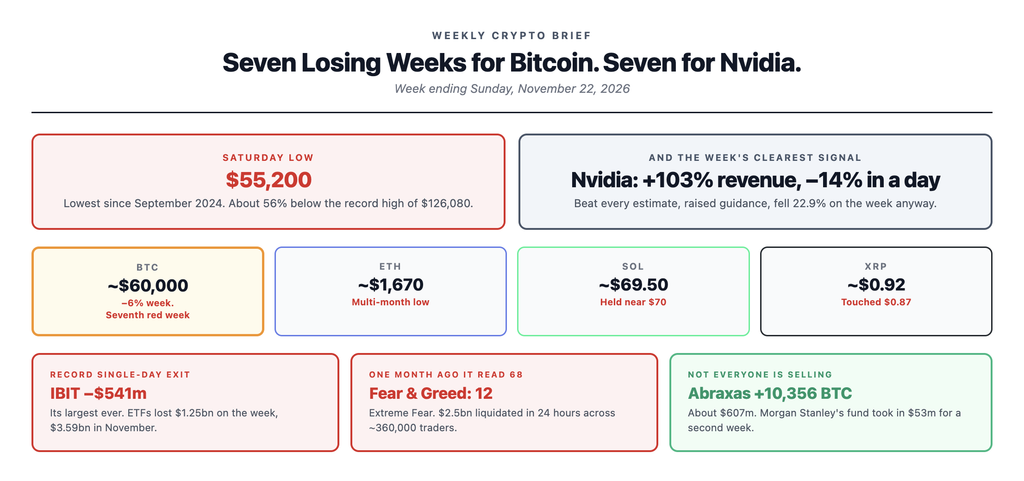
Bitcoin finished its seventh consecutive losing week. So did Nvidia. The same seven weeks.
The earnings that did not matter
Nvidia reported on Tuesday after the market closed. The numbers were close to flawless.
Revenue of $115.8 billion, up 103% from a year ago, against the $109.2 billion analysts expected. Data centre revenue of $107.6 billion, up 110%. Earnings per share up 111%. Gross margin near 75%. Guidance for next quarter of $130 billion, above expectations, and the full-year growth outlook raised rather than trimmed.
The company doubled in a year. The stock fell anyway: a little on Wednesday, then 14% on Friday alone, closing at $125.53. Over the week it lost 22.9%. Since its early-October peak, Nvidia has shed roughly $2.7 trillion in market value.
Three reasons are usually given. Jensen Huang’s resignation on 12 November, with the board confirming it does not intend to reinstate him and a search firm now hired. A federal investigation into whether Nvidia chips reached restricted Chinese entities through a customer. And a disclosure in the results themselves: about $118 billion in financial guarantees, including credit support for a planned data centre campus.
The chip sector as a whole had its worst stretch since 2008: the semiconductor index fell about 17% in the week and has lost roughly a third of its value since 30 September. The Nasdaq 100 closed just short of a bear market.
One detail keeps this honest: the equal-weight S&P 500 is roughly flat since the end of September. This is not “stocks are crashing.” It is the AI complex repricing — and Bitcoin moving with it.
The biggest IPO in history, and the market shrugged
On Thursday, Anthropic listed on the Nasdaq under the ticker ANT. It priced at $83 a share, above its own indicated range, and sold 980 million shares to raise about $81 billion — the largest initial public offering ever completed.
It opened at $111.50, up 34%, closed its first day at $97.17, and was trading near $91 by Friday morning.
The listing lifted nothing. Nvidia, AMD and the rest of the sector fell around it, and the Nasdaq dropped more than 5% on Friday. A record-breaking IPO in the hottest sector of the economy, and the sector sold off straight through it.
Where prices sit
All prices as of Sunday afternoon, European time.
BTC ~$60,000 · −6% week · Saturday low ~$55,200 ETH ~$1,670 · SOL ~$69.50 · XRP ~$0.92
Total market cap $2.03 trillion, down from $2.27 trillion last Sunday. All four majors are lower than they were seven days ago.
Saturday’s low of roughly $55,200 was Bitcoin’s lowest level since September 2024. At that price it was worth 43.8% of its record high of $126,080 — a drawdown of about 56%. It has since recovered to around $60,400, which is still about 52% below the peak.
Fear & Greed stands at 12 — “Extreme Fear” — on the index we always use. One month ago the same index read 68, which is Greed.
Roughly $2.5 billion of leveraged positions were liquidated inside twenty-four hours, hitting about 360,000 traders. Close to 90% of that was people betting the price would rise.
What the Fed said about AI
The Federal Reserve published the minutes of its October meeting on Wednesday, and they are the most quietly important document of the week.
Almost all officials expected further rate increases. A couple said a hike larger than a quarter point could be considered in December if inflation data disappointed. Futures now fully price a quarter-point rise at the 8–9 December meeting.
Why is Bitcoin falling on the back of a Federal Reserve document? Because the Fed has just named, in its own words, the thing Bitcoin is currently priced against.
The minutes record that “many participants viewed the AI buildout as a material source of inflation risk,” because demand for AI-related products “was continuing to strain supply.”
Then, on financial stability, they describe “the rapid growth of debt associated with the artificial intelligence (AI) buildout,” noting “off-balance-sheet leasing commitments and circular financing arrangements among AI-related firms,” and that “much of this growth had taken place through complex and opaque financing structures.”
Those minutes were written in late October and published on Wednesday. Nvidia disclosed $118 billion of financial guarantees on Tuesday. The two documents were not coordinated, and they describe the same thing.
The money leaving
Why is Bitcoin falling when nothing broke inside crypto? Part of the answer is simply mechanical.
US spot Bitcoin ETFs lost $1.25 billion across the week, per Farside Investors, with Ethereum funds losing a further $221.7 million.
Monday was the only positive day, at $7.9 million. Thursday was the worst, at $582.3 million — and BlackRock’s IBIT alone accounted for $541.1 million of it, the largest single-day outflow in the fund’s history. Across Tuesday to Thursday, IBIT shed nearly $900 million.
November now stands at $3.59 billion of Bitcoin ETF outflows, the heaviest month since these funds launched, with only two positive sessions in the entire month.
Two counterpoints deserve printing. Morgan Stanley’s Bitcoin fund took in $53.3 million while everything around it bled, a second consecutive week of inflows. And Abraxas Capital appears to have bought 10,356 BTC, roughly $607 million, at an average near $58,651.
Money is leaving. Not everyone is selling.
Saturday night, and a lesson about thin markets
The sharpest part of the fall happened over the weekend, when traditional markets were closed and crypto was not.
During the worst of it, Kraken executed Canadian-dollar trades as low as C$24,250 while its US dollar price never went below about $55,000. Nothing was broken. Kraken said its systems processed the orders correctly and found no compromised accounts, so the trades stand.
This is what a thin order book looks like under pressure. The Canadian dollar pair has far fewer buyers and sellers than the dollar pair, so when sell orders arrived faster than bids could absorb them, the price fell through the gaps. Anyone holding a market order got filled at whatever was there.
It is the clearest real-world illustration of liquidity we have had all year, and it cost some people real money.
On sentiment, and why the fear gauge has stopped helping
Last Sunday we reported Fear & Greed at 10 and called it the lowest reading we had ever published. Prices have fallen almost 6% since, and Bitcoin set a two-year low on the way. The index today reads 12 — slightly higher.
It did not get worse as the price got worse, because it has effectively run out of room.
This is worth understanding if you are new to these gauges. An index compressed near its floor has stopped carrying information — it tells you people are frightened, but not how frightened, and not whether tomorrow is worse than today. The number that actually tells this story is the one from four weeks ago: 68, Greed.
Four different providers published a Fear & Greed reading this week, and they gave 6, 7, 8 and 9. We quote one source every week, so the number means something when you compare it to the last brief. A sentiment reading is only useful as a series.
Strategy is now underwater on its bitcoin
Michael Saylor’s Strategy holds 850,849 bitcoin at an average cost of about $75,452, roughly $64.2 billion all in. At today’s price that stack is worth about $51 billion — roughly 20% below what the company paid.
Its mNAV, the ratio of its market value to the value of its bitcoin, closed Friday at 0.97. The market is valuing the entire company at slightly less than the coins it holds. Management has previously said that issuing new stock to buy bitcoin only works above 1.22.
MSCI removes Strategy from three of its US indexes at the close on 30 November. Index funds hold about 13 million shares, worth around $1.5 billion, and will have to sell. They will be selling shares, not bitcoin.
Will it be forced to sell its bitcoin? Not forced, no — its funding came through convertible notes and preferred shares rather than loans that fall due when the price drops, and it says it holds $4.9 billion in dollar assets, enough for over three years of interest and dividends.
But “not forced” is not “never.” It sold 32 coins in May, its first sale since 2022, and 3,588 more for $216 million in the following weeks to cover preferred dividends. The honest version: it has a cushion, has used it before, and is now underwater on the average.
Also this week
The SEC obtained an emergency asset freeze against Backward Hat Capital and its two co-founders on Thursday. The allegation is that about $560 million was raised from more than 2,000 investors on the promise of at least 6% monthly returns from an “AI-driven” crypto strategy, with more than $250 million of it paid to earlier investors. Federal prosecutors have filed separate charges. If you ever need a shape to recognise, that is the shape: a fashionable technology, a fixed monthly percentage, and returns funded by the next person through the door.
Russia’s retail crypto rules took effect on 17 November. We listed this last week as the day retail trading opened; more precisely, the legal framework opened and the venues have not. Non-qualified investors can buy up to 300,000 roubles — about $3,700 — per year through each licensed intermediary, in Bitcoin, Ether and Tether only, after passing a mandatory risk test. The Moscow Exchange is targeting 1 December for its actual launch.
The European Commission escalated infringement proceedings against Spain and Czechia on 19 November over gaps in implementing DAC8, the EU’s crypto tax reporting rules. Both have two months to respond. The first exchange of 2026 transaction data between EU tax authorities is due by September 2027 — which is to say that European crypto reporting is arriving, slowly and on a published timetable.
Solana dropped the “beta” label. On 16 November the Solana Foundation moved the network to protocol version 1.0, retiring the “mainnet beta” designation it had carried since March 2020. Nothing changes for holders — no new wallets, no migration. Separately, Solana’s US ETFs took in about $4.4 million this week, ending six straight weeks of withdrawals and marking the only positive ETF flow anywhere in crypto.
What to watch
Tue 24 Nov US consumer confidence · Wed 25 Nov Q3 GDP revision, October PCE inflation, jobless claims and the Fed’s Beige Book, all before a shortened holiday week · Thu 26 Nov Thanksgiving, US markets closed · Mon 30 Nov MSCI removals take effect · Tue 1 Dec Moscow Exchange targets its crypto launch · 8–9 Dec FOMC, with a quarter-point hike fully priced
The bigger picture
Seven weeks ago, Bitcoin and Nvidia both started falling. Neither has had an up week since.
In those seven weeks the events that moved Bitcoin most were: a chip company’s chief executive resigning, two American inflation readings, a semiconductor earnings report, the largest IPO in history, and the published minutes of a Federal Reserve meeting.
Not one of those happened on a blockchain.
So, why is Bitcoin falling? Because the market has spent seven weeks reassessing how much money will be made from building artificial intelligence, and Bitcoin is one of the assets people sell when they are reassessing that. The Fed’s own minutes now describe the AI buildout as both an inflation risk and a financial stability risk. Bitcoin is priced off the same question.
Last week we wrote that you do not own a hedge against the financial system, you own a high-beta position inside it. This week sharpens it. You are not holding a hedge against the AI trade. For seven weeks, you have been holding the AI trade.
That may well change. Correlations break as easily as they form, and seven weeks is seven data points, not a law — Bitcoin also had its own reasons to fall this week, in record ETF redemptions and a $2.5 billion leverage unwind. But if you bought Bitcoin expecting it to protect you from exactly this kind of week, it is worth knowing what you actually bought.
Where to go next
New to this and wondering what any of it means for you:
- Why do crypto prices move together? — the single most relevant thing we have written for a week like this one
- What is liquidity in crypto? — exactly why Kraken printed C$24,250 while the dollar price held
- Crypto bull run vs bear market — the five tests, all of which still read bear
- Crypto market cycles — the four phases, and where a 52% drawdown sits
- Dollar-cost averaging — the approach that doesn’t require you to guess where the bottom is
- How to check a token before you buy it — worth re-reading next to that 6%-a-month fraud case
See you next Sunday.
A note on financial advice
This is a summary of the week’s news, not advice. Nothing here is a recommendation to buy or sell anything. Crypto carries a real risk of total loss. Seven consecutive losing weeks and a drawdown of more than half are a reminder that markets can keep moving in one direction for far longer than feels reasonable, and that the three previous crypto bear markets fell 84%, 84% and 77% — considerably further than this one has. Only invest what you can afford to lose entirely, and make your own decisions based on your own circumstances.