Market cap in crypto is the number everyone quotes and almost nobody understands.
It sits at the top of every crypto ranking page. It’s how coins get compared. It’s the metric beginners reach for first when they want to know if something is “big” or “small,” “safe” or “risky.” And most of what beginners think it means is wrong.
Every crypto beginner I’ve talked to since 2017 eventually asks about market cap — and gets it wrong on the first pass. Not because they’re stupid. Because the word borrows meaning from the stock market, where it means something specific, and then gets used in crypto to describe something structurally different. This article walks you through what market cap actually is (the formula), what it isn’t (three big misconceptions), and how to read it honestly without letting it trick you.
TL;DR
- Market cap = current price × circulating supply. It’s a mathematical calculation, not a cash total.
- Market cap is not money invested. If Bitcoin’s price doubles, market cap doubles with zero new dollars entering.
- Market cap is not company value. Crypto tokens have no underlying business, revenue, or assets.
- Market cap is not safety. Terra Luna went from ~$40 billion to near zero in a week. Big-cap doesn’t mean safe-cap.
- Circulating market cap and fully diluted valuation (FDV) are two different numbers. Always check both.
- A cheap-looking price doesn’t mean a cheap coin. Dogecoin at ~$0.085 has a $13 billion market cap because there are ~156 billion of them.
- What market cap is useful for: rough sizing, liquidity signal, ranking bands. What it isn’t: valuation, safety, or quality.
The one-sentence version
So, what is market cap in crypto in one sentence? Market cap in crypto is a mathematical calculation — current token price multiplied by circulating supply — that beginners often mistake for something it isn’t, like money invested, company value, or safety through size.
That’s the whole thing. Everything else in this article is unpacking why that sentence matters.
The formula: how market cap is actually calculated
The math is boring. That’s part of the problem — the math looks simple, so people assume the meaning is simple too.
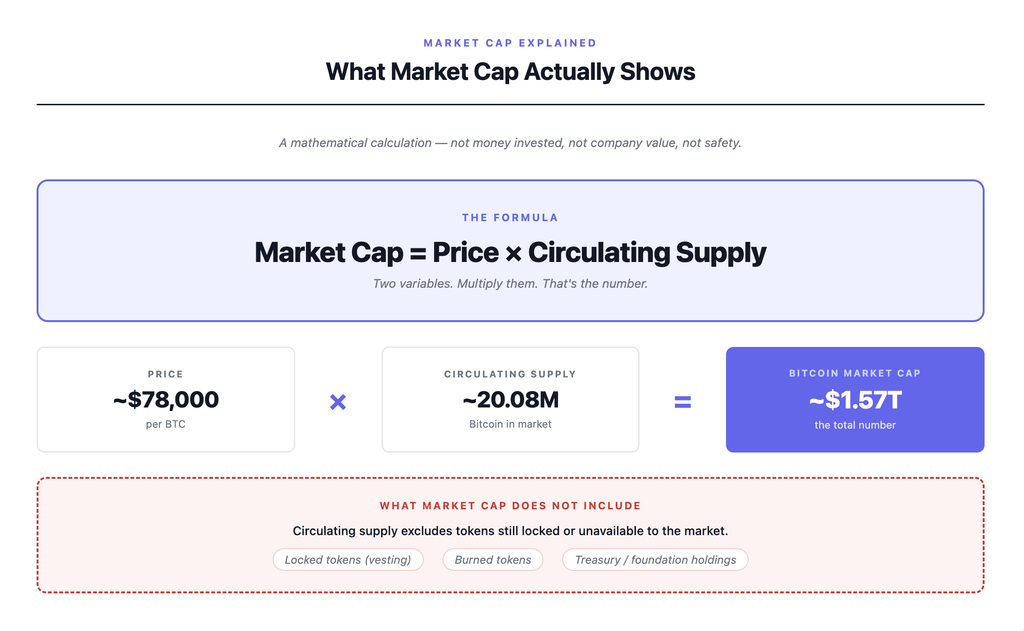
Market cap = current price × circulating supply
Two variables. Multiply them. That’s the number.
For Bitcoin, roughly:
- Circulating supply: ~20.08 million BTC
- Current price: ~$78,000
- Market cap: ~$1.57 trillion
What “circulating supply” actually means
Circulating supply is the number of tokens available in the market right now. Tokens you could theoretically buy or sell today. It excludes:
- Tokens still locked up in team or investor vesting contracts
- Tokens burned (permanently destroyed and provably unrecoverable)
- Tokens held in escrow, treasury, or foundation wallets that aren’t liquid
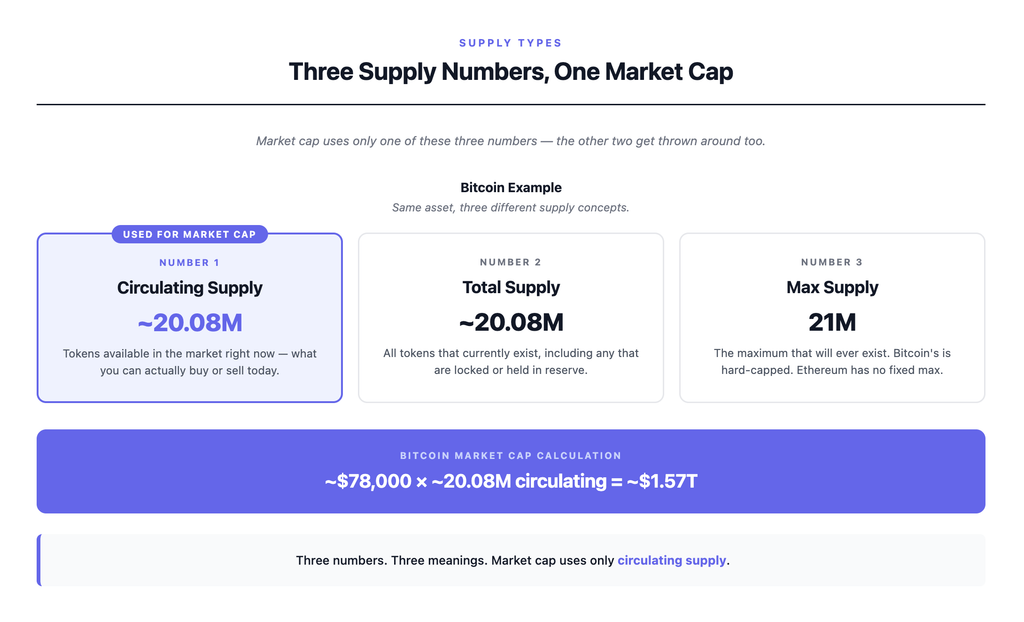
This matters because two other supply numbers get thrown around, and they’re not the same thing:
- Total supply: All tokens that currently exist, including locked ones.
- Max supply: The maximum number of tokens that will ever exist. Bitcoin’s max supply is 21 million. Ethereum has no fixed max supply.
Three numbers, three meanings. Market cap uses only one of them — circulating supply.
Where the numbers come from
The market cap figures you see on CoinGecko, CoinMarketCap, and every crypto app pull from those two aggregators’ methodologies. They estimate circulating supply based on public token contracts, project disclosures, and on-chain data. Prices come from a volume-weighted average across major exchanges.
The number updates in near real-time. Every price tick recalculates the market cap. That’s why you’ll see it move by the second when a coin is volatile.
Simple formula. Simple sources. It’s the meaning people assign to the result that goes sideways.
Market cap vs stocks: a useful comparison (and a misleading one)
Most beginners meet the concept of market cap through stocks first. Apple has a market cap of a few trillion dollars. That’s shares outstanding times share price. Easy.
Then they see Bitcoin’s market cap next to Apple’s on some chart and assume the two numbers mean the same thing.
They don’t.
Stock market cap represents a claim on something real. When you own a share of Apple, you own a fraction of the company. You have a legal claim on future earnings, on physical and financial assets, on cash flow. In some cases you get dividends. You get voting rights. The market cap is the market’s rough estimate of what all those claims are worth added together.
Crypto market cap represents the tokens themselves. Nothing else.
When you own one Bitcoin, you own one Bitcoin. There’s no company behind it. No earnings. No assets on a balance sheet. No dividend. No voting shares in some underlying business. Bitcoin’s ~$1.57 trillion market cap doesn’t mean Bitcoin holders collectively own $1.57 trillion of anything else. It means the market is currently pricing each Bitcoin at a level that, multiplied across the supply, produces that number.
The stock analogy is helpful because the arithmetic transfers. Multiply supply by price. Same math.
The stock analogy is misleading because the underlying meaning doesn’t transfer at all. Comparing “Solana’s market cap vs Apple’s market cap” is comparing two things that use the same formula to describe fundamentally different objects.
Even Bitcoin’s “digital gold” thesis — which is a legitimate case worth taking seriously — doesn’t make Bitcoin’s market cap comparable to a company’s market cap. Gold has no market cap in the stock sense either. It’s just the price of gold times the amount of gold that exists.
Market cap tells you the tokens exist. It doesn’t tell you what they’re worth.
Market cap vs price: why cheap coins aren’t cheap
This is the misconception that costs beginners the most money.
Two beliefs, both wrong:
- “This coin costs $0.01, so it’s cheap and has room to grow 1000x.”
- “This coin costs $78,000, so it’s expensive and near the top.”
Price alone tells you nothing about whether a coin is “cheap” or “expensive.” Price without supply context is meaningless. And the market cap vs price confusion is baked into every exchange interface, which shows the price front and center and buries the market cap in a smaller font.
The Dogecoin math
Let’s run the numbers with Dogecoin.
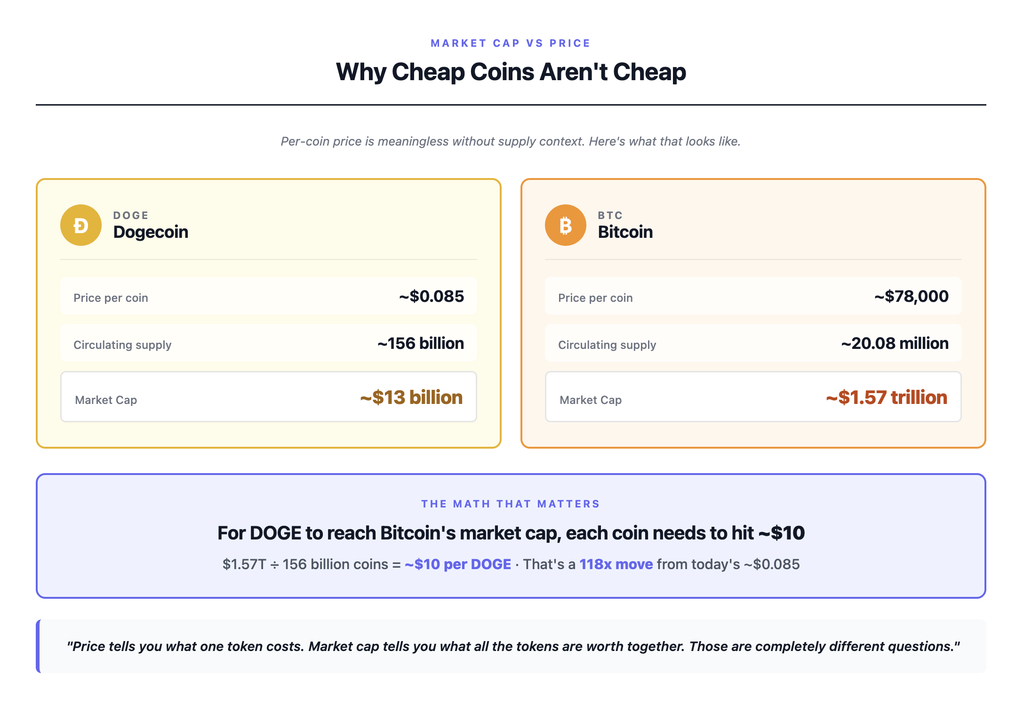
- Dogecoin trades around $0.085 per coin
- Circulating supply: ~156 billion DOGE
- Market cap: ~$13 billion
Now imagine Dogecoin reaching Bitcoin’s market cap of roughly $1.57 trillion. What would one DOGE need to be worth?
$1.57 trillion ÷ 156 billion coins = ~$10 per DOGE.
Read that again. For Dogecoin to reach Bitcoin’s current market cap, each Doge would need to hit around ten dollars. That’s a 118x move from where it trades today.
Which sounds achievable — until you realize what it actually means. It means the market would need to decide that Dogecoin, in aggregate, is worth as much as Bitcoin. Not “one dogecoin is worth one bitcoin.” Not even close. The entire Dogecoin float — every meme, tip, and speculative bag — priced at the same total value as all of Bitcoin.
The “cheap price” is an illusion created by supply. There are 156 billion of them.
The Bitcoin flip side
Bitcoin at $78,000 sounds expensive. It isn’t, in the way beginners mean.
- Circulating supply: ~20.08 million BTC
- Price: ~$78,000
- Market cap: ~$1.57 trillion
There are only ~20 million Bitcoin in circulation, and there will only ever be 21 million total. The high per-coin price is a function of low supply relative to demand. You can buy 0.001 BTC. The unit price of the whole coin doesn’t limit you.
The penny crypto trap
Exchanges and social media prominently display price, not market cap. Trading interfaces put price in bold, market cap in a corner if at all. Twitter posts scream about a coin “at $0.001!” without mentioning that its supply is 10 trillion.
This creates a persistent bias toward cheap-looking coins. Memecoins and low-priced altcoins exploit this bias intentionally — high supply keeps the per-coin price low, which makes retail buyers feel like they’re getting in early.
The real question isn’t “is this coin’s price low?” It’s “is this coin’s market cap low relative to what it does?”
A $50 million market cap coin with real product-market fit is genuinely small. A $0.0001 memecoin with a $2 billion market cap isn’t small — it’s a $2 billion bet on a joke.
Price tells you what one token costs. Market cap tells you what all the tokens are worth together. Those are completely different questions.
The three big things market cap ISN’T
Here’s where beginners get it wrong. Three big misunderstandings, all common, all costly if you act on them.
1. Market cap is NOT money invested
If Bitcoin’s price doubles from $78,000 to $156,000, market cap doubles from ~$1.57 trillion to ~$3.14 trillion. Zero new dollars are needed for this to happen. The market cap number moves because the price moves — that’s it.
The concrete math:
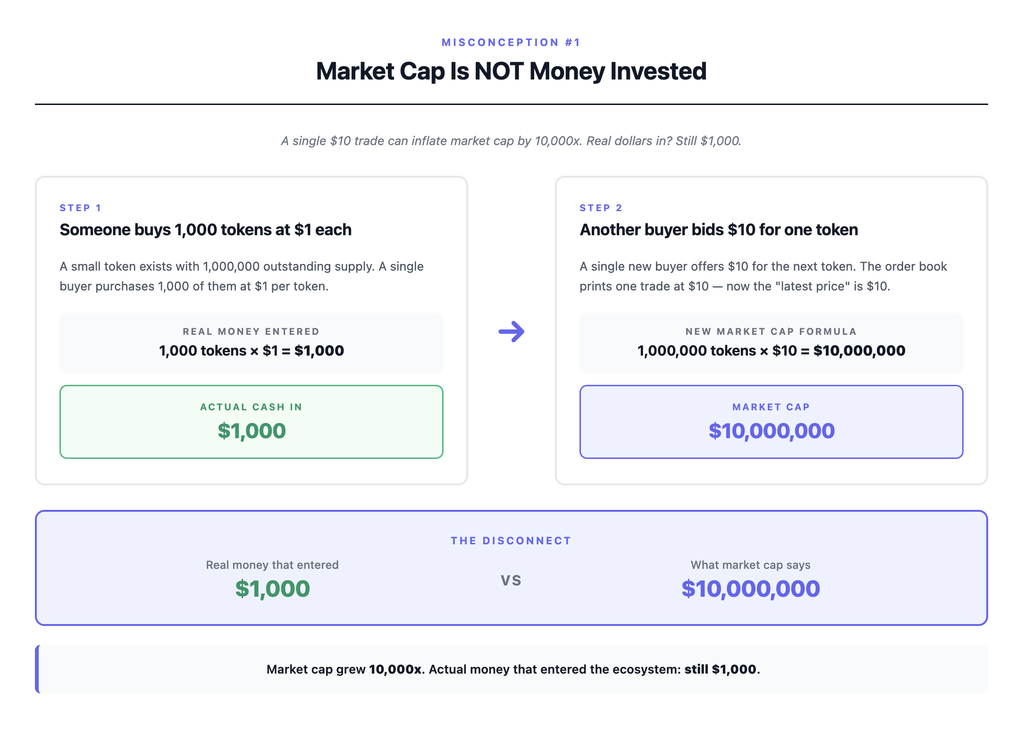
Imagine a small token I’ve never heard of. Someone buys 1,000 tokens at $1 each. Total real money that entered the market: $1,000.
Then some other buyer bids $10 for the next token. The order book prints one trade at $10. The market cap formula now reads:
1,000,000 tokens outstanding × $10 latest price = $10,000,000 market cap.
Market cap: ten million dollars. Actual money that entered the ecosystem: still one thousand dollars.
This is not an edge case. This is how the formula works at every scale. When crypto Twitter says “$500 billion of value was destroyed today,” that’s not $500 billion of actual investor cash evaporating. It’s the market cap calculation reflecting lower prices across the board. The cash-in never matched the market cap on the way up, and the cash-out never matches it on the way down.
That’s why “market cap misleading” is a real, honest framing — the number looks like a total investment figure. It isn’t.
2. Market cap is NOT company value
Companies have revenue. Profits. Assets. Liabilities. Cash flow. Employees. Contracts. Physical infrastructure. Their market cap is a rough market estimate of what all of that is worth in aggregate.
Crypto tokens have token supply and a current price.
That’s the entire input.
There’s no earnings statement. No book value. No cash flow to discount. No dividend. Most crypto projects have no legal claim to underlying assets. When you own SOL or ADA or a memecoin, you own the token — not a fractional interest in a business.
This is why headlines like “Solana’s market cap exceeds Company X’s market cap” are journalistically lazy. The two numbers use the same math to describe fundamentally different objects. One represents a claim on a real economic entity. The other represents the market’s current willingness to pay for a digital token.
Even Bitcoin, which has the strongest non-company thesis (fixed supply, digital scarcity, “digital gold”), doesn’t have anything like a company underneath it. Its market cap is a scarcity-and-demand calculation, not an enterprise valuation.
3. Market cap is NOT safety through size
Bigger market cap does not mean safer investment. It means bigger. Those aren’t the same thing.
Two examples that should be permanently tattooed on beginner brains:
Terra Luna, May 2022. LUNA and its associated stablecoin UST collapsed from a combined market cap of roughly $40 billion to near zero in about a week. LUNA had been a top-10 crypto by market cap. It went to essentially nothing. Not down 80%. Down effectively 100%.
FTX and FTT, November 2022. FTT, the exchange token of what was then one of the largest crypto exchanges, dropped from a peak market cap of roughly $9 billion to around $200 million in days. Top-tier “safe” exchange token. Gone.
Neither collapse was gradual. Neither was foreseeable from the market cap alone. Both projects looked fine by the “top-N ranking” heuristic right up until they didn’t.
Meanwhile, small-cap coins can 100x on nothing but attention. Memecoins routinely do this.
Market cap tells you popularity and liquidity. It says nothing about the fundamentals, the code quality, the treasury health, the regulatory exposure, or the human beings running the project. Big projects fail. Small projects moon. The market cap number doesn’t know either is coming.
Bigger market cap doesn’t mean safer. It means bigger. Those aren’t the same thing.
So market cap isn’t three of the most intuitive things beginners assume. What is it, then? Before we get to the honest uses, there’s one more distinction that matters.
Fully diluted market cap vs circulating market cap
Two different numbers, both often called “market cap” depending on who’s talking.
- Circulating market cap: Current price × circulating supply. What’s tradeable today.
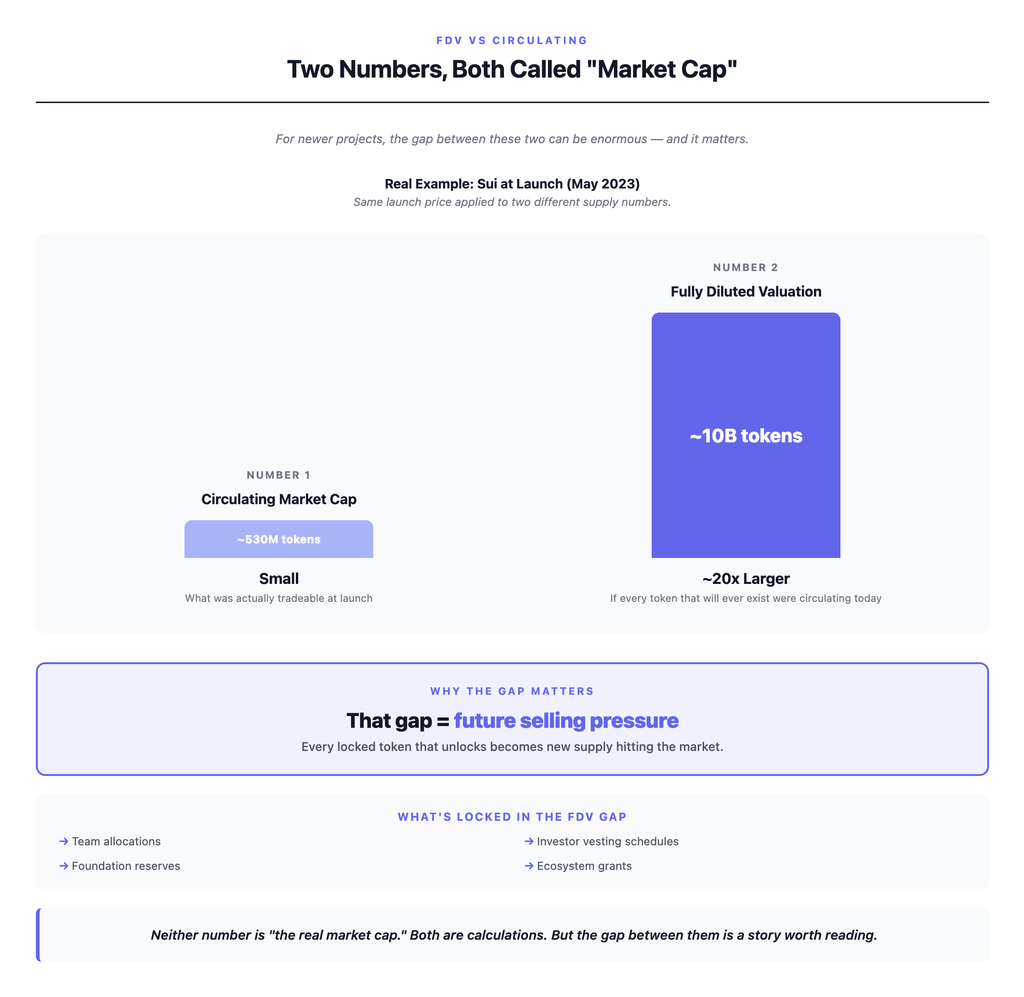
- Fully diluted valuation (FDV): Current price × total or max supply. What the market cap would be if every token that will ever exist were circulating right now at today’s price.
For Bitcoin, the two numbers are close — most Bitcoin is already circulating. But for many newer projects, the gap between circulating and fully diluted is enormous.
The Sui example
Sui launched in May 2023 with roughly 530 million tokens circulating and a total supply of about 10 billion. The circulating market cap looked reasonable. The FDV — the number you’d get if you multiplied the price by all 10 billion tokens — was almost 20 times larger.
That gap is important. It represents tokens locked up in team allocations, investor vesting schedules, foundation reserves, and ecosystem grants. Those tokens don’t sit locked forever. They vest over months and years, and when they unlock, holders often sell.
This pattern shows up across many 2022–2024 launches — Aptos (launched October 2022), Sui, dYdX, and others. Low float at launch, high FDV, staggered unlocks that create ongoing supply pressure.
Why this matters for you
If you’re looking at a project where FDV is 10x the circulating market cap, you’re looking at future selling pressure. Every unlock event puts new supply into the market. If demand doesn’t grow to match, price drops.
This is not a hypothetical concern. It’s one of the most reliable patterns in crypto: tokens with heavy unlocks scheduled tend to underperform through their unlock periods.
Practical rule: always check both numbers. If a project reports its market cap as $500 million but its FDV is $8 billion, that’s a very different investment picture from a project with $500 million circulating and $600 million FDV. One has most of its supply already in the wild. The other has most of its supply still coming.
Neither number is “the real market cap.” Both are calculations. But the gap between them is a story worth reading.
What market cap IS actually useful for
Enough negativity. Market cap does contain real information — it just isn’t the information most beginners think it is.
Rough sizing. Order of magnitude matters. A $50 billion project is meaningfully different from a $5 million project. Not because $50 billion is “safer” — see above — but because you’re looking at very different levels of adoption, exchange listings, developer activity, and liquidity. The order-of-magnitude read is genuinely useful.
Liquidity signal. Bigger market cap generally means more liquid trading. You can move meaningful amounts of Bitcoin without moving the price much. You can’t do that with a $2 million market cap microcap — even a $10,000 buy can pump it 20%, and selling out of it is often harder than buying in. Market cap correlates loosely with liquidity, which correlates with your ability to enter and exit at prices close to what you see on screen.
Ranking bands. Not exact rank, but bands. Top 10 vs top 100 vs top 1,000 tells you something about visibility, exchange availability, and how much attention a project has attracted. A top-10 project is on every major exchange. A rank-750 project might be on two DEXes. That’s real information, even if it doesn’t tell you whether either project is “good.”
Comparative velocity. Comparing same-day market cap movements across coins in the same category (L1 chains, DeFi tokens, memecoins) can give you a rough sense of what’s rotating in and out of favor. Useful for context. Not useful as a buy signal.
What market cap doesn’t tell you: valuation, safety, quality, adoption, actual usage, or whether the project will exist in three years. For those, you need other data — active addresses, TVL, revenue if any, developer commits, unlock schedules, and honest reading.
Common misconceptions worth naming
A quick pass through the beliefs beginners bring in, and why they’re wrong:
“Market cap is the money invested.” Wrong. It’s a formula output. Real capital in circulation is almost always a fraction of the market cap.
“Higher market cap means safer investment.” Wrong. Terra Luna, FTT, and a long list of other top-100 collapses prove otherwise. Safety comes from fundamentals, not from rank.
“If Bitcoin’s market cap is $1.57 trillion, I could sell all my BTC at that price.” Wrong. That’s not how order books work. Trying to sell a large position at once would move the price down through the bids — slippage — and you’d get an average price well below the “spot” price at the top of the book. Market cap assumes the last trade price holds for the entire supply. In reality, it doesn’t.
“Comparing crypto market cap to stock market cap is a fair comparison.” Wrong. Same formula, structurally different underlying meanings.
“FDV is the ‘real’ market cap.” Also wrong. FDV assumes every token instantly exists at today’s price — which won’t be true when those tokens unlock and hit the market. Neither number is “real.” Both are calculations that mean specific things.
And then there’s the reflexive loop: price goes up → market cap goes up → the coin looks more legitimate in rankings → more attention → more buying → price goes up again. This works in reverse on the way down. Market cap isn’t a neutral scoreboard. It’s part of the psychology that moves the market.
How to read market cap honestly
A practical framework you can use every time you check a coin:
- Check both circulating market cap and FDV. If the gap is large, ask why. Look up the unlock schedule.
- Compare within category. An L1’s market cap only makes sense next to other L1s. Memecoins only make sense next to memecoins. Cross-category comparisons are noise.
- Cross-reference with 24-hour volume. High market cap plus thin volume is a red flag — the market cap number isn’t backed by real trading activity, and you may not be able to exit at anything close to the printed price.
- Think in ranking bands, not exact ranks. Top 10 vs top 100 vs top 500 is real information. Whether something is rank 43 vs rank 51 is basically noise.
- Combine with other metrics. TVL for DeFi protocols. Active addresses and transaction counts for L1s. Developer activity. Revenue if the project has any. Market cap alone is one data point, not a decision framework.
- Ask the honest question: “Does this market cap represent anything real, or is it a price × supply calculation that hasn’t been tested by real selling?”
That last question is the whole game.
Common questions
How is crypto market cap calculated?
Current token price multiplied by circulating supply. Prices come from volume-weighted averages across major exchanges. Circulating supply is estimated by aggregators like CoinGecko and CoinMarketCap based on public token contracts, project disclosures, and on-chain data. The number updates in near real-time with every price tick.
What’s the difference between market cap and fully diluted valuation (FDV)?
Circulating market cap uses only the tokens currently available in the market. Fully diluted valuation uses the total or maximum supply — every token that will ever exist. For projects with heavy vesting schedules, FDV can be many times larger than circulating market cap. That gap signals future selling pressure as locked tokens unlock over time. Always check both numbers.
Is a higher market cap always safer?
No. Terra Luna went from roughly $40 billion in market cap to near zero in a week in May 2022. FTT collapsed from ~$9 billion to ~$200 million in November 2022. Both were considered “safe” top-tier assets right up until they weren’t. Market cap tells you popularity and liquidity — not fundamentals, not solvency, not code quality. Real safety assessments require looking at the underlying project, not the ranking.
Is crypto market cap the same as stock market cap?
Not really. The math is the same — supply times price. But stock market cap represents a claim on a real business: earnings, assets, dividends, voting rights. Crypto market cap represents the tokens themselves, with no underlying business, revenue, or legal claim on assets. Same formula, structurally different meaning. Comparing them side-by-side is misleading even when the numbers are technically comparable.
What’s the total crypto market cap right now?
As of 2026, the total crypto market cap sits in the ~$3 trillion range, but the number swings by hundreds of billions on volatile weeks. Bitcoin typically accounts for a large share of that total. Because it’s a price-based calculation, “total crypto market cap” moves whenever major coins move — it’s not a measure of capital deployed, and it can double or halve without matching flows of real money.
Where to go from here
Market cap is a starting point, not an answer. If you understand what it is (a formula) and what it isn’t (money invested, company value, safety), you’re already ahead of most people quoting the number on social media.
From here, the useful next reads:
- What is Bitcoin — the biggest crypto market cap, and why its supply mechanics matter.
- What is Ethereum — the second-biggest, with very different supply dynamics (no fixed cap, EIP-1559 burn).
- Dollar-cost averaging in crypto — a strategy that doesn’t require you to read market cap correctly to work.
- How to buy crypto safely — if you’re still new to owning any of this.
- What is a DEX — for understanding the liquidity side of the market cap picture.
A note on financial advice
None of this is financial advice. It’s context.
Market cap comes with its own specific risks worth naming: over-relying on it as a safety signal, ignoring FDV dilution when a project has heavy unlocks coming, chasing rankings instead of fundamentals, and taking false comfort from a “top 10” position that history shows is not permanent. Terra Luna was top 10. So was FTT. Rank isn’t a moat.
Crypto is volatile. Positions can go to zero. Market cap is a data point — one of many — and it’s a poor decision framework on its own. Read it for what it is: price times supply, updated every second, meaning exactly as much as the market’s current willingness to pay. Nothing more.