Last week, Kevin Warsh’s hawkish Jackson Hole speech reset the entire market’s rate-cut expectations in a single day. This week gave us two more macro shocks — a US airstrike on Iran and an August jobs report that came in three times higher than economists expected. And yet Bitcoin closed the week higher than it started, powered by the biggest single-day ETF inflows in weeks.
This is your weekly crypto brief for the week ending Sunday, September 6, 2026. The August jobs report crushed forecasts. Iran military escalation triggered a mid-week crypto sell-off. And the September 15 CLARITY Act vote is now nine days away with prediction markets giving it less than a 20% chance of passing.
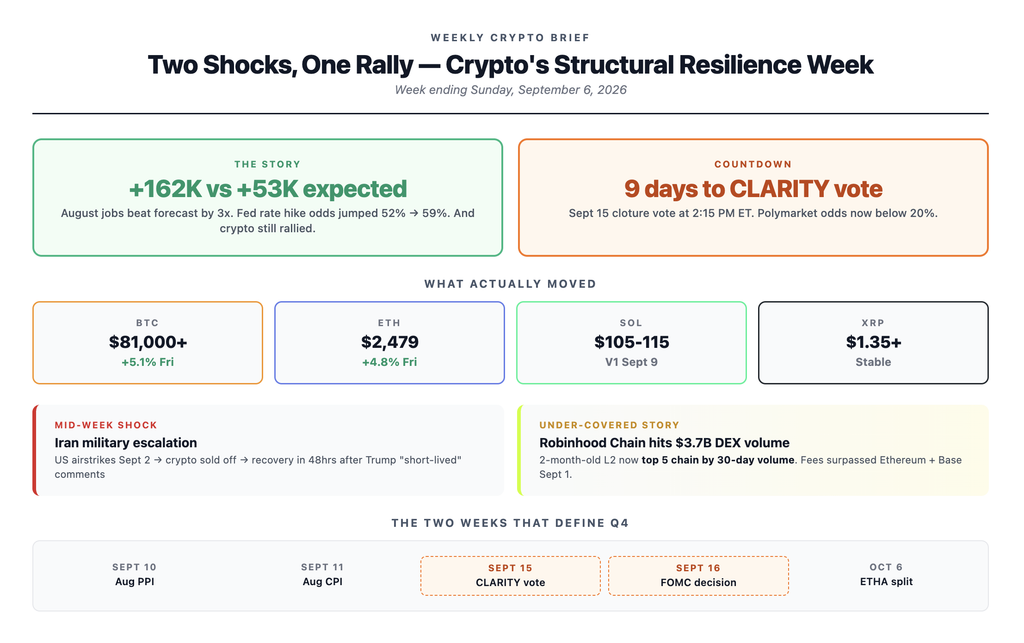
What actually moved
Here’s the price action across the majors this week. If you’ve been reading this weekly crypto brief through the summer, the pattern will look familiar: macro events dominate everything else, and ETF flows drive the recovery.
Bitcoin (BTC): Opened the week around $77,000 after last week’s Warsh drop. Fell to intraday lows around $76,500 on Tuesday’s Iran shock. Recovered mid-week, then exploded 5.1% on Thursday-Friday to close above $81,000 on massive ETF inflows. Weekly net: positive, one of the strongest recoveries of Q3.
Ethereum (ETH): More volatile than Bitcoin this week. Fell to $2,373 on Wednesday’s Iran continuation, then rallied 4.8% on Friday to $2,479. ETH is now +29.6% vs Bitcoin in August, its strongest monthly outperformance versus BTC of the year. Testing $2,500 resistance heading into the weekend.
Solana (SOL): Followed the BTC pattern — down early week, sharp recovery Thursday-Friday. Trading in the $105-$115 range through the week. Focus turns to Transaction V1 launch on September 9 (3.3x transaction size increase).
XRP: Held above $1.35 through the week, recovering from last week’s 4.8% drop. Continued to trail the majors on volatility but showed relative stability.
Total crypto market cap ended the week at approximately $2.7 trillion, up from $2.6T at week’s open. Ethereum’s market cap now sits at $302 billion, giving ETH a 10.8% dominance of the total market — a slight uptick as ETH continues outperforming BTC.
The story: August jobs report crushed forecasts
Friday morning, the Bureau of Labor Statistics released the August employment report. The numbers were dramatically stronger than economists expected:
- Nonfarm payrolls: +162,000 (vs. Dow Jones consensus of +53,000) — the strongest monthly gain since March
- Unemployment rate: 4.1% (unchanged, as expected)
- Average hourly earnings: +0.3% MoM, +3.1% YoY
- Labor force participation: 61.6% (rebound from July’s multi-year low)
- June/July revisions: +55,000 combined (erased July’s earlier reported job losses)
This is the number Fed officials had been waiting for. The market-implied odds of a September rate hike jumped from 52% to 59% within hours of the release. The Fed’s dual mandate (inflation + employment) now shows both indicators pushing toward higher-for-longer rates: PCE inflation stubborn at 3.7%, and now jobs proving the labor market can absorb tight policy.
The counterintuitive market reaction: Crypto RALLIED despite the hawkish jobs data. Historically, strong jobs = hawkish Fed = crypto sells off. This week, that pattern broke. Bitcoin closed the week above $81,000 despite September rate hike odds climbing to nearly 60%.
Why the pattern broke this week: Three specific factors overwhelmed the Fed narrative:
- Iran de-escalation relief — Wednesday’s Trump comments that airstrikes were “short-lived” reduced geopolitical risk premium
- Massive ETF inflows — Thursday-Friday saw Bitcoin ETF inflows large enough to force a 5.1% BTC rally
- Ethereum breakout momentum — ETH’s +29.6% August vs BTC outperformance signals rotation into altcoins, drawing capital into the broader crypto category
This is the crypto market showing structural strength — the ability to rally against a hawkish Fed narrative because institutional flows and altcoin momentum overpowered the macro headwind.
Iran military escalation — the mid-week shock
On Tuesday, September 2, the United States conducted airstrikes against Iran (specific targets and rationale reported but classified in scope). Financial markets reacted immediately:
- Bitcoin dropped from ~$77,500 to below $77,000 within hours
- Ethereum fell 2% from Tuesday open to $2,373 mid-morning Wednesday
- Oil spiked on supply concerns (though within the current range)
- Equities sold off across the board as risk-off sentiment took hold
The Iran shock is the second geopolitical catalyst in three weeks to move crypto prices meaningfully (following August’s Israel-Iran tensions). It confirms that crypto now trades as a full-fledged macro asset — geopolitical events move it the same way they move equities, commodities, and traditional risk assets.
The recovery came within 48 hours after President Trump indicated that the strikes were “short-lived” and would not escalate into broader military engagement. This de-escalation pattern is critical for markets: it removes the geopolitical risk premium and allows fundamentals (ETF flows, macro data) to drive prices again.
Ethereum outperforming Bitcoin — the alt season signal
August 2026 was a genuinely notable month for Ethereum. ETH gained 32.5% for the month vs Bitcoin’s 24.95% gain — meaning ETH outperformed BTC by roughly 7.5 percentage points. Extended to a rolling one-month view against BTC, ETH is up 29.6%.
This is the strongest ETH vs BTC month of 2026. Two things worth understanding:
First, ETH is finally breaking a year-long downtrend. Ethereum broke through the descending trendline that had capped every rally since the August 2025 peak at $4,958. The weekly candle two weeks ago showed a 31% weekly gain — the first “higher high” of this cycle.
Second, this is what the beginning of alt season looks like. When BTC leads a rally and ETH outperforms, it’s typically the earliest signal that capital is rotating from Bitcoin into altcoins. Historically, this pattern precedes 2-4 month periods of altcoin outperformance across the market.
The technical picture: ETH is testing $2,500 resistance (the 50-week moving average sits at $2,542). A weekly close above $2,438 keeps the breakout intact. A close above $2,550 would open the door to the $2,900 zone.
The caveat: Alt seasons are late-cycle phenomena. They often occur near market tops, not near bottoms. Reader takeaway: ETH’s outperformance is real and worth understanding, but it’s not necessarily a “buy signal” — it’s a rotation signal.
ETF flows: the August record
August 2026 was the best month of the year for Bitcoin spot ETFs. According to Farside Investors ETF flow data:
- $3.52 billion in net inflows across all spot Bitcoin ETFs in August — the strongest monthly total of 2026
- ~80% of those inflows landed in the two weeks following the August 19 Treasury bond buyback announcement (confirming last week’s brief thesis that the buyback expansion was a liquidity catalyst)
- September 1 outflows: $236 million (largest single-day withdrawal since July 31 — a warning sign)
- September 4 (Friday): massive inflows that fueled BTC’s rally to $81,000
The pattern reveals institutional behavior: the marginal Bitcoin bid is now ETF-driven, not retail-driven. When flows are strong, price rallies. When flows reverse (as on September 1), price drops sharply. This makes daily ETF flow data one of the most reliable near-term price predictors in the current cycle.
Also notable: the BlackRock 1-for-3 reverse split on iShares Ethereum Trust ETF (ETHA) is confirmed for October 6. Prep in advance if you hold ETHA.
Solana this week — Transaction V1 approaches
The Solana ecosystem has two major stories worth tracking:
Transaction V1 launches September 9. This upgrade increases transaction size by 3.3x, enabling zero-knowledge proofs and cross-chain operations at native Solana speeds. The launch continues Solana’s aggressive 2026 technical roadmap:
- Block time reductions: 400ms → 300ms (25% faster) completed August
- Transaction V1: September 9 launch (this coming week)
- Alpenglow consensus upgrade: October 2026 (targets ~150ms finality)
- Faster disinflation implementation: 2027 (from the SGP-0002 governance vote passed last week)
September token unlocks: The Solana ecosystem faces approximately $100 million in token unlocks in September, led by:
- Official Trump ($TRUMP): 28.271 million tokens (~$60.25M) — 10.35% of circulating supply
- Pump.fun ($PUMP): 6.875 billion tokens (~$28.8M) — 1.73% of circulating supply
- Kamino ($KMNO): 229.17 million tokens (~$5.51M) — 4.21% of circulating supply
- Sanctum ($CLOUD): 10.45 million tokens (~$208K)
These unlocks create ongoing supply pressure specifically for those tokens. They generally don’t affect SOL itself directly, but they can drag on the broader Solana ecosystem sentiment.
Robinhood Chain — the two-month-old L2 outperforming veterans
One of the most under-covered stories of 2026 continues building momentum. Robinhood Chain, the Ethereum Layer 2 network launched by the brokerage firm on July 1, 2026, is now processing more daily decentralized exchange volume than blockchains that have existed for years.
This week’s headline numbers:
- $3.7 billion in 24-hour DEX volume — a new all-time high set this past week
- $47+ billion in cumulative DEX volume since the July 1 launch
- Top 5 chain by 30-day volume (~$15 billion), sitting behind Solana, BNB Chain, Ethereum, and Base
- 576 million total transactions in two months
- 12.3 million addresses created
- 190+ tokenized stocks live with $3+ billion in cumulative stock token DEX volume
The revenue milestone: In July 2026, Robinhood Chain generated roughly $3.6 million in transaction fees — making it the top revenue-producing Layer 2 in the entire Ethereum ecosystem that month. On September 1, daily fees hit a record $3.75 million, surpassing both Ethereum mainnet and Base for a single day. That’s a two-month-old chain outearning networks with years of ecosystem development.
Technical fundamentals: Robinhood Chain is built on Arbitrum’s Orbit stack, uses ETH as gas token, and features 100-millisecond block times. It settles directly to Ethereum for security. Uniswap v3 and v4 handle roughly 86-90% of trading volume — the network is more of a Uniswap-dominant execution venue than a diverse DeFi ecosystem.
Three important caveats worth naming honestly:
- The gas subsidy expires late September 2026. Robinhood has been covering network fees for eligible transactions in the Robinhood Wallet app for 90 days. When the subsidy ends this month, the real test of whether volume holds begins. Chains that grew on subsidies often don’t retain volume when users start paying.
- Uniswap dependency is a concentration risk. With ~90% of volume flowing through Uniswap, Robinhood Chain isn’t showing organic protocol diversity yet. It’s essentially a highly-successful Uniswap deployment on new infrastructure.
- Memecoin activity drove early growth. CASHCAT (the chain’s breakout memecoin) fluctuated between $100-156M market cap during peak weeks. Token launchpads like Pons contributed significantly. This is genuine activity, but it’s speculative activity — not the “real-world utility” some analysts have described.
Why this matters for the market thesis: Robinhood Chain proves that new L2 infrastructure can genuinely scale fast when backed by an existing consumer platform with millions of users. It’s a template that other traditional finance firms (Coinbase already has Base, others are exploring) may follow. But it’s also a warning about how much “chain success” is really about the memecoin and DeFi speculation layered on top rather than long-term utility.
CLARITY Act — nine days to the September 15 vote
The Senate’s procedural cloture vote on the CLARITY Act is scheduled for Tuesday, September 15, 2026 at 2:15 PM ET — nine days away as of this brief.
The math: Cloture requires 60 votes. Failure to reach 60 effectively kills the bill for 2026 and pushes it into an uncertain 2027 legislative environment.
Prediction market signal: Polymarket odds of the CLARITY Act passing have collapsed from 58% (August peak) to below 20% currently. This is the market pricing in the political reality: bipartisan disagreements over ethics provisions and DeFi treatment have made compromise increasingly difficult.
Industry response: SEC Chair Paul Atkins has continued signaling that the SEC will use its August 18 “Regulation Crypto Assets” proposal as fallback if CLARITY fails. This provides regulatory floor — even without congressional action, executive-branch clarity is coming. But that’s a weaker outcome than legislation, which would be more permanent.
What to watch September 15: If cloture fails, expect immediate market reaction (typically negative for regulatory-sensitive names like DeFi tokens and exchange tokens). If cloture succeeds, the bill still needs to pass amendment votes, reconciliation with House version, and Trump signature — but momentum would build significantly. Expect next Sunday’s weekly crypto brief to preview the vote with fresh Polymarket odds and senator whip counts.
What to watch this coming week
Mon September 7: Labor Day observed — US markets closed. Light volume expected.
Tue September 9: Solana Transaction V1 launch. Watch for network stability and any short-term SOL price impact.
Wed September 10: August PPI (Producer Price Index) release. First inflation reading of the month. Higher-than-expected number would reinforce hawkish Fed narrative and possibly cap crypto’s recovery.
Thu September 11: August CPI (Consumer Price Index) release. The single most important inflation data point before the September 16 FOMC decision. A hot number essentially confirms rate hike odds; a cool number reintroduces cut possibility.
Sun September 14: Senate reconvenes from recess.
Tue September 15 at 2:15 PM ET: CLARITY Act cloture vote. The single biggest crypto policy catalyst of 2026. Prediction markets currently give it less than 20% chance of clearing the 60-vote threshold.
Wed September 16: FOMC decision. Currently 59% odds of a rate hike, 40% odds of hold, 1% odds of cut. The most uncertain FOMC meeting in over a year.
The bigger picture
Two weeks ago, we said the setup for the next six weeks was “more consequential than any six weeks we’ve had in 2026.” Nothing has changed that assessment — if anything, this week reinforced it.
The market absorbed two major shocks (Iran military action + strong jobs beat) and STILL closed the week higher. That’s structural resilience. Bitcoin ETFs are absorbing every dip as buying opportunities. Ethereum is showing genuine relative strength that suggests alt season may be forming. And the Solana ecosystem is delivering technical upgrades on schedule.
But the next two weeks contain two events that will define Q4:
- September 15 CLARITY vote — 9 days away, currently priced as unlikely to pass
- September 16 FOMC decision — hike odds at 59%, hold at 40%, historically uncertain
If both events go badly for crypto (CLARITY fails + Fed hikes), expect meaningful downside pressure. If one goes well and the other neutrally (CLARITY passes OR Fed holds), crypto likely holds current levels. If both go favorably (CLARITY passes AND Fed holds), we could see another Aug 22-style rally.
Next Sunday’s weekly crypto brief will cover the August CPI number, PPI data, Solana’s Transaction V1 rollout, and set the final stage for the September 15 CLARITY vote and September 16 FOMC decision. This is the last quiet Sunday brief before Q4’s most consequential week.
Where to go next:
- New here? Start with our beginner path or read dollar-cost averaging crypto — the strategy specifically designed for weeks like this one when the news moves faster than your conviction should.
- Want to understand why crypto now trades on Fed decisions and jobs reports? Our new What is market cap in crypto explainer covers the metric everyone quotes and nobody understands.
- Curious about the technical differences between the major Layer 1 blockchains? Read What is Bitcoin, What is Ethereum, What is Solana, or What is Cardano.
- If this week made you want to actually buy some crypto, how to buy crypto safely walks through the sober version of that decision. Pair with how crypto wallets work for self-custody guidance.
- Curious how decentralized exchanges fit into all this? What is a DEX explains the basics.
See you next Sunday.
A note on financial advice
This brief is for education, not investment advice. This week showed crypto’s structural resilience — the ability to absorb geopolitical shocks and hawkish Fed data while still closing higher. That’s real. It’s also not a guarantee of anything.
The September 15 CLARITY vote and September 16 FOMC decision remain the two events most likely to define Q4 for crypto. Between now and then, expect volatility around the CPI (Sept 11) and PPI (Sept 10) inflation prints. Only invest what you can afford to lose entirely, and make your own decisions based on your own situation.