Last Sunday we said crypto had shown “structural resilience” — the ability to rally against a hawkish Fed narrative because institutional flows overpowered the macro headwind.
This week tested that claim, and it did not survive.
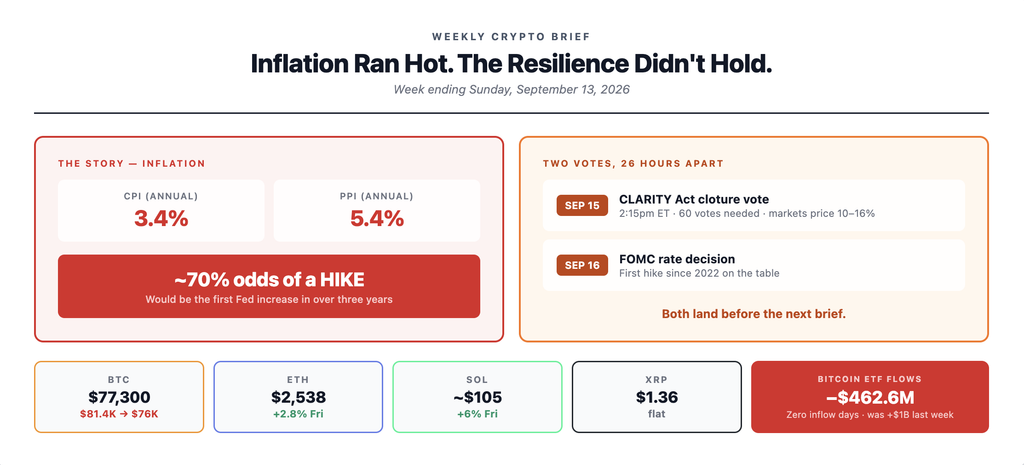
Same pressure, opposite outcome. Bitcoin ETFs went from nearly a billion dollars of inflows to $462 million of outflows without a single positive day. Bitcoin fell from $81,427 to below $76,000. The bid that held everything up seven days ago simply was not there.
This is your weekly crypto brief for the week ending Sunday, September 13, 2026. Inflation came in hot on both readings. Oil crossed $100 as the Iran war escalated sharply. And the Fed is now expected to raise rates for the first time in more than three years — a decision that lands next Wednesday, roughly 26 hours after the Senate votes on whether US crypto legislation survives 2026.
What actually moved
If you’ve been reading this weekly crypto brief through the summer, you’ll recognise the shape: one macro story driving everything, with crypto-specific news barely registering against it.
Bitcoin (BTC): Opened the week around $79,000 after markets reopened from Labor Day. Fell steadily as inflation data landed — below $77,000 on Thursday, down to a $76,535 open on Friday. Closed the week near $77,300. Peak-to-trough: from $81,427 the previous week to roughly $76,000, a 6.7% drawdown.
Ethereum (ETH): Opened Monday at $2,514.80, its strongest open since August 22. Slid through the week to a $2,437 open on Friday, then recovered strongly — up 2.8% to $2,538 by late Friday, the best performance among the majors that day. The August outperformance versus Bitcoin has stalled, but ETH is holding the $2,500 level.
Solana (SOL): The exception. Fell with everything else Monday through Thursday, dropping to around $98 and printing a short-term death cross on the two-hour chart. Then reversed sharply on Friday, climbing from $98 to $104 while Bitcoin went nowhere. Closed the week near $105, up roughly 6% on the day. There are reasons, and they’re below.
XRP: Followed the majors down, without notable divergence.
Total crypto market cap stood at $2.73 trillion as of early Saturday, with 24-hour volume of $110.2 billion. Bitcoin dominance sits at 56.8%, Ethereum at 11.2%. Stablecoin market cap held flat at $290.9 billion.
Inflation came in hot — twice
Two readings landed this week, and both pointed the same direction.
Thursday: Producer prices. The PPI rose 0.4% in August, in line with forecasts. But the annual figure came in at 5.4% — the highest twelve-month reading of 2026, up from 4.7% in July. Energy did the damage: final-demand energy prices climbed 4.2%, and diesel alone jumped 24.1% in a single month, accounting for more than a third of the entire increase in goods prices.
Core PPI was actually softer than expected at 0.2%. That nuance got lost, and understandably so — when headline wholesale inflation is running at 5.4% against a 2% target, the core reading is not what moves the conversation.
Friday: Consumer prices. The CPI rose 0.4% for the month and 3.4% year over year, matching July. Core CPI rose 0.3%, a tenth above forecast, with the annual core rate at 2.4% — the lowest since March 2021.
That split matters. Underlying inflation is genuinely cooling. Energy is not. Gasoline rose 3.9% in August and is up 27.4% from a year ago, accounting for over a third of the monthly increase on its own. Diesel is up 52% year over year. Shelter, the largest single CPI component, eased to 3.0% annually.
The market read it as a hike. Odds of a September rate increase moved to roughly 70% after the CPI print. The fed funds rate has sat at 3.5%–3.75% for all of 2026. A quarter-point increase next Wednesday would be the Fed’s first hike in more than three years.
Kathy Bostjancic, chief economist at Nationwide, summarised the problem directly: Chair Warsh and others signalled that rates could stay on hold only if disinflation continued, and the August report did not deliver that.
The Iran war is the reason
None of the energy story is separate from the war.
The US–Iran conflict passed six months this week and escalated sharply. On Tuesday, US Central Command destroyed five Islamic Revolutionary Guard Corps oil tankers in the Gulf of Oman. The IRGC responded by warning all tankers in Kuwaiti and Bahraini waters to evacuate. Houthi attacks set Saudi energy facilities ablaze, with satellite imagery showing smoke rising from an Aramco refinery.
Oil responded immediately. Brent crossed $100 on Wednesday for the first time since July, settling at $101.21. Thursday brought a much larger move: WTI closed at $102.48, up 6.7%, its highest settle since May 19, with Brent at $107.63. Oil is up more than 18% in September alone. Goldman Sachs raised its odds of crude exceeding $120 a barrel.
The consumer numbers follow directly. US gasoline averages $4.22 a gallon — a 41% jump since the war began and more than a dollar above this time last year. Diesel hit a new record high.
The Wall Street Journal reported that White House advisors have discussed with the President the possibility the war drags on past Inauguration Day in January 2029. The European Central Bank raised rates on Thursday, explicitly citing inflation driven by the conflict.
For crypto, the chain is short: war raises oil, oil raises inflation, inflation raises rates, and higher rates pressure an asset that pays no yield. Every leg of that ran against crypto this week.
ETF flows reversed completely
This is the cleanest signal of the week, and it’s the one that undercuts last Sunday’s framing.
US spot Bitcoin ETFs saw $462.6 million in net outflows. There was not a single day of inflows.
- Monday: markets closed
- Tuesday: −$46.6 million
- Wednesday: −$120.2 million
- Thursday: −$282.6 million — the largest single day of the week
- Friday: −$13.2 million
Thursday’s outflow was concentrated: roughly $164 million from ARK 21Shares, $36 million from Grayscale, $33.6 million from Fidelity.
Compare that to the previous week, which brought close to $1 billion in inflows, including a single $730.9 million day on September 3. Total net assets held by US spot Bitcoin ETFs fell from about $101.25 billion to roughly $97.5 billion.
The reversal was not crypto-specific. Reuters reported that global equity funds saw $15.52 billion withdrawn in the week through September 9 as higher oil intensified inflation concerns. Money left risk assets broadly. Crypto was included, not singled out.
Which is the honest correction to last week’s brief. What looked like structural resilience was one week of ETF flows. When the flows turned, so did the price. That’s not a structure — it’s a bid, and bids can leave.
CLARITY Act — three days away
The Senate returns from recess on Monday. On Tuesday, September 15, at 2:15pm ET, it holds a cloture vote on the motion to proceed to H.R. 3633, the Digital Asset Market Clarity Act. Sixty votes are needed.
The odds have collapsed. Polymarket put the probability of the bill becoming law in 2026 at 82% in February. It now sits at roughly 16%. Galaxy Research puts it at 10%, down a staircase: 75% after the Senate Banking markup in May, 60% in early June, 50% by late June, 30% after the combined text landed in July, 10% when the Senate left for August recess.
One distinction worth being precise about. Those prediction markets measure whether the bill becomes law in 2026 — not whether it clears cloture on Tuesday. Those are different questions. Clearing cloture only opens floor debate. The bill would still need a full Senate vote, reconciliation with the House version, votes in both chambers, and a signature. A successful Tuesday would be a meaningful step, not a finish line.
This weekly crypto brief has tracked the CLARITY Act every week since July. Here is where it stands three days out.
The text changed on Thursday. Senate Republicans released a revised 630-page version of the CLARITY Act on September 10, five days before the vote. The most notable addition targets what the drafters call “decentralised-in-name-only” protocols — those actually controlled by an individual or a small group — requiring them to register with the Commodity Futures Trading Commission.
That’s a meaningful change. It narrows the definition of what counts as genuinely decentralised, and it lands close enough to the vote that senators are being asked to move on text most will not have read in full.
Three disputes remain unresolved:
- Ethics provisions. Seven Democratic senators say the current draft falls short on ethics, consumer protection, and illicit finance. Their core demand is an enforceable ban on presidents and senior officials issuing or profiting from crypto — pointed at the President’s roughly $1.4 billion in crypto-linked income.
- DeFi developer liability under Section 604 — the provision shielding non-custodial software developers from money-transmission liability. The Solana Policy Institute lobbied specifically for this language.
- A stablecoin yield provision that threatens roughly $1.35 billion in annual Coinbase USDC rewards revenue.
The calendar is brutal. House leaders cut eight September voting days. House members leave two days after the Senate’s procedural vote. Completing every remaining stage in September leaves essentially no room for delay.
Not everyone is pessimistic. SEC Chairman Paul Atkins made his first on-record endorsement of the bill in July, pledging the agency’s technical assistance to Congress — and he’s giving a keynote in Washington the afternoon before the vote. Coinbase CEO Brian Armstrong told CNBC he believes passage is likely, reasoning that Majority Leader Thune would not have scheduled the vote otherwise.
Three failures, three completely different attacks
Two of these broke around last Sunday and we didn’t cover them. The third landed mid-week. Together they’re a useful map of where crypto risk actually lives, because no two of them are the same kind of problem.
Liquid Network — $320 million, a logic flaw
On September 6, roughly 4,000 of the 4,200 bitcoin held in a wallet used by Blockstream’s Liquid Network were taken — around $320 million. Liquid is a Bitcoin sidechain used by several exchanges to move BTC.
The mechanism is the interesting part. Funds left through the peg-out authorization key system, but Liquid reported no evidence that the signing keys themselves were stolen. The flaw sat one layer above the keys, in the software logic that decides which peg-out requests are valid.
Liquid operates an 11-of-15 threshold multisig specifically to prevent a single rogue signer or stolen key from draining the pool. If the peg-out logic allows someone to route around that threshold, the multisig arithmetic stops mattering. The keys were fine. The rules governing the keys were not.
Liquid initially said the perpetrators appeared to be white-hat hackers, who typically return funds for a fee. That’s not how it played out. Blockstream refused to pay a ransom and has since recovered roughly 3,400 BTC — about 85% of what was taken. Other Liquid-issued assets — USDT, DePix, tokenised real-world assets — were not directly affected. The damage concentrated on the BTC reserves backing L-BTC.
For scale: even after the recovery, the unreturned portion sits alongside a gross figure that exceeded the combined total of all August 2026 crypto hacks, which ran $136–140 million across roughly 50 separate incidents.
A second, smaller bridge exploit followed. On September 11 at around 04:28 UTC, Symbiosis was exploited on its Bitcoin Bridge. The team halted BTC routes, recovered about 15 BTC, and offered the attacker a 20% white-hat bounty with a deadline of September 13. Other Symbiosis routes remained operational. Small in absolute terms, but it’s two Bitcoin bridge failures in five days.
Orionx — $7 million, apparently from the inside
On September 3, Orionx, a Chilean crypto exchange, announced a permanent shutdown after a forensic audit found more than $7 million in customer assets had been moved to wallets outside the company’s control. Bitcoin, Ethereum, XRP and Polygon were affected. The transfers allegedly span 2018 to 2021 — years, not days.
Orionx filed a criminal complaint against its own co-founders, Joaquín Díaz and Roberto Zibert. Both deny wrongdoing. More than 100,000 registered users are affected, withdrawals are suspended, and there is no firm timeline for returns.
Two details make this worth understanding rather than just noting.
Tether exclusively led Orionx’s Series A in June 2025 — fifteen months before the collapse — as part of a Latin America expansion push. Bitfinex, a Tether affiliate, had invested earlier in 2023. Tether has since removed the investment announcement from its website without comment.
Chile’s financial regulator had already rejected Orionx’s registration application — and now says it cannot oversee the wind-down or order the return of customer assets. Users are dependent on the company’s own restitution process or on court action.
That second point is the one to sit with. The regulator had said no. When the exchange failed, there was no regulator to appeal to.
Brevo — nobody’s crypto was touched, and it may be the most dangerous
On September 9 and 10, an attacker exploited a flaw in how Brevo — the email marketing platform formerly known as Sendinblue — handles SAML single sign-on. The attacker created a Brevo account, enabled SSO, and sent workspace invitations to legitimate account holders. Access was, in Brevo’s words, “not properly scoped.”
138 customer accounts were accessed. Six were used to send phishing emails. Forty-three had their contact lists exported. Ninety-three showed no meaningful activity.
Crypto companies bore the brunt. Trezor confirmed roughly 347,000 phishing emails went to its newsletter subscribers, carrying the subject line “Critical Security Alert: STM32 Entropy Vulnerability.” The link downloaded an app that asked victims for their wallet backup. Trezor killed the domain in under twenty minutes — but roughly 2,500 people had already clicked.
BitBox and CoinTracking confirmed their accounts were also compromised. Solana Mobile disclosed unauthorised access to its own Brevo account, disabled it, and said that to its knowledge no emails were sent — while continuing to verify with Brevo.
No blockchain was hacked. No smart contract failed. No private key was stolen. The attackers went after the mailing list, because a phishing email that arrives through a company’s real email infrastructure, from its real domain, passing every authentication check, is enormously more convincing than a spoofed one.
This is Trezor’s second third-party breach in two months. It’s also close to a repeat of Ledger’s 2020 e-commerce breach, where leaked customer data fed years of targeted phishing. The lesson then was supposed to be that customer contact data deserves the same rigour as the wallets. Six years later, different vendor, same failure.
The practical takeaway, and it’s the one worth keeping: Solana Mobile’s advisory said it plainly — they will never ask for your seed phrase, private keys, or recovery details. Neither will Trezor, Ledger, your exchange, or anyone else legitimate. An email asking for any of those is fraudulent regardless of how convincingly it arrives.
What the pattern says
A protocol logic flaw. Apparent long-running insider theft. A supply-chain phishing campaign through an email vendor. Three incidents in a week, and the only thing they share is that people lost money.
The 2026 data says the non-code failures are winning. CertiK recorded $1.315 billion stolen across 344 incidents in the first half of the year. The two largest — Kelp DAO at $291 million and Drift Protocol at $285 million, together 44% of all losses — involved no smart contract bug at all. They were compromised keys and credentials.
CertiK’s Ronghui Gu put it plainly: a protocol can pass a flawless code audit and still lose millions because of a compromised admin key.
For most readers, the Brevo incident is the directly relevant one. You don’t need to use a DeFi protocol or hold funds on a Chilean exchange to be on a crypto company’s mailing list.
Solana had a genuinely busy week
Three things landed, and together they explain Friday’s divergence.
Transaction V1 went live Tuesday. Solana activated the upgrade on mainnet as scheduled. Maximum transaction size rises from 1,232 bytes to 4,096 bytes, roughly 3.3 times larger. Practically, more complex operations now fit inside a single atomic transaction — a multi-step swap across several liquidity pools either fully succeeds or fully fails, with no partial state in between. The upgrade also moves priority fees and resource limits into fixed positions rather than burying them inside instructions, making transactions more predictable for validators to parse.
It’s one step in a longer roadmap: a five-stage rent reduction targeting a 90% cut, slot times heading from 400ms toward 200ms, and the Alpenglow consensus redesign — targeting roughly 150ms finality — still scheduled for October.
A prediction market opened on Solana the same day. World, the identity-and-payments platform, opened its Solana-based prediction market to more than a million waitlisted users on September 9. Over 150,000 markets are live, covering NFL games, seven soccer leagues, F1, the 2026 midterms — and the Fed’s next rate decision. Trades settle in CASH, a dollar-backed stablecoin, routed to Solana liquidity providers in a non-custodial structure.
Worth noting the loop: you can now bet on Wednesday’s Fed decision on a blockchain whose own price will be moved by Wednesday’s Fed decision.
And the SEC named SOL a core ETF asset. On September 5 the regulator approved changes to Nasdaq Texas Rule 5711(d), explicitly naming Bitcoin, Ether, Solana and XRP as digital assets meeting the exchange’s commodity-based trust standards. A new provision also allows such trusts to allocate up to 15% to other digital assets.
That matters more than it sounds. SOL was named an unregistered security in the SEC’s 2023 enforcement actions against Coinbase and Binance — a designation that put Solana’s developers and validators in direct regulatory crosshairs and helped prompt the founding of the Solana Policy Institute. Three years later the same agency lists it as a core commodity-trust asset.
That institute is hosting a summit in Washington on Monday. We’ll come back to it.
Separately, Pons passed $4 billion in cumulative trading volume on Robinhood Chain, extending last week’s story. The gas subsidy expiry later this month remains the real test.
Two institutional notes
Nasdaq Ventures invested $100 million in Payward, the parent company of Kraken, valuing the exchange at $21 billion. The two will partner on a tokenised equity framework targeted for launch by the second quarter of 2027. Nasdaq — the exchange operator — taking a direct stake in a crypto exchange to build tokenised stock infrastructure is a reasonable marker of where traditional market plumbing is heading.
Canada’s banking regulator confirmed that banks can launch blockchain deposit products in 2026. Quieter than the US legislative fight, and arguably more consequential for ordinary users, since it puts regulated deposit products on public infrastructure rather than leaving the space to unregulated intermediaries.
What to watch — the week that decides Q4
Monday, September 14: Senate returns from recess. Also in Washington: the Solana Policy Institute hosts Solana Summit: Washington x Wall Street, running noon to 5pm ET. SEC Commissioner Hester Peirce joins a fireside chat at 5:00pm, and SEC Chairman Paul Atkins delivers the closing keynote at 5:10pm. Rep. Tom Emmer — a CLARITY Act co-sponsor — and Sen. Cynthia Lummis are both speaking, as is Patrick Witt, who runs the President’s Council of Advisors for Digital Assets.
The timing is not accidental. Two of the bill’s most prominent advocates and the SEC chairman all speaking the afternoon before the vote is worth watching for signals about the whip count.
Tuesday, September 15, 2:15pm ET: CLARITY Act cloture vote. Sixty votes needed. If it fails, comprehensive US crypto market structure legislation is effectively dead for 2026.
Tuesday–Wednesday: FOMC two-day meeting.
Wednesday, September 16: Fed rate decision. Roughly 70% odds of a quarter-point hike — which would be the first increase since 2022.
Thursday, September 17: House members leave, two days after the Senate vote.
October 6: BlackRock’s ETHA 1-for-3 reverse split.
The bigger picture
For six weeks this brief has been pointing at the same two dates. They’re now three and four days out, and they land within roughly 26 hours of each other.
Tuesday afternoon tells us whether US crypto legislation survives 2026. Wednesday afternoon tells us whether the Fed is raising rates for the first time since 2022. There is no version of next week where crypto doesn’t move.
What this week clarified is how much of crypto’s direction is set outside crypto. A $320 million hack hit a Bitcoin sidechain. A Tether-backed exchange collapsed with 100,000 users’ funds frozen. Hundreds of thousands of hardware wallet owners got a phishing email through their vendor’s own mailing list. None of it set the price. Oil and inflation did.
Solana was the one partial exception, and even that is instructive. It took a network upgrade, a major app launch, an SEC designation and a Washington summit to produce one day of divergence — and SOL still finished the week where the macro allowed. Good news moves a coin at the margin. Macro moves everything.
Next Sunday’s weekly crypto brief will cover both outcomes — the CLARITY vote and the Fed decision — and what they mean for the rest of the year.
Where to go next:
- New here? Start with our beginner path or read dollar-cost averaging crypto — the strategy built for weeks where the news moves faster than your conviction should.
- This week was a textbook demonstration of correlation. Our new Why do crypto prices move together explainer covers exactly why one macro catalyst moves everything at once.
- Want to understand the numbers everyone quotes? What is market cap in crypto covers the metric almost nobody uses correctly.
- New to the major chains? Read What is Bitcoin, What is Ethereum, What is Solana, or What is Cardano.
- The Orionx collapse and the Trezor phishing campaign are both good reasons to read how to buy crypto safely and how crypto wallets work — particularly the sections on what a legitimate provider will never ask you for.
- Curious how decentralised exchanges fit in? What is a DEX explains the basics.
See you next Sunday.
A note on financial advice
This brief is for education, not investment advice.
Last week we described crypto’s resilience and this week it didn’t hold. That’s worth saying out loud rather than quietly moving on, because it’s exactly the kind of thing that happens when you read a single week as a trend. One week of ETF inflows is not a structure. One week of outflows isn’t either.
Next week contains two genuine binary outcomes within 26 hours. Nobody knows which way either goes, and anyone telling you they do is guessing with confidence. Only invest what you can afford to lose entirely, and make your own decisions based on your own situation.