Six weeks ago this brief started pointing at two dates. Both landed this week, about twenty-four hours apart.
The CLARITY Act died in the Senate on Tuesday. The Fed raised rates on Wednesday for the first time since 2023.
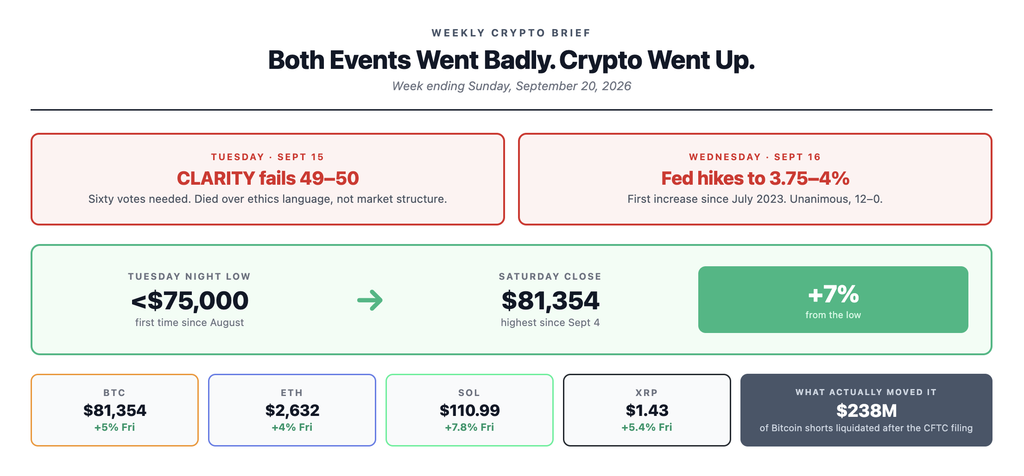
Bitcoin finished the week at $81,354.
This is your weekly crypto brief for the week ending Sunday, September 20, 2026 — the week everything crypto had been waiting on resolved badly, and the market went up anyway. There’s a reason, it isn’t “crypto is unstoppable,” and it’s worth understanding properly.
What actually moved
If you’ve been reading this weekly crypto brief for a while, you’ll have noticed we spent five weeks warning that this one mattered. It did. Just not in the direction anyone expected.
Bitcoin (BTC): Opened Monday at $76,806. Fell through Tuesday’s vote, dipping below $75,000 — its first time under that level since August. Held near $76,000 through the Fed decision Wednesday. Reclaimed $76,000–$77,000 Thursday. Then Friday: from $78,000 to an intraday peak of $81,238, its highest since September 4. Closed the week at $81,354. Up roughly 7% from Tuesday night’s low.
Ethereum (ETH): Opened Monday at $2,475. Followed Bitcoin down, then rallied 4% on Friday to $2,511 and kept going — $2,632 by Saturday, the strongest level in weeks.
Solana (SOL): The biggest single-day gain among the majors on Friday, up 7.8% to $106. Settled at $110.99.
XRP: Up 5.4% Friday to $1.33, then $1.43 by Saturday.
Elsewhere: Hyperliquid’s HYPE token hit an all-time high of $92.56. Bitcoin’s market cap went from $1.54 trillion to $1.62 trillion across Friday alone, with 24-hour volume jumping 61% to $38.3 billion.
Sunday morning note: some of that came back off. Bitcoin sat around $81,260 at midnight UTC and the total market cap eased about 1% to $2.74 trillion through the early hours, with Ethereum back near $2,577. Squeeze-driven rallies tend to give back a portion once the forced buying stops. The Fear and Greed Index jumped to 71 from 56 across the week — firmly into greed territory, which is itself worth watching.
Tuesday: the CLARITY Act died
At 2:15pm ET on September 15, the Senate voted on cloture for the motion to proceed to H.R. 3633. Sixty votes were needed.
The result was 49–50. Roll Call 234. One senator didn’t vote. Susan Collins of Maine voted no.
Senator Thom Tillis immediately entered a motion to reconsider — a procedural step that keeps a technical sliver of life in the bill without changing much about its prospects.
What killed it was ethics, not market structure. Republicans had released a revised 630-page text on Sunday adding new ethics restrictions, specifically to address Democratic concerns about public officials profiting from crypto. It wasn’t enough. The Democrats who had spent months at the negotiating table — Gillibrand, Warner, Booker, Warnock, Gallego, Alsobrooks, Cortez Masto — did not deliver.
The framework the industry actually wanted, the SEC and CFTC division of responsibility, was never the sticking point.
Elizabeth Warren made the case on the floor beforehand, saying the President had “opened his own crypto business” shortly before his second term and that as he “talked up crypto,” the “money just kept rolling in” — putting the family’s 2025 crypto income at $1.4 billion.
John Thune framed it the other way: “This bill has had bipartisan support from the beginning… the only reason for this progress to end now would be if Democrats choose politics over good policy.”
Cynthia Lummis, the bill’s author, told reporters before the vote that if cloture failed, “I think we’re done. It’s over.”
Prediction markets moved accordingly. Polymarket’s contract on the bill becoming law in 2026 had already halved overnight, from about 32% to 17–18% going in. Afterward it sat at roughly 8%. Kalshi’s broader market-structure contract priced similarly.
Wednesday: the Fed hiked
Twenty-four hours later, the FOMC raised the federal funds rate by 25 basis points to 3.75%–4.00%. It’s the first increase since July 2023, and it followed five meetings of holding steady through 2026.
The vote was 12–0. That unanimity is worth pausing on. The President has been publicly demanding cuts. A unanimous vote to hike in that environment is an assertion of independence as much as a policy decision.
Markets had it priced — CME FedWatch showed over 92% odds going in, up from 33% a month earlier.
Warsh’s framing leaned on strength rather than fear. The economy “appears to be strengthening,” he said, citing labour data, private sector earnings and capital investment. He added that he “would be hard-pressed to describe broad financial conditions as restrictive.”
On oil — the thing that actually drove the inflation readings — he was careful about the limits of what the Fed can do: “We cannot affect any individual price… But what we can do and will do is ensure that any change in relative prices don’t broaden out, don’t have second and third order effects on the economy.”
The dot plot is the part that matters for the next few months. Sixteen of eighteen participants expect at least one more hike this year. Four expect two more. Only two think the committee should stop here. Warsh withheld his own projection, as he did in June.
Beyond 2026 the picture flattens: 2027 splits eight-six-four between another hike, a hold and cuts, with no increases penciled in after that and one cut indicated for 2028.
After Warsh’s press conference, odds of at least one more hike this year rose to 87%, from 77% that morning.
And not just the Fed. The Bank of Japan raised its own rate to 1.25% on a 7–2 vote the same week. Two major central banks tightening within days of each other.
So why did crypto go up?
Two events that should have hurt, and a market that finished higher. The explanation matters more than the fact, because the explanation is repeatable and the fact isn’t.
Part one: the bad news was already in the price.
Before the vote, Yusuf Fakhro of ARP Digital described the setup as asymmetric — “downside from a failed vote is largely priced; a surprise passage is not.” Funding rates were near zero and leverage was thin, which meant something specific: there was no stack of over-leveraged long positions waiting to be force-sold. The cascade that usually turns bad news into a crash had no fuel.
Part two — and this is the piece that actually did the work — traders then positioned short.
After two days of confirmed bad news, the market leaned bearish, expecting more of the same. Then on Thursday, something unexpected happened.
The CFTC sent two crypto rulemakings to the White House for review, filed as “Regulation of Crypto Asset Transactions and Crypto Asset Markets.” The full text stays confidential during review, but the filing itself was the signal. CFTC Chairman Michael Selig had said the agency was “locked in and ready to ship rules” immediately after the Senate vote failed — and two days later, he shipped.
Reporting on the framework suggests a new designated contract market category that would let unregistered crypto exchanges offer leveraged trading under CFTC supervision. Without legislation.
The SEC moved the same day, launching a five-year “Innovation Exception” programme for platforms trading tokenised US stocks on-chain — the first time eligible venues have been allowed to facilitate on-chain trading of tokenised US equities backed by real underlying shares.
Platforms moved within twenty-four hours. On September 18, Coinbase Derivatives filed with the CFTC to offer single-stock perpetual futures, and Kalshi submitted rules for equity perpetual trading including contracts linked to individual stocks such as Apple. Whatever else the week was, the regulatory route is clearly being used.
Friday, the shorts got run over. Roughly $238 million of Bitcoin short positions were liquidated, plus $85 million in Ethereum shorts — with some estimates putting total short liquidations near $470 million. Forced buying carried Bitcoin from $78,000 through $80,000 and on to $81,238.
That’s the mechanism. Not sentiment, not conviction, not crypto shrugging off adversity. Positioning. The market was set up for more bad news, got good news instead, and the people betting against it had to buy at whatever price was available.
If you read our piece on why crypto prices move together, this is the same leverage-cascade machinery — just running in the opposite direction.
The caveat worth keeping
It would be easy to read the CFTC filing as CLARITY-by-other-means. Several people did.
Dan Morehead put the optimistic case plainly: “The SEC and the CFTC are enacting all of the things that would have been in Clarity anyway. And so on a practical level, it shouldn’t make a big difference.”
But there’s a real difference, and JPMorgan named it. A rulemaking is less durable than a statute. A future Commission can revise it. A court can overturn it. The CLARITY Act would have been law; this is not. It is a substitute, not a bonus — and it exists precisely because the Senate vote failed. An agency routing around Congress is a signal about how hard the legislative path has become, not evidence that the legislative path didn’t matter.
Jeff Anderson of STS Digital offered the sceptical read: “Markets are trading suspiciously well after the double whammy of Clarity Act failure and Warsh’s hawkish hike.”
And one number complicates the bullish story: Polymarket’s October rate-hike contract rose to 55.5% on Friday, up from 46.5% on Thursday. Crypto rallied while the odds of another hike went up.
Two institutional notes. Deutsche Bank confirmed plans to provide Bitcoin and digital-asset custody to European institutional clients by the end of 2026. And Bastion, a stablecoin infrastructure company, received approval from the US Office of the Comptroller of the Currency to apply for a national trust bank charter.
One more thing nobody noticed. The same week, the House Ways and Means Committee advanced the first federal crypto tax bill, 38–5. It includes a de minimis exemption for transactions under $10, a voluntary disclosure programme, and ordinary-income treatment for staking rewards. Bipartisan, barely covered, and arguably more likely to affect an ordinary holder’s life than CLARITY would have.
ETF flows: out through both events, back on Thursday
The daily flow data tells the story cleanly.
- Tuesday Sept 15 (vote day): −$450.4 million
- Wednesday Sept 16 (Fed day): −$295.9 million
- Thursday Sept 17: +$159.5 million — BlackRock’s IBIT drove it with $183.7 million in fresh capital, while Fidelity’s FBTC lost $16.6 million and VanEck’s HODL lost $7.6 million
Roughly $746 million left across the two event days. The three-day net was still about −$587 million.
Ethereum ETFs shed $142.3 million on one of those sessions. Solana ETFs took in $1.3 million.
Worth noting honestly: institutional money left during both events, and Bitcoin rallied anyway. Which brings us to something we need to address directly.
What we’ve got wrong, three weeks running
Three weeks, three explanations, and the first two didn’t hold up.
August 30: crypto rallied against a hawkish Fed. We called it “structural resilience.”
September 13: ETF flows reversed, price fell. We corrected ourselves — it wasn’t structural, it was one week of ETF flows, and when the flows turned, so did the price.
This week: flows were negative through both events and price rose regardless. Neither previous explanation covers it.
The better answer is the one above: positioning, not sentiment. Whether the market goes up or down on a given piece of news depends less on the news than on how traders were positioned before it arrived. Expected bad news with thin leverage produces no crash. Unexpected good news into a short-heavy market produces a squeeze.
That’s a more useful thing to understand than any of the three narratives we tried, including this one. And it’s worth saying plainly that we reached for the easier story twice before getting to it.
Revolut: 680 crypto accounts, and nobody broke in
The security story of the week involved no blockchain, no smart contract, and no stolen credential.
On September 12, Revolut confirmed it had handed sensitive customer data to criminals who impersonated a government agency and simply asked for it.
The vector was Italy’s PEC certified email system — requests came from an account tied to the Prefecture of Reggio Calabria, which denies sending them. PEC certifies that a message was sent and delivered. It does not verify that whoever controls the mailbox is who they claim to be. Italy’s cybersecurity agency had flagged exactly this risk in June, reporting more than 650 incidents involving abused PEC accounts since the start of the year.
The crypto angle is the part that should worry you. The attackers say they selected 680 high-net-worth crypto accounts using blockchain analysis of wallet activity. They built a target list from public on-chain data, then went after the off-chain company holding those people’s identity documents.
What Revolut handed over: passports and driving licences, bank account numbers, home addresses, birth dates, phone numbers, verification selfies, account statements, and Bitcoin transaction histories.
Most affected customers were in Switzerland and France, with data also released on residents of 31 other countries including the UK, Germany and Spain. Mark Karpelès, the former CEO of Mt Gox, was among them. The attackers are demanding a ransom to not publish.
The UK’s Information Commissioner’s Office and Italy’s Polizia Postale are both investigating. Revolut says its systems and customer funds were unaffected, which is true and somewhat beside the point.
Why this is worse than a hack. Losing tokens is recoverable in principle — you can rebuild a position. A confirmed home address paired with a known crypto balance, in criminal hands, with a ransom demand attached, is a different category of problem entirely.
It also completes a pattern. Three weeks, three security stories, and not one of them involved breaking a blockchain: a protocol logic flaw at Liquid, an email vendor compromise at Brevo, and now a company being talked into handing over files.
The data backs the pattern up. TRM Labs found that in the first half of 2026, infrastructure compromises were about 15% of incidents but roughly 76% of losses. Compromised keys and credentials overtook smart contract bugs as the leading attack vector for the first time on record.
The code mostly works. The people and processes around it are where the money goes.
What to watch
This weekly crypto brief will be tracking all of the following. October 20: the SEC’s Regulation Crypto Assets comment period closes. With CLARITY dead, this is where US crypto rules are actually being written.
The CFTC filing: prerule submissions typically get about ten working days at OIRA before returning to the agency. Expect movement in early October.
The next FOMC: markets put roughly 87% odds on at least one more hike this year, with Polymarket’s October contract at 55.5%.
The Tillis motion to reconsider: technically alive, practically narrow. JPMorgan notes the GENIUS Act also failed its first cloture vote before eventually passing — so “dead” may be premature — but the calendar before the November elections is unforgiving.
The bigger picture
For six weeks we said these two dates would define the rest of the year for crypto. They arrived, both went against the industry, and the market closed the week up 7% from its low.
The lesson isn’t that the events didn’t matter. CLARITY’s failure means US crypto rules will be written by agencies rather than Congress for the foreseeable future, and agency rules can be undone by the next agency. The Fed hiking means the cost of holding a non-yielding asset just went up, with more hikes likely.
The lesson is that markets price expectations in advance, and by the time everyone agrees something bad will happen, the price already reflects it. What moves markets is the gap between what was expected and what arrived — which is why a mid-sized regulatory filing on a Thursday afternoon did more for Bitcoin’s price than a Senate vote everyone had been watching for six weeks.
Next Sunday’s weekly crypto brief will cover the fallout from the CFTC filing, where CLARITY goes from here, and whether the short squeeze turns into something more durable.
Where to go next:
- New here? Start with our beginner path or dollar-cost averaging crypto — the strategy built for weeks where the news moves faster than your conviction should.
- This week was a short squeeze, which is a liquidity story. Why do crypto prices move together explains the leverage-cascade machinery that drives both crashes and squeezes.
- Want the number everyone quotes and nobody uses correctly? What is market cap in crypto.
- New to the major chains? Read What is Bitcoin, What is Ethereum, What is Solana, or What is Cardano.
- The Revolut breach is a good reason to read how to buy crypto safely and how crypto wallets work — particularly on what a legitimate company will never ask you for.
- Curious how decentralised exchanges fit in? What is a DEX.
See you next Sunday.
A note on financial advice
This brief is for education, not investment advice.
This week is a good argument for not trading on headlines. Two major events went against crypto and the price rose. If you had positioned for the obvious outcome, you would have lost money being right about the news and wrong about the positioning.
That cuts both ways. The rally was driven by forced short covering, not by a change in anyone’s view of what crypto is worth. Squeezes fade. The Fed is still hiking, CLARITY is still dead, and the regulatory framework now rests on agency rules that a future agency can rewrite.
Only invest what you can afford to lose entirely, and make your own decisions based on your own situation.