Three weeks ago the Fed raised rates for the first time since 2023, and sixteen of eighteen officials signalled more to come.
This week that expectation fell apart. Soft inflation on Wednesday, a badly missed jobs report on Friday, and the odds of an October hike collapsed from around 70% to roughly 14%.
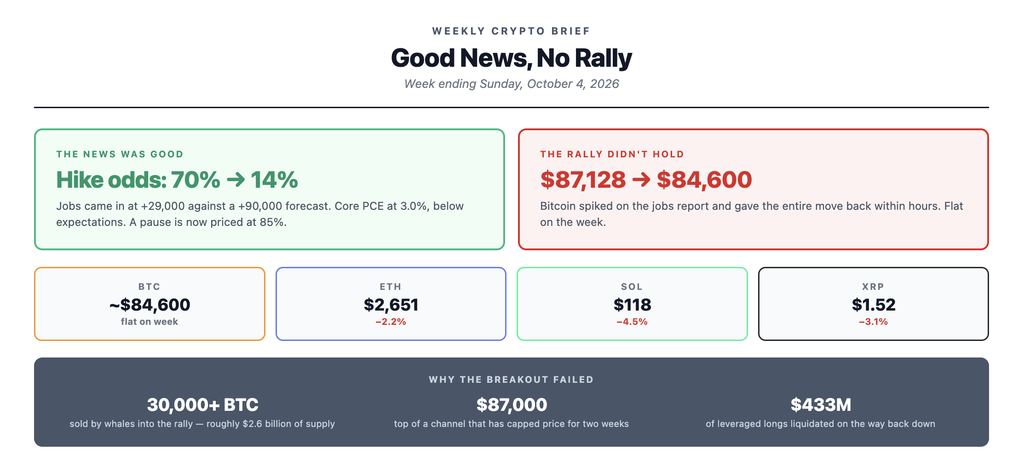
Bitcoin spiked to $87,128 on the news. Then gave the entire move back within hours.
This is your weekly crypto brief for the week ending Sunday, October 4, 2026. The macro news was unambiguously good for crypto and crypto couldn’t hold the gain. The reason is worth understanding, because part of it sits in the bond market and part of it sits in the order book.
What actually moved
This weekly crypto brief has spent two months explaining that higher rates pressure crypto. This week tested that directly — rate expectations fell hard, and crypto went nowhere. The explanation is more interesting than the simple version.
Bitcoin (BTC): A flat week with a violent Friday. Opened around $84,456, slid to a low of $82,600 on Monday, recovered through midweek, then spiked to $87,128 on Friday’s jobs report before being rejected and falling back. Closed the week around $84,600 — within a few hundred dollars of where it started.
Ethereum (ETH): $2,651, down 2.22% on Saturday.
Solana (SOL): $118, down 4.45% — giving back last week’s break above $120.
XRP: $1.52, down 3.06%.
Market-wide: Total crypto market cap around $2.98 trillion. Bitcoin’s market cap at $1.69 trillion with dominance at 57.1%. Circulating supply stands at 20.09 million of 21 million. Corporate treasuries now hold 1.34 million BTC between them, of which Strategy alone holds 847,666.
Fear and Greed read 74 on Monday and 73 by Thursday — the greediest stretch since July 2025.
Two soft data prints
Wednesday: Core PCE came in at 3.0%, against expectations of 3.3%. That’s the Fed’s preferred inflation measure, and the first genuine sign of easing price pressure in months.
Friday: the jobs report missed badly.
| Actual | Expected | |
|---|---|---|
| Nonfarm payrolls | +29,000 | +90,000 |
| Unemployment rate | 4.2% | 4.1% |
| Hourly earnings, monthly | +0.1% | +0.3% |
| Hourly earnings, annual | 3.0% | 3.2% |
On top of the miss came 60,000 of downward revisions to the previous two months. August’s blowout 162,000 — the print that triggered the Fed’s first hike in three years — was revised down to 133,000.
It’s the third weakest jobs report of 2026. Private payrolls added 46,000 while government shed 17,000. Financial activities lost 7,000 and information lost 10,000. Health care was the only sector with a meaningful gain.
One honest counterpoint, from Collin Martin at Schwab: “It wasn’t all bad, as the household survey showed a gain of 406,000 in September and the participation rate rose.” Some of the rise in unemployment reflects people re-entering the workforce rather than losing jobs. That’s a materially different thing, and worth knowing before reading the headline as a collapse.
The rate narrative came apart in stages
| Point in the week | October hike odds |
|---|---|
| Monday | ~70–75% |
| After Williams’ comments | ~50% |
| Thursday | ~37% |
| Friday pre-jobs | 23–24% |
| Friday post-jobs | ~14% |
The first move wasn’t data — it was a Fed official. New York Fed President John Williams argued that September’s quarter-point hike had reduced the urgency for further tightening, and that the Fed now had time to assess incoming data. Markets took roughly 25 percentage points off the odds on that comment alone, before any of the week’s numbers landed.
By Friday afternoon, CME FedWatch had the probability of an October hike at 14%, and prediction markets put the chance of a pause at 85%. The next FOMC meeting is October 28.
Mohamed El-Erian said the report was “going to put the Fed definitely on hold for October.”
The more careful read came from Fabian Dori, chief investment officer at Sygnum Bank: “Weak print strengthens the no October hike scenario, but weak is not automatically bullish: soft-but-orderly supports the liquidity trade, a growth scare pulls risk assets, Bitcoin potentially included.”
That’s the distinction that matters. A gently cooling economy means cheaper money, which helps risk assets. An economy falling off a cliff means everything sells, crypto included. The jobs report is consistent with both readings, and one week doesn’t tell you which.
The bond market is telling a different story
Here’s the thing most coverage missed this week, and it’s the most interesting development in the macro picture for months.
Short-term rate expectations fell. Long-term yields went up.
While futures markets were slashing October hike odds, longer-dated Treasury yields hit a 24-year high — levels last seen in 2002. The 10-year sat at 5.217% on Thursday even after falling more than nine basis points that day.
CoinShares described it as “diverging signals between monetary policy and US fiscal risk.“
In plain terms: the market has stopped worrying about the Fed hiking and started worrying about something else. Short-term expectations say no more increases. Long-term yields say investors want more compensation for holding US government debt over decades. Those are two different fears, and the second one isn’t something the Fed can fix by holding rates steady.
Why this matters for how you read crypto news. This brief has repeated for two months that higher rates pressure assets that pay no yield. That’s true, but it’s incomplete, and this week shows why.
Policy rates and long-term yields move for different reasons. Policy rates reflect what the central bank is doing about inflation and employment. Long-term yields reflect what investors demand for lending to a government for ten or thirty years — which includes a judgement about that government’s fiscal position.
Falling hike odds are straightforwardly good for crypto. Rising long yields driven by fiscal concern are more complicated — arguably they’re one of the reasons some investors look at Bitcoin in the first place. CoinShares noted both could prove supportive, through entirely different channels.
If you want the broader version of how one catalyst ends up moving everything at once, our piece on why crypto prices move together covers the machinery.
Why Bitcoin couldn’t hold $87,000
The bond market explains the context. The order book explains the specific failure.
Whales sold into the rally. Analyst Ali Martinez reported that the run toward $87,000 stalled after large holders took profits on more than 30,000 BTC. At roughly $86,000, that’s around $2.6 billion of supply arriving while the price was spiking.
$87,000 was already a ceiling. It marks the upper boundary of a trading channel that has capped Bitcoin for more than two weeks — the same level that rejected it on September 23.
Then the leverage unwound. CoinGlass recorded $433.57 million in crypto liquidations over 24 hours, concentrated in long positions, as Bitcoin fell from $87,128 back toward $84,600. Derivatives open interest had reached roughly $56.7 billion going into the data, which is why the reversal was as sharp as it was.
So the full sequence: good macro news, a spike into known resistance, large holders distributing into the strength, over-leveraged longs liquidated on the way back down, price ending where it started.
That’s a more useful explanation than “the market ignored good news.” It’s also a textbook example of what we covered in what is liquidity in crypto — $2.6 billion of selling into a book that wasn’t deep enough to absorb it at that level.
The broader trend is still intact. Bitcoin remains above its 50-day moving average at $78,136 and its 200-day at $71,404. Martinez puts immediate downside support at $82,500.
ETF flows — and a correction to last week
Last week’s brief understated this story, and it’s worth saying so directly.
We reported that ETF flows had “turned positive for 2026, erasing a $5.8 billion deficit,” with roughly $800 million in net inflows for the year. All accurate. But in researching that brief we noted that the September 21–25 flow data needed checking before publication, and then published without checking it. Here’s what we missed:
- Monday September 21 brought in $998.95 million — the single largest session of 2026, and the strongest day for Bitcoin ETFs since October 2025. BlackRock’s IBIT alone took $381.4 million.
- The full week through September 25 recorded $2.39 billion in net inflows, beating the previous 2026 weekly record of $1.92 billion set in August.
So the week we described as a recovery was in fact a record. The conclusion was right; the scale was wrong.
This week’s flows tell a quieter story. The buying streak extended to nine consecutive sessions totalling roughly $3.1 billion before ending on Wednesday with $148.7 million in outflows. Flows were described as thin again on Friday.
The quarterly picture: spot Bitcoin ETFs took in approximately $6.34 billion across Q3, including $2.65 billion in September.
Hester Peirce is leaving the SEC
Bloomberg reported on Thursday that Hester Peirce is departing the Securities and Exchange Commission — described as crypto’s longest-standing advocate in Washington.
For readers unfamiliar: Peirce has been the most consistently crypto-friendly voice inside the agency for years, to the point that the industry calls her “Crypto Mom.” She was speaking at the Solana Policy Institute’s Washington summit just two weeks ago, the afternoon before the CLARITY Act vote failed.
Her departure comes exactly as the SEC writes the rules that are now replacing the failed legislation — the Innovation Exception, the custody proposal, the tokenised securities pilot.
Worth not over-reading it. One commissioner leaving doesn’t reverse an agency’s direction, and Chairman Paul Atkins has been publicly supportive of the industry. But it is a genuine loss of an internal advocate at a consequential moment, and it’s reasonable to note that.
The agencies keep moving
Thursday: the SEC proposed new crypto custody rules, opening a 60-day public comment period.
Atkins said the rules would give investment advisers and funds a compliant path to hold crypto, and that onchain markets “should not be pushed offshore or forced into ill-fitting models.” More proposals are expected. Bitwise’s counsel noted the framework addresses custody but leaves decentralised vaults in an unsettled zone.
That’s the fourth major agency action in roughly three weeks, after the CFTC’s rulemaking filing, the SEC’s Innovation Exception and the Fed’s stablecoin proposal. With CLARITY dead, this is where US crypto policy is being written.
Elsewhere:
- The SEC approved 3x leveraged Bitcoin, Ether and commodity ETPs for listing — Volatility Shares products covering BTC, ETH, gold, silver, crude oil and natural gas, via a Cboe BZX rule change. Worth saying plainly: 3x leveraged products are not beginner instruments, and the daily rebalancing mechanics mean they decay in choppy markets even when the underlying ends flat.
- The Independent Community Bankers of America is suing the OCC over national trust bank charters for crypto firms, arguing the charters let crypto companies bypass safeguards that apply to traditional banks. That connects directly to last week’s item on Bastion receiving OCC approval to apply for exactly such a charter.
- The IMF approved a $138 million disbursement to El Salvador under its $1.4 billion facility — while waiving the country’s breach of a condition limiting further Bitcoin accumulation. El Salvador broke the terms and received the money regardless.
September was the worst month for crypto hacks in 2026
PeckShield’s monthly figures: 55 major hacks totalling $766.49 million — a 462% increase on August’s $136.3 million. CertiK put August at $220.3 million under its own methodology, but either way the jump is enormous.
Bitget’s $387 million ranks first for the month, Liquid Network’s $320 million second.
Two recoveries worth reporting, since we covered both incidents when they happened:
Liquid Network has recovered $285 million of the $320 million taken. It has begun an independent security audit of Elements v23.3.4 and work to replace its peg-out authorisation entries. Peg-outs remained suspended as of September 30. That’s a materially better outcome than it looked three weeks ago.
NEAR Intents recovered the full $3.8 million from its exploit and closed the investigation. Alex Shevchenko said 34.59 BTC came back to a published Bitcoin address, with the remaining $850,000 returned by another route.
Bitget’s recovery went to plan. The exchange restored withdrawals in four phases exactly on the schedule it published — BTC on September 28, ETH on the 29th, USDT on the 30th, and all remaining tokens plus fiat and P2P on October 2. It also published a proof-of-reserves snapshot showing a 131% overall reserve ratio across nineteen assets.
Two new details on the Bitget attack, both significant.
First, Chainalysis has attributed the theft to North Korean actors, tracking funds across Ethereum, XRP, Zcash and Tron. Last week that was a suspicion from Bitget’s CEO; it’s now an attribution from the main blockchain analytics firm.
Second, and more important for anyone trying to learn from this: reporting now indicates attackers exploited a third-party security product to obtain credentials and forge withdrawal commands.
Not a backend system in general. A security vendor specifically. The thing that failed was a product sold to make the exchange safer.
Five weeks, five failures, zero broken blockchains
It’s worth laying this out plainly now, because the pattern has become difficult to dismiss.
- Liquid Network — a logic flaw in the software deciding which withdrawals were valid. Keys intact.
- Brevo — an email vendor compromised through its single sign-on, used to phish hundreds of thousands of hardware wallet owners.
- Revolut — a company socially engineered into handing customer passports and home addresses to criminals who simply asked.
- Bitget — a third-party security product compromised, credentials stolen, withdrawal commands forged.
- Plus smaller incidents at Fetch.ai, DoinGud, Blink Wallet and NEAR Intents.
Five consecutive weeks. Not one broken blockchain. Not one stolen private key.
The industry data says the same thing. TRM Labs found that in the first half of 2026, infrastructure compromises accounted for roughly 15% of incidents but about 76% of losses, and compromised credentials overtook smart contract bugs as the leading attack vector for the first time on record.
If you hold crypto on an exchange, the cryptography is not your exposure. The company’s vendors, systems and staff are — and you have essentially no way to assess any of them from the outside. Our guides on how to buy crypto safely and how crypto wallets work cover the practical response to that.
What to watch
This weekly crypto brief will be tracking each of these. October 28: the FOMC decision. Markets now price a pause at roughly 85%. After a week where expectations swung 56 percentage points, treat that number as current rather than settled.
October 20: the SEC’s Regulation Crypto Assets comment period closes.
The new custody proposal: 60 days of public comment from October 1, so early December.
The CFTC rulemaking, which went to White House review on September 17 with a roughly ten-working-day window. That has now lapsed without public news of its return.
$82,500 and $87,000. Bitcoin has been range-bound between roughly those levels for over two weeks. A clean break either way would be the first directional signal in a fortnight.
The bigger picture
Two months of this brief have been built on a straightforward premise: rates up, crypto down. This week broke it, and the way it broke is instructive.
Hike odds fell by 56 percentage points in five days. If the simple story were complete, Bitcoin should have run. Instead it spiked for a few hours and finished flat, because $2.6 billion of whale selling met a technical ceiling and $433 million of leverage unwound into the gap.
Meanwhile long-term yields reached a 24-year high for reasons that have nothing to do with the Fed’s next meeting.
The useful lesson isn’t about this week’s price. It’s that “rates” is not one thing. The policy rate, the two-year, and the thirty-year move for different reasons and mean different things. A market that cheers a dovish Fed while demanding record compensation to hold long government debt is telling you something more complicated than either headline captures.
Next Sunday’s weekly crypto brief will cover whether the range holds, any movement on the CFTC filing, and the run-up to the October 28 FOMC.
Where to go next:
- New here? Start with our beginner path or dollar-cost averaging crypto — the strategy designed for weeks when the market swings $4,500 and ends where it began.
- This week was a textbook failed breakout. What is liquidity in crypto explains why $2.6 billion of selling into a thin book stops a rally cold.
- Why does one data release move everything at once? Why do crypto prices move together.
- The number everyone quotes and almost nobody uses correctly: what is market cap in crypto.
- New to the major chains? Read What is Bitcoin, What is Ethereum, What is Solana, or What is Cardano.
- Curious how decentralised exchanges fit in? What is a DEX.
See you next Sunday.
A note on financial advice
This brief is for education, not investment advice.
This week is a good argument against trading on data releases. The jobs report was a clear positive for rate expectations, Bitcoin rose roughly $3,000 on it, and anyone who bought that spike was underwater within hours. Being right about the news and wrong about the positioning is still being wrong.
It’s also worth sitting with the Dori point. Weak employment data is good for crypto because it means cheaper money, right up until it means a recession — at which point everything sells. One soft print does not tell you which of those is happening.
Fear and Greed has been sitting in the low-to-mid 70s for two weeks. That is historically a worse moment for large decisions than when it reads 25, even though it feels considerably better.
Only invest what you can afford to lose entirely, and make your own decisions based on your own situation.