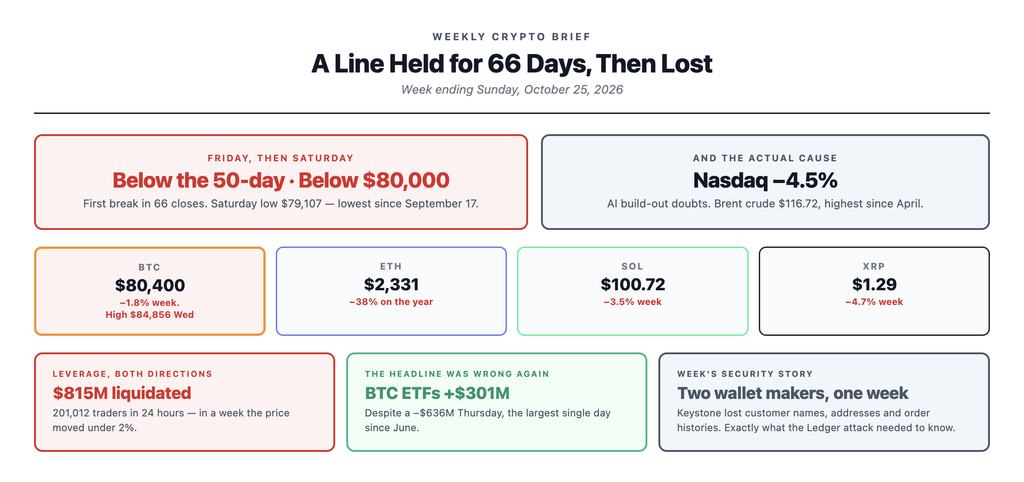
On Friday Bitcoin closed below its 50-day moving average for the first time in 66 trading days. On Saturday it lost $80,000, touching $79,107 — the lowest since 17 September — and $815 million of leveraged positions were force-closed across 201,012 traders.
Almost none of that was caused by anything that happened in crypto.
This is your weekly crypto brief for the week ending Sunday, October 25, 2026. The Nasdaq fell 4.5% on doubts about the AI build-out, Brent crude hit its highest since April, and Bitcoin went along for the ride. Meanwhile two hardware wallet companies had a bad week in ways that are more connected than they look.
What actually moved
A week with a sharp high, a sharper low, and a close near the bottom.
Bitcoin (BTC): peaked at $84,856 on Wednesday on a short squeeze, then fell four days straight. Saturday’s low was $79,107, the lowest since 17 September, and Saturday’s close of $80,770 was the weakest in over a month. Trading around $80,400 on Sunday, down roughly 1.8% on the week inside a $5,749 range.
Ethereum (ETH): $2,331, the continued laggard. Down 38% over twelve months against Bitcoin’s 26%.
Solana (SOL): $100.72, flirting with double digits for the first time since the summer.
XRP: $1.29.
Market-wide: total crypto market cap around $2.76 trillion, down 2.1%. Bitcoin dominance held between 59.7% and 60.4%.
Sentiment has cooled hard. Depending on which index you read, the Fear and Greed gauge now sits somewhere between the low 40s and mid 50s — different providers weight the inputs differently — against readings in the low 70s three weeks ago. The direction is unambiguous even if the number isn’t.
The line that broke
| Average | Level | Bitcoin vs it |
|---|---|---|
| 20-day | ~$82,500 | below |
| 50-day | ~$81,800 | below — broke Friday |
| 200-day | ~$72,900 | ~10% above |
Friday’s close came in $459 under the 50-day, ending a run of 66 consecutive closes above it. The last time Bitcoin closed below that line was 17 August, at $62,844.
Worth keeping in proportion. The 50-day is a line that trend-following systems watch, so breaking it can trigger mechanical selling — but the 50-day is still rising, and Bitcoin remains about 10% above its 200-day. It’s a level that moves programmes, not a change of trend.
And it’s a neat illustration of something we’ll be writing about shortly. Right now Bitcoin is below one widely used trend line, comfortably above another, and roughly 36% below its record high. Three legitimate ways of measuring, three different answers. Anyone telling you confidently whether this is a bull or bear market is choosing one and not mentioning the other two.
The Nasdaq drove the week, not crypto
| Index | Week |
|---|---|
| Nasdaq | −4.5% |
| S&P 500 | −1.9% |
| Dow | +0.7% |
That Dow/Nasdaq split is the whole story. This wasn’t broad risk-off — the Dow rose. It was a tech repricing, led by Micron and Intel, as doubts spread about how much of the AI build-out will actually get paid for. Bitcoin traded like a tech stock, because for this week that’s what it was.
And the oil problem got worse. Brent settled at $116.72 on Friday, its highest since 29 April, on the Iran conflict. That’s up from $109.86 last week and $106 the week before. Two weeks ago this brief explained that September’s hot inflation was mostly petrol; at $116 that pressure isn’t easing, it’s building.
Supporting detail: the 10-year Treasury closed the week at 5.00%, University of Michigan consumer sentiment came in at 48.0 with one-year inflation expectations at 4.7%, and weekly jobless claims were 194,000.
If you want the machinery behind why one macro move drags everything in crypto at once, why do crypto prices move together covers it — and the same logic extends past crypto into tech equities.
Leverage got blown out in both directions
The week is a clean demonstration of how much leverage shapes short-term price, because it happened twice, in opposite directions.
Wednesday: roughly $173 million of short positions were liquidated, driving Bitcoin up to its weekly high of $84,856.
Saturday: $436 million in a single four-hour window, $404 million of it longs. Over 24 hours the total reached $815.26 million across 201,012 traders. Open interest fell 2.2% to $140.10 billion.
So within four days the same mechanism pushed the price up nearly $5,000 and then back down nearly $5,700. Thin weekend liquidity made the second move worse — fewer resting orders means forced selling travels further, which is the mechanism in what is liquidity in crypto.
Two hundred thousand traders were liquidated in a day on a week where Bitcoin’s actual net change was under 2%.
The ETF headline was wrong again, and that’s now three weeks running
Thursday brought the largest single-day Bitcoin ETF outflow since 25 June: −$635.6 million. It was reported everywhere.
Here’s the full week, from Farside Investors:
| Day | Net flow |
|---|---|
| Mon 19 Oct | +$526.7M |
| Tue 20 Oct | +$23.2M |
| Wed 21 Oct | +$524.8M |
| Thu 22 Oct | −$635.6M |
| Fri 23 Oct | −$137.9M |
| Week | +$301.2 million |
Bitcoin ETFs took in money this week. Both facts are true, and the second one went almost entirely unreported.
BlackRock’s IBIT finished +$565.7 million for the week despite losing $254 million on Thursday, because Monday brought $665 million of subscriptions. Fidelity’s FBTC ended about $117 million down. October to date, Bitcoin ETFs are at roughly −$313.5 million, against cumulative net inflows since launch of $57.25 billion.
Ether remains the genuinely weak side: −$220.7 million for the week, a fourth consecutive weekly outflow, with BlackRock’s ETHA alone at −$233.2 million. October outflows from Ether funds are approaching $1 billion.
This is the third week in a row we’ve had to correct an ETF flow headline. Two weeks ago it was “$1 billion of October outflows” that was really $386 million for Bitcoin. Last week it was Ethereum quietly overtaking Bitcoin. This week it’s a record outflow day inside a positive week.
The underlying point stands from a fortnight ago: 93 of 190 trading days in 2026 have been net negative, and the year is still positive overall. Single-day flow figures are noise reported as signal, almost every time.
Two hardware wallet companies, one week
The Ledger supply-chain story has gone quiet — no confirmed loss total, no confirmed cause, nothing on compensation. But a second hardware wallet maker had an incident this week, and the two fit together in a way worth understanding.
Keystone detected unauthorised access to its website on 20 October, confirmed on the 23rd that a third party had obtained customer information, and disclosed publicly on Saturday.
What was exposed: customer names, contact details, shipping addresses, and order details including items purchased and prices paid.
What was not: payment cards, bank details, recovery phrases, private keys or wallet passwords. No funds have been reported stolen.
So on its own this is an ordinary e-commerce breach. Set it beside the Ledger attack and it stops being ordinary.
The Ledger attack worked by intercepting devices somewhere in the distribution chain and returning them with an implant inside. The hard part of that attack is knowing which parcels are worth intercepting. A list of confirmed hardware wallet buyers, with what they bought, what they paid, and where it was delivered, is precisely that information.
There’s a second-order problem too. A verified list of people who own crypto hardware, complete with home addresses, is a targeting list — for phishing that can cite your real order, and in the worst case for showing up in person. Keystone’s own warning to customers tells you where its concerns sit: never enter a recovery phrase into a device you did not order.
One detail that makes this worse than it needed to be. Keystone has said publicly that it deletes shipping data 180 days after an order. Customers report otherwise — one says they ordered over two years ago and still got a breach notice, another counted 214 days. Keystone’s privacy policy, last updated in 2021, describes the rule differently, and its help centre says city and country are retained with final deletion handled by Shopify. Keystone hasn’t said how many customers were affected, how the attacker got in, or whether it followed its own policy.
The lesson generalises beyond crypto: data that was deleted on schedule cannot leak. Every company holding order history longer than it promised is holding a liability, and you have no way to check from the outside.
Our guides on how crypto wallets work and how to buy crypto safely cover the practical side. Buying direct from the manufacturer remains right. It just isn’t the whole answer.
Initia halted its own blockchain
On Friday at 15:41 UTC, Initia stopped its layer-1 chain and its rollups after an infinite-mint exploit. The chain stalled at block 23365925 and, as of Sunday, has not restarted.
A flaw let tokens be created with no cap. The attacker bridged the newly minted units to other chains and cashed them out. Co-founder Ezaan Mangalji described it as a day-zero bug in Initia’s MoveVM implementation on the Cosmos SDK — present since launch — and said native INIT tokens were unaffected.
On the amount, be careful which figure you read. Bitquery found roughly $7.48 million nominally minted, but most of that was synthetic iUSD that could never be redeemed at face value. The actual extracted value is about $2.6–2.7 million in AUSD, USDC and ether — the figure DefiLlama’s hack database carries. The larger number is circulating and it overstates the loss by nearly three times.
Upbit suspended INIT deposits and withdrawals. Agora, which issues AUSD, is freezing attacker-linked balances where it can. INIT itself rose about 14%, which is being read as confidence in a restart.
The pattern: two chains stopped in two weeks
Last week Pirate Chain rolled its chain back to an earlier state after an exploit corrupted its supply records. This week Initia halted entirely.
This deserves more attention than it gets. A blockchain whose operators can stop it — or rewind it — is making an explicit trade: containment over immutability. In the moment it’s usually the right call, and it is also precisely the thing these networks are marketed as being unable to do.
It’s a question of scale rather than principle. Bitcoin and Ethereum have validator sets too large and too dispersed to coordinate a halt at any practical speed. Smaller chains with concentrated validators can, and increasingly do. If you hold a token on a newer network, “decentralised” may describe the architecture without describing the governance, and it’s worth knowing which one you’re relying on.
MSCI finalised its rule — and an update to what we told you last week
MSCI has finalised its “non-operating company” screen. It takes effect at the close on 30 November, with the final list of affected companies published on 11 November.
The newly clear mechanism: the rule ends the interim protection granted in October 2025 to firms holding more than 50% of their assets in digital assets. That protection is what has been shielding Bitcoin treasury companies. Michael Saylor has called the rule “discriminatory.”
Now, a correction to our own correction. Last week this brief told you that the $2.8 billion JPMorgan passive-selling estimate “refers to the earlier proposal, not the rule MSCI adopted.” That was accurate when we wrote it — the figure was produced against the consultation document.
The rule is now final, and the figure is being quoted against the finished version. So our framing is too strong as it stands. The honest position is narrower: the estimate is no longer attached to the wrong document, but MSCI has only said it made unspecified “minor amendments” to what it consulted on, and the company list doesn’t exist until 11 November. It remains an estimate built on an undisclosed methodology. Strategy’s own figure — that 3–4% of its shares sit in MSCI-tracking funds — is the counterweight, and it comes from an interested party.
We’ve built this brief partly on correcting other people’s numbers. The same standard has to apply when one of our own needs qualifying.
Strategy’s week, separately: it bought 267 BTC for $22.1 million, taking holdings to 848,517 BTC at an average cost of $75,446, repurchased $193.1 million of STRC preferred shares, and raised its buyback authorisation to $3 billion. Its shareholders vote on STRC dividends on 28 October.
Solana’s biggest upgrade shipped, and the price fell
Alpenglow activated on Solana mainnet on Wednesday, at the start of epoch 1064. Anza calls it the largest mainnet upgrade in the network’s history, and the official page has the technical detail.
What changed: a new consensus process called Votor, in which validators exchange votes directly and combine them into certificates, so a block can finalise in one or two rounds. Transaction execution is unchanged, and Rotor — the block-distribution half of the design — is not in this first phase.
The headline number: finality falls from roughly 12.8 seconds to a target of 150 milliseconds, about 85 times faster.
The caveat that belongs in the same sentence: 150ms is a target, not a measured result. It doesn’t mean every transaction now settles in 150ms, and there were no published mainnet measurements at activation. A target and observed performance are different things.
What you’d notice as a user: probably nothing yet. Wallets look and behave the same. The benefit only arrives when applications start using the faster finality signal. Separately, slot time dropped from 400ms to 200ms through unrelated changes, and no throughput gain follows from the finality target at all.
One practical note for anyone comparing Solana statistics: validator vote transactions no longer appear in blocks, so transaction-count dashboards need re-baselining. Comparisons with last month aren’t like-for-like.
SOL fell 3.5% on the week, into the upgrade. That’s the second week running where a major protocol milestone landed alongside underperformance — Ethereum’s Glamsterdam testnet activation was the same. Engineering timelines and price timelines simply aren’t related, and beginners consistently expect them to be.
Regulation: a deadline passed, an adviser left
The SEC’s Regulation Crypto Assets comment period closed on Tuesday with roughly 140 submissions — and the SEC has said it will keep accepting comments past the deadline, which tells you something about how settled the proposal is.
What the industry asked for: the Hyperliquid Policy Center wants the SEC to codify that airdrops given for nothing in return aren’t securities, and says the safe harbour requires a certification “many projects cannot make.” AIMA wants issuers to spell out investors’ legal rights and distinguish utility from ownership and cash-flow rights. SIFMA wants investor protection addressed immediately, noting the five-year term of the innovation exemption makes early design choices hard to undo.
Patrick Witt is leaving as White House crypto adviser for the private sector, with no successor named. The White House says the CLARITY Act “will continue to be a priority,” though it stalled on a 49–50 cloture vote in September and Congress is in recess until after the 3 November midterms. That’s the second crypto-friendly departure from Washington in a month, after Hester Peirce’s exit from the SEC.
In Europe, the European Banking Authority has classified Circle’s USDC as the EU’s first “significant” e-money token under MiCA. From 12 November the EBA directly supervises its reserves, liquidity and redemption plans. USDC supply is nearly $73 billion.
Elsewhere this week
The strangest story: special committees at SpaceX and Tesla are exploring a merger, with no terms agreed. Between them they hold 30,221 BTC — 18,712 and 11,509. Tesla’s digital assets are now valued at $962 million, up from $674 million.
China: a Tianjin court has accepted an application to confiscate 61,896 BTC tied to a $5.7 billion fraud case. A six-month notice period has begun. At current prices that’s roughly $5 billion of Bitcoin.
New products: Switzerland’s FINMA approved BIT Asset Management’s Bitcoin Fund ETF, the country’s first retail spot Bitcoin ETF, with a SIX listing planned for November. BlackRock filed for a buffered Bitcoin ETF using IBIT options. Franklin Templeton’s Bitcoin dividend-reinvestment ETFs take effect on 27 October.
Banking: Standard Chartered has agreed to acquire Zodia Custody. Germany’s Sparkassen savings banks began offering crypto trading on 19 October. Russia’s VTB and Sberbank plan retail launches for November and 1 December. JPMorgan brought its JPM Coin deposit token to Ethereum for institutional clients, and several large banks are planning a shared tokenised deposit network as early as H1 2027.
On quantum computing, which resurfaces as a Bitcoin scare every few months: Google Quantum AI reported a roughly 40-fold reduction in errors on its Willow chip. The relevant numbers are that Google’s own March estimate put breaking Bitcoin’s cryptography at under 500,000 physical qubits, and Willow has 105.
Also: the UK’s FCA opened a consultation on crypto financial crime guidance, responses due 24 December. Nine US-listed companies objected to tokenised versions of their shares trading on the OKX/ICE venue. Stablecoin payments reached about $482 billion in the first nine months of 2026, up 45%, while total supply stayed flat near $305 billion — a velocity story rather than a growth one.
What to watch
Wednesday 28 October: the FOMC decision. A hold is priced at 90%, so the decision itself is close to settled — watch the press conference instead, specifically anything on the threshold for further tightening in 2027. October hike odds have now gone 22% → 42% → 10% in three weeks. December remains the live meeting.
Wednesday 28 October: Strategy’s STRC shareholder vote. Thursday 29 October: Bitcoin mining difficulty expected to rise about 5.1%, with hashrate near 1,070 EH/s.
Friday 30 October: roughly $12.3 billion in Bitcoin options expire, with max pain at $79,000 — close to where Saturday’s low landed.
3 November: US midterms. 11 November: MSCI’s final list. 12 November: EBA supervision of USDC begins. 30 November: MSCI exclusions effective. 9 December: FOMC with projections. 14 December: CFTC comments close.
Price levels: the 50-day near $81,800 is now resistance rather than support, with $81,500–$82,500 above that. Below, support at $79,500–$80,500 has held four times; beneath it the next band is $76,000–$76,600.
The bigger picture
Three weeks ago this brief noted that the simple story — rates up, crypto down — had stopped explaining the weeks. This week supplies the clearest version yet of what replaced it.
Bitcoin’s net move was under 2%. Inside that, it rose $5,000 on short liquidations and fell $5,700 on long liquidations, while the Nasdaq dropped 4.5% and oil climbed to a six-month high. The crypto-specific news of the week — a chain halted, an SEC deadline, Solana’s largest-ever upgrade, two wallet makers in trouble — moved the price essentially not at all.
That is worth sitting with, because it inverts how crypto coverage usually reads. For a long stretch the asset class was explained by its own news. Right now it is explained by equities, oil and leverage, and the industry’s own events are a story about the industry rather than about the price.
The security pattern holds too, and it has shifted shape. Six weeks of failures in vendors, staff and supply chains have been joined by something quieter: companies holding data they said they had deleted. The Ledger attack needed to know which parcels to intercept. The Keystone breach is exactly that kind of knowledge, sitting in a database two years after it was supposed to be gone. Neither story involves broken cryptography, and neither would have been prevented by a better blockchain.
Next Sunday’s weekly crypto brief will cover the FOMC decision, the midterm result, and whether Initia’s chain is running again.
Where to go next:
- New here? Start with our beginner path, or dollar-cost averaging crypto — built for weeks where the price swings $5,700 and ends roughly where it started.
- Two hardware wallet companies had incidents this week. How crypto wallets work explains what a recovery phrase is and why nobody legitimate ever asks for it.
- Buying your first device or coins? How to buy crypto safely.
- Why did 200,000 traders get liquidated on a week the price barely moved? What is liquidity in crypto.
- Why does one Nasdaq selloff drag every coin at once? Why do crypto prices move together.
- Below one trend line, above another, 36% off the high — bull or bear? Crypto market cycles.
- New to the major chains? What is Bitcoin, What is Ethereum, What is Solana, What is XRP, What is Cardano.
See you next Sunday.
A note on financial advice
This brief is for education, not investment advice.
The practical item this week is about data, not price. If you have ever ordered a hardware wallet, your name, address and order history sit in that company’s database — possibly long after their stated deletion window. You can’t control that. What you can control is treating any contact that references a real order as suspicious anyway, because a convincing phishing message is exactly what that data enables. No manufacturer will ever ask for your recovery phrase, and a device you did not order is never safe to set up.
On the market: 201,012 traders were liquidated in 24 hours during a week when Bitcoin’s net change was under 2%. Leverage doesn’t amplify your judgment, it amplifies the gap between being right eventually and being solvent meanwhile. If you can’t say the exact price that closes your position, you don’t have a position, you have a countdown.
And on the Fed: a 90% probability of a hold is not a guarantee, and the decision is largely priced in regardless. Anything that moves markets on Wednesday will come from the language, not the number — which is precisely the part nobody can forecast.
Only invest what you can afford to lose entirely, and make your own decisions based on your own situation.