Last Sunday this brief ended with something specific to watch. Bitcoin had been stuck between roughly $82,500 and $87,000 for a fortnight, and a clean break either way would be the first directional signal in weeks.
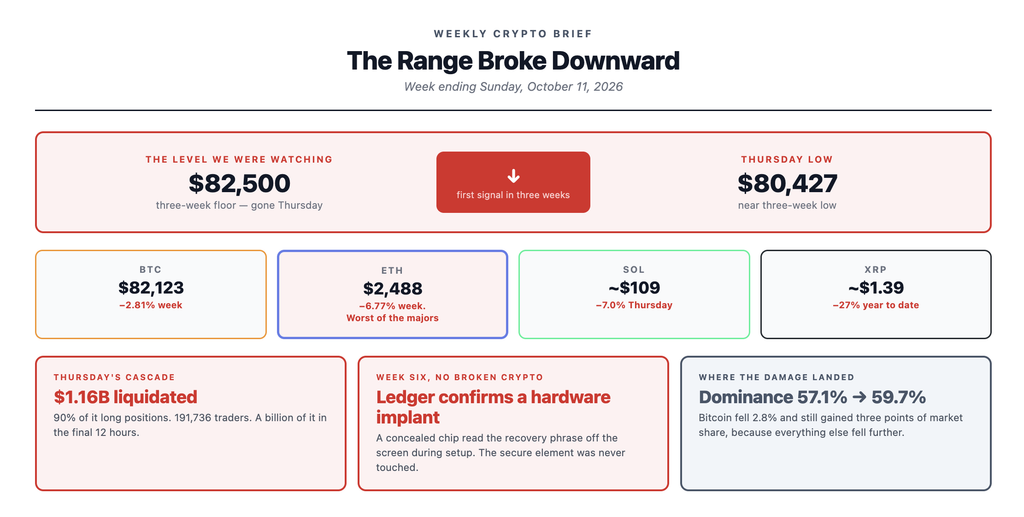
It broke on Thursday, downward, to $80,427.
This is your weekly crypto brief for the week ending Sunday, October 11, 2026. The week also produced the clearest security story of the year — Ledger has confirmed an unauthorised hardware implant inside a customer’s wallet — and a Treasury decision that barely registered but matters more to anyone holding their own keys than anything else that happened.
What actually moved
A down week, with the damage concentrated in two days and in everything that isn’t Bitcoin.
Bitcoin (BTC): traded above $85,500 into Wednesday, then fell through the floor of its three-week range. Thursday’s low was $80,427. Closed Friday at $82,123, down 2.81% on the week, and recovered to around $83,055 by Sunday morning.
Ethereum (ETH): $2,488, down 6.77% — the worst of the majors, and down roughly 18% year to date.
Solana (SOL): ~$109, after a 7.0% fall on Thursday that gave back the entire break above $120.
XRP: ~$1.39, down roughly 27% year to date.
Market-wide: total crypto market cap fell to about $2.80 trillion from $2.98 trillion a week ago. Bitcoin’s market cap is around $1.66 trillion.
The number that tells the real story: Bitcoin dominance is now about 59.7%, up from 57.1% in last Sunday’s brief. Bitcoin fell 2.8% and still gained nearly three points of market share, because everything else fell further.
Fear and Greed reads 64 — still greed, down from 73–74. Three weeks now in the 59–74 band.
The Fed minutes reversed the mood, but not the meeting everyone is watching
Wednesday’s minutes from the September meeting carried a hawkish sentence: “most participants judged a further increase in the target range by the end of the year to be likely appropriate.” Coverage ran with “Fed signals another hike,” and crypto sold off.
But there is a distinction inside that sentence, and it matters. October did not become hawkish. December did.
| Meeting | Current pricing |
|---|---|
| October 27–28 | Hike odds below 22% — a hold priced at roughly 81% |
| December 8–9 | ING’s base case is now a December hike |
Last Sunday this brief reported October hike odds near 14% with a pause priced at 85%. That has not reversed. The October meeting is still overwhelmingly expected to be a hold. What the minutes moved was the next meeting — and “by the end of the year” has only one meeting left in it after October.
The second detail. Bitcoin fell from about $85,500 to $83,900 on Wednesday before the minutes were published, steadied after the release, then drifted lower. Most of the move happened ahead of the news — the same lesson as last week’s failed breakout, arriving from the opposite direction.
High oil prices on renewed US–Iran tension pressed on the whole week. Oil eased Friday after Trump said the US would not attack Iran before the November 3 midterms, and Bitcoin bounced off its low.
$1.16 billion liquidated, and 90% of it was longs
Thursday produced the largest liquidation event since the summer. CoinGlass figures for the 24 hours to 20:19 UTC: $1.16 billion in total, about $1.05 billion of it long positions, across 191,736 traders. Futures open interest fell 5.9% to $143.2 billion.
Two things stand out. A billion of that came in the final twelve hours — that is not steady selling, it is forced selling triggering more forced selling. And Ether long liquidations ($293.8M) exceeded Bitcoin’s ($269.7M) in a market a fraction of the size, which says where the leverage was sitting rather than anything about conviction.
Leveraged longs had built up beneath the $83,000–$87,000 range. The break took them out, and the liquidations pushed price further than the news alone would have. What is liquidity in crypto covers why.
The ETF streak broke — and the headline figure is wrong
A three-week run of weekly net inflows ended. The daily numbers for US spot Bitcoin ETFs, from Farside Investors:
| Date | Net flow |
|---|---|
| October 1 | +$102.7M |
| October 2 | +$189.9M |
| October 5 | −$89.8M |
| October 6 | +$118.8M |
| October 7 | −$484.9M |
| October 8 | −$244.1M |
| October 9 | +$21.1M |
The week came to −$678.9 million — the largest weekly outflow in months, after two weeks that took in nearly $2.4 billion.
But several outlets are running “crypto ETF outflows pass $1 billion in October,” and that number does two things at once. It combines Bitcoin and Ether products, and it ignores the strongly positive first two days. Bitcoin ETFs alone are down about $386 million month to date, not a billion.
Fidelity led outflows at up to $380.4 million and ARK 21Shares at $207.2 million, while BlackRock finished the week marginally positive. IBIT did account for $207.7 million of Thursday’s single-day exit — a fund can lead one day’s outflow and still end the week in the black. Ether ETFs are the weaker side: net outflows on every trading day since September 29.
The context that should change how you read any of this
Martin Lee of DWF Labs put 2026’s flows in order this week: 93 of 190 trading days this year have been net negative — 48% — and the year is still at roughly $1.2 billion in net inflows.
Nearly half of all trading days are outflow days. A red day is the base rate, not a signal. A single large investor can move a daily figure, and the daily number never explains why.
This brief has leaned on single-day ETF figures before, and that framing was looser than it should have been. The useful unit is weeks and months, and the useful question is whether several consecutive weeks of outflows follow a strong run — a trend — not whether yesterday was red.
Week six: Ledger confirms a hardware implant
The biggest story of the week, and the one closest to this site’s own advice.
Users across Southeast Asia who bought Ledger hardware wallets from CryptoBilis — a reseller covering Indonesia, Malaysia and the Philippines — were drained. The first signs appeared early Friday as large USDT transfers arrived at a Tron collection address. Ledger confirmed it was investigating by Friday afternoon and asked the reseller to halt all sales and shipments.
On Saturday, Ledger confirmed the mechanism, stating that “one of the impacted users’ devices contained an unauthorized hardware implant,” and separately that “we have no indication that Ledger’s security infrastructure, systems or services have been compromised.”
How it worked, per independent analysis by Mark Karpelès, formerly of Mt. Gox: a modified Nano X containing a concealed circuit board and cellular hardware. The implant watched the data being sent to the device’s screen during setup, captured the 24 recovery words as they were displayed to the owner, and transmitted them out over a cellular connection.
It never touched the cryptography. The secure element was authentic and working — which is exactly why the device passed a genuineness check. Nothing was wrong with the chip doing the signing. Something was sitting next to it, reading the screen.
Be careful with the numbers. Ledger has confirmed an implant in one device. It has not confirmed any loss figure, any total wallet count, or that every victim’s device was tampered with — some may have been phished instead. The third-party estimates range from $72 million to $93.4 million across somewhere between 98 and 471 addresses, and they do not agree with each other. So “Ledger confirms implant tied to $93.4 million in thefts” is two separate claims stuck together: a confirmed fact about one device, and an unverified estimate about a range of addresses.
On the laundering: Tether froze some of the linked USDT, and the attacker responded by swapping into USDD, which Tether cannot freeze.
What Ledger is telling people to do
- Bought from CryptoBilis in the last 90 days and haven’t set the device up? Do not set it up.
- Already set it up? Move your assets to a new device with a new recovery phrase.
- Ledger will never ask for your 24-word recovery phrase.
Devices bought directly from Ledger show no indication of being affected. Ledger says it is working with authorities, contacting affected users and developing enhanced anti-tampering measures. It has said nothing about compensation.
Six weeks, six failures, nothing broken in the cryptography
- Liquid Network — a logic flaw in withdrawal validation.
- Brevo — an email vendor compromised through its single sign-on.
- Revolut — staff socially engineered into handing over customer data.
- Bitget — a third-party security product compromised.
- Smaller incidents at Fetch.ai, DoinGud, Blink Wallet and NEAR Intents.
- Ledger / CryptoBilis — a reseller’s supply chain, and a chip that read a screen.
Six consecutive weeks. No broken blockchains. No cracked private keys. This week’s seed phrase wasn’t computed or guessed. It was read off a screen by hardware sitting inside the box.
And this one is about the advice we give. Our guides on how to buy crypto safely and how crypto wallets work both recommend hardware wallets. That has not changed, and this week does not change it — a hardware wallet is still the strongest protection available to a private individual.
What this week adds is that where you buy the device is part of its security model. Buy direct from the manufacturer. If a device arrives already initialised, with a recovery phrase printed on a card, or with packaging that has clearly been opened, it is compromised and should not be used at all.
The Treasury quietly made self-custody easier
Almost nobody covered this, and for ordinary holders it may be the most consequential decision of the week.
On October 5, FinCEN withdrew two proposed rules. The 2020 “unhosted wallet” proposal is dead — it would have required financial institutions to keep records on transfers above $3,000 and report transactions over $10,000, including some involving self-custody wallets. The 2023 foreign-mixing proposal is also withdrawn, with FinCEN acknowledging its definition of mixing “could discourage lawful activity” and would create substantial compliance costs.
There is an uncomfortable symmetry in this week. In law, holding your own keys got easier. In practice, it got harder.
Last week’s open question: the CFTC filing came back
Last Sunday this brief noted the CFTC’s rulemaking had gone to White House review on September 17 and the window had lapsed without news. The review concluded October 2, and on October 5 the CFTC published an Advanced Notice of Proposed Rulemaking on retail crypto trading.
An Advanced Notice asks questions; it does not propose rule text, and anything binding needs a separate rulemaking later. Comments are due 60 days after Federal Register publication, which hadn’t happened by the end of the week — so there is still no deadline to diarise.
The substance matters more than the procedure, because the line being drawn is custody. Under the framework sketched out, an exchange offering margin or financing could pull its covered transactions under federal rules for as long as the crypto sits on its internal ledger. Transactions leave that regime only after “actual delivery,” which the CFTC provisionally ties to the customer holding the private keys. The trigger is leverage — a spot-only exchange making no margined offer can stay under state licensing.
In plain terms: assets an exchange holds for you would sit inside the federal perimeter, and assets you hold the keys to would sit outside it. That is the same distinction our wallet guide is built around, arriving from the regulatory direction.
One SEC date is close: comments on Regulation Crypto Assets close October 20. And on the legislative route, CLARITY failed cloture on September 15 and is now assessed as unlikely to advance before the new Congress convenes in January 2027 — which is why every meaningful development is coming from agencies rather than Congress.
Altcoins fell about twice as hard
Bitcoin fell 2.9% in 24 hours on Thursday. Ethereum fell 5.3%, XRP 6.2%, Solana and Dogecoin 7.0%, Chainlink 7.9%. Zcash fell 15.6% in a day while still up 119% on the year. Stablecoins were flat, as designed.
The reasons given are thinner order books, heavier retail leverage in altcoin perpetuals, and capital rotating into Bitcoin and stablecoins. All three are one story told three ways: the same selling pressure moves a thin market further than a deep one. That mechanism is in what is liquidity in crypto, and the reason it hits everything at once is in why do crypto prices move together.
One caution. Zcash is up 119% this year and Hyperliquid 228%, while Ethereum is down 18% and XRP 27%. Numbers that spread out like that get used to sell theses about rotation and what’s “finally working.” A single year’s dispersion tells you about flows and attention, not about quality, and it does not predict the next year.
Ethereum had a notable week for a second reason. On October 6 the Ethereum Foundation activated Glamsterdam on the Sepolia testnet, the final step before mainnet — and ETH then had the worst week of the majors. A testnet activation is an engineering milestone, not a product launch. Nothing a holder can use has changed and the mainnet date is still unfixed. The two facts are barely related.
One year since the record high
October 6, 2025: Bitcoin set its all-time high above $126,000. October 6, 2026: about $85,453 — down roughly 32%.
Here is the part most people would not guess, and CoinDesk ran the comparison this week. This is the mildest bear market in Bitcoin’s history.
| Peak | One year later |
|---|---|
| 2013 | −69.7% |
| December 2017 | −82.3% |
| November 2021 | −74.6% |
| October 2025 | −32% |
The low so far was just under $59,000 on June 30, about 53% below the peak and reached roughly nine months in — earlier than previous bottoms. Every previous bear market ran to between 77% and 85% down.
Today is an anniversary too. On October 10, 2025, four days after that record high, roughly $19 billion of derivatives positions were liquidated in a single sell-off — the largest in the history of the asset class. This week’s $1.16 billion felt dramatic. Beside $19 billion it is a rounding error.
Tim Sun of HashKey attributes the shallower decline to macro-driven outflows rather than the exchange failures and fund blowups of previous cycles: it “did not trigger the persistent negative feedback loops seen in the past.” Annualised volatility is running near 40%, against long-term levels above 80%.
Which raises a question this brief gets asked often. Is this a bull market or a bear market? Bitcoin is 32% below its record high, which by the standard definition is a bear market. It is also above both its 50-day and 200-day moving averages, which by the most common trend test is an uptrend. Sentiment reads greed. All three tests are legitimate and they currently disagree.
We have a full article on exactly that coming shortly. For now the honest answer is that the question is less useful than it sounds, because nobody applying the label tells you which test they used. Crypto market cycles covers the shape of it.
Elsewhere this week
A headline worth correcting. Several outlets reported the US government “quietly offloaded $770 million in bitcoin.” It sold nothing. Between October 6 and 8 it moved 9,261 BTC to Coinbase Prime — about half recovered from the Bitfinex hackers, the rest from known Binance seizures plus 2,456 BTC from previously unknown holdings. Coinbase Prime has been the US Marshals Service’s custodian for seized assets since 2024. A transfer to your existing custodian is not a sale, and a sale would conflict with the March 2025 executive order stating seized Bitcoin “should not be sold.”
Alex Mashinsky accepted a lifetime ban from the securities, commodities and crypto industries under a settlement with New York’s Attorney General. The widely reported $35 million is conditional on two separate failures to comply.
Europe set a deadline. ESMA told MiCA-authorised firms to clear client exposure to non-compliant stablecoins by January 8, 2027. Greece published a draft 10% capital gains tax on crypto, exempting the first €500 a year.
Also: OKX expanded its investment round with Circle, Ripple and Standard Chartered’s SC Ventures at a $25 billion valuation · Securitize launched tokenised US equities on Solana · Bitmine now holds 6,016,414 ETH, roughly 4.9% of the supply · the Winklevoss twins filed for a spot Zcash ETF · Sberbank began testing BTC, ETH and USDT in its main banking app.
What to watch
October 14: US CPI, the last major inflation print before the Fed meets. October 20: the SEC’s Regulation Crypto Assets comment period closes. October 27–28: FOMC, with a hold priced at roughly 81%. December 8–9: the FOMC meeting with updated projections — after this week, the live hike meeting.
Ongoing: the Ledger investigation — the confirmed loss total, the confirmed cause, whether other resellers are affected, and whether there is compensation.
Price levels: the $82,500 floor is gone. The references now are Thursday’s $80,427 low below and the broken range at $83,000–$87,000 above. The 50-day moving average was $78,136 and the 200-day $71,404 as of last week, both still well below spot.
The bigger picture
Three weeks running, the price has moved for reasons that had little to do with the news that supposedly caused it.
Two weeks ago hike odds collapsed 56 percentage points and Bitcoin spiked for hours before finishing flat, because whales sold into the strength. Last week it couldn’t hold $87,000. This week the minutes read hawkish about a meeting in December, the price had already fallen most of the way before they were published, and then a billion dollars of long positions were force-closed and took it further.
The point isn’t that news doesn’t matter. It is that by the time you read it, positioning has usually already responded to the expectation of it, and what you then watch is the unwinding. A week where the Fed sounded hawkish and Bitcoin ended 2.8% lower is not really a story about the Fed. It is a story about who was leveraged, and in which direction.
The security pattern is six weeks old and has stopped being coincidence. The blockchains are fine. The cryptography is fine. What keeps failing is everything built around it — a vendor’s email system, a company’s support staff, a security product, and this week a reseller’s warehouse. If you are assessing your own risk, the cryptography is not the part to worry about, and the part to worry about is mostly invisible from the outside.
Next Sunday’s weekly crypto brief will cover CPI, the run-up to the October 28 FOMC, and whatever the Ledger investigation has confirmed by then.
Where to go next:
- New here? Start with our beginner path, or dollar-cost averaging crypto — the strategy built for weeks like this one.
- This week’s lead story is about hardware wallets. How crypto wallets work explains what a recovery phrase is and why reading it off a screen is enough to take everything.
- Buying for the first time? How to buy crypto safely, including buying hardware direct.
- Why did $1.16 billion of forced selling move price so much further than the selling itself? What is liquidity in crypto.
- Why did everything fall together, and the smaller things harder? Why do crypto prices move together.
- Bull market or bear market? Crypto market cycles.
- New to the major chains? What is Bitcoin, What is Ethereum, What is Solana, What is XRP, What is Cardano.
See you next Sunday.
A note on financial advice
This brief is for education, not investment advice.
The clearest practical lesson this week has nothing to do with price. If you own a hardware wallet, buy the next one direct from the manufacturer, and treat any device that arrives pre-initialised or with a recovery phrase supplied as compromised. That is not a precaution against a hypothetical — it is a precaution against something that happened on Friday to people who did everything else right.
On the market: 191,736 traders were liquidated on Thursday, about 90% of them long. Many were directionally right at some point in the previous month and still lost the position, because leverage converts being early into being wrong. If you use it and cannot say precisely what price takes you out, you are not managing a position.
Fear and Greed has read between 59 and 74 for three straight weeks. That is historically a worse environment for large decisions than a reading of 25, even though it feels considerably more comfortable.
And the ETF point generalises. Nearly half of this year’s trading days have been net outflow days and the year is still positive. Most single-day numbers you read about anything sit inside the normal range of noise. The useful question is almost never “what happened yesterday.”
Only invest what you can afford to lose entirely, and make your own decisions based on your own situation.